The documentary unfolds as a richly detailed visual and narrative exploration of the giraffe (Giraffa camelopardalis), a species whose unmistakable silhouette and exceptional biological traits have long fascinated both scientists and the general public. From the very first frames, the viewer is immersed in the vast expanses of the African savanna, where the elongated forms of these animals rise above acacia canopies like living watchtowers. Sweeping aerial shots alternate with close-range footage, creating a vivid sense of scale and placing the giraffe within the broader tapestry of its ecosystem. This is not merely a film about an animal’s appearance - it is a multi-layered account of adaptation, survival, and interdependence between species and their environments.
Early in the film, the narrative focuses on the anatomy that makes the giraffe so extraordinary. The camera lingers on the elegant curve of the neck, whose structure - though composed of the same seven cervical vertebrae found in most mammals - has been stretched to extremes through evolutionary pressures. The commentary explains how this adaptation is supported by a cardiovascular system of unusual power and precision: a heart weighing over ten kilograms, reinforced arterial valves, and a specialized vascular network known as the rete mirabile, all working in concert to maintain stable cerebral blood flow despite dramatic shifts in head position. The viewer is also introduced to the giraffe’s remarkable tongue, nearly half a meter in length and darkly pigmented, evolved not only for grasping but also for resisting sun damage and avoiding injury while stripping foliage from thorn-covered branches.
The ecological role of the giraffe emerges as a central theme. Through its feeding habits, the species reshapes the structure of tree crowns, alters the composition of plant communities, and indirectly influences the availability of food and shelter for numerous other organisms. Scenes of giraffes methodically foraging on the upper branches of acacias illustrate how their selective browsing reduces shading in the lower layers, encouraging the growth of herbaceous plants. This seemingly simple act has cascading effects - supporting pollinators, sustaining smaller herbivores, and even affecting predator distribution. In portraying the giraffe as an “ecosystem engineer,” the film underscores its significance far beyond its own survival.
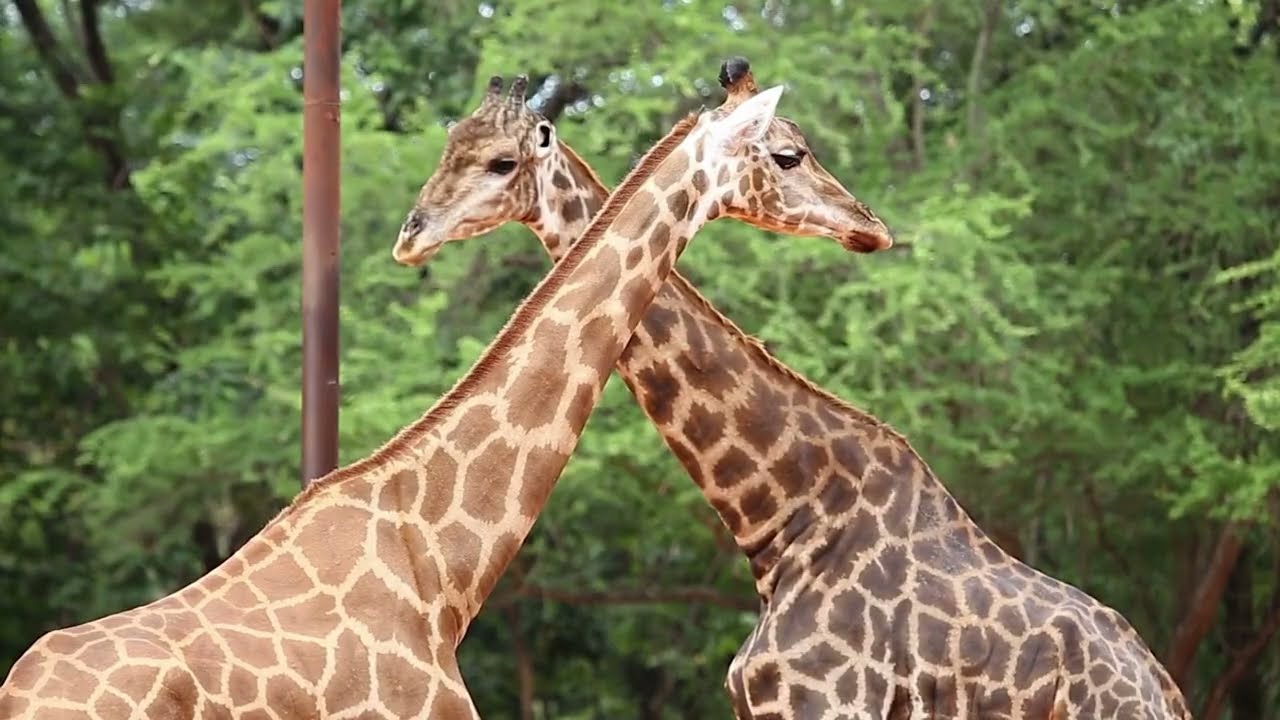
Behavioral sequences are filmed with an observational patience that allows the subtleties of social life to emerge. Unlike rigidly structured herds, giraffes form fluid associations whose composition changes in response to environmental conditions, food availability, and reproductive status. This fission–fusion social organization is portrayed through shifting group dynamics, moments of solitary wandering, and gatherings at seasonal feeding grounds. The documentary captures their varied communication methods, from body postures and olfactory signals to low-frequency sounds that travel beyond the human hearing range. Particularly striking are the scenes of male “necking” contests - slow, deliberate bouts in which necks swing like pendulums, delivering powerful blows to establish dominance, yet rarely resulting in serious injury.
The life cycle of the species is presented with equal care. A segment follows a pregnant female over the final stages of a 15-month gestation, culminating in the precarious moment of birth. Within minutes, the newborn calf struggles to stand, an instinctive urgency driven by the ever-present threat of predators. The film documents maternal vigilance, as well as the formation of “nursery herds,” where several females pool their protective efforts. Yet, despite such strategies, juvenile mortality remains high, a reminder of the delicate balance between predator and prey in the wild.
Interwoven with these biological narratives is an unflinching examination of the pressures jeopardizing giraffe populations. Habitat loss due to agricultural expansion, illegal hunting for meat and hides, human–wildlife conflict, and the broader destabilizing effects of climate change are all presented through a combination of statistical evidence and on-the-ground testimonies from conservationists. Archival images reveal the scale of decline, with certain populations reduced by over a third in just a few decades. The film highlights current conservation strategies, from translocation projects and expansion of protected areas to community-led initiatives that integrate sustainable livelihoods with wildlife protection.

Информация по комментариям в разработке