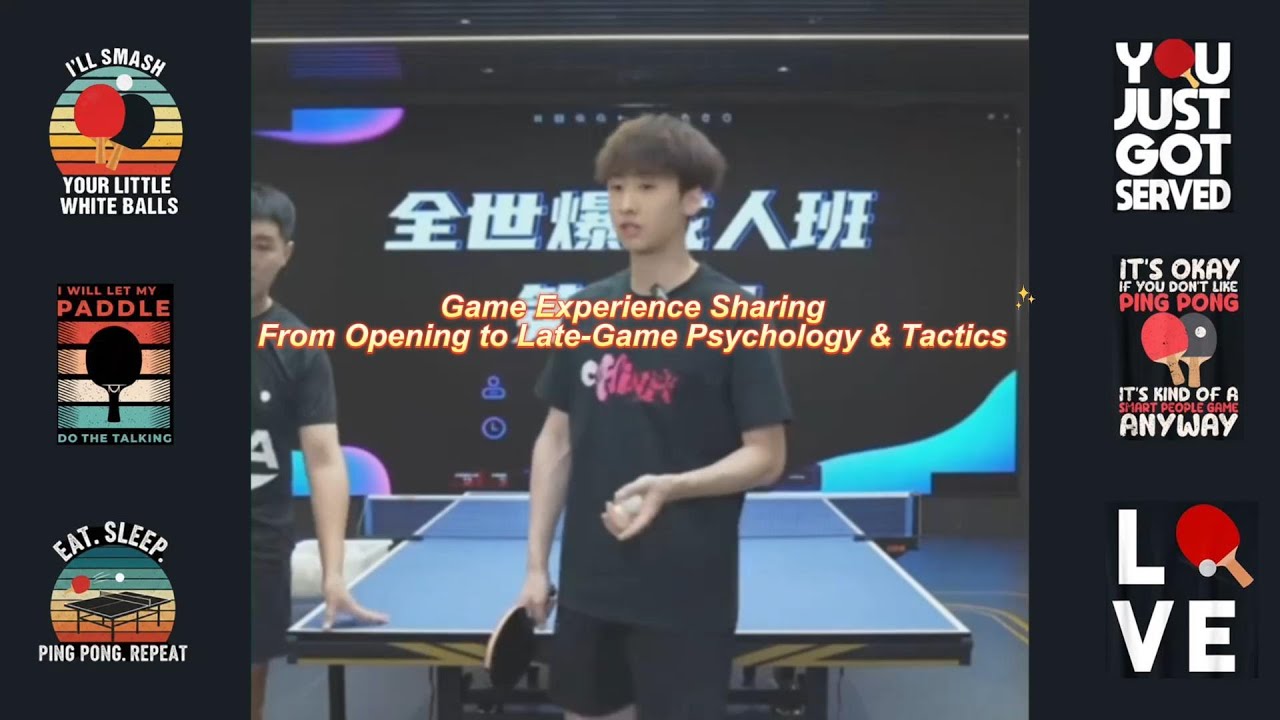
Let’s share key insights from recent table tennis challenges—covering opening moves, key points, psychology, and tactics. You can apply these to your own games, no matter your level!
1. Learn from Players: Adapt to “Strong Forehand, Weak Backhand” Style 🏓
Take Guo Xianjie as an example: His forehand is stronger, while his backhand has lower power but super high stability (few unforced errors). This is a great model if your forehand is better than your backhand:
Backhand first: Prioritize stability over attack. Ensure you can loop underspin (even with low power) and avoid frequent mistakes—don’t let your backhand become a “leak”. If you keep losing points on your backhand, opponents will keep targeting it, leaving your forehand no chance to shine.
Seize forehand chances: Use backhand to sustain rallies (e.g., gentle loops or pushes) and wait for openings—like when opponents hit to your forehand side—to attack.
Reminder: Don’t rely solely on forehand (e.g., full-court side steps to hit forehand every time). Opponents will catch on and keep the ball on your backhand, making you run nonstop and lose rhythm. Balance is key!
2. Opening Moves: It’s About “Steadiness,” Not “Aggression” ⚖️
Many players lose the opening because they rush to hit “killer shots” right away. The truth is, the opening is more about adaptation than attack:
Opening = Adaptation phase: Focus on reducing unforced errors first. “Feel” your opponent’s serve (e.g., spin, speed) and tactics (e.g., do they prefer short or long balls?). Don’t aim for instant kills—just loop the ball up actively (active offense is always better than passive defense).
Score links to mindset: A good opening (e.g., 7:4 lead) makes you more relaxed and confident; a bad one (e.g., 4:7 behind) adds pressure. Play “safe but active”: Use moves you’re good at (high success rate, like your go-to serve return) to push difficulty to your opponent. If they can’t handle your steady play, they’ll make mistakes first.
3. Mid/Late Game: It’s All About “Ability & Psychology” 🧠
By mid-game (3rd/4th sets), opponents have adapted to your serves and tactics—there’s no “surprise” left. Now, two things matter most:
Ability: Your rally quality (spin, power) and consistency. For example, if your backhand rally is stronger than your opponent’s, use it to suppress them—hit steady backhand loops to force them to use their weaker forehand. If you can keep the rally going and avoid mistakes, you’ll wear them down.
Psychology:
Leading: Don’t relax! When opponents are behind, they may take risks (e.g., hard smashes or tricky fakes). Stay focused, control the rhythm (e.g., slow down if they’re rushing), and don’t let them “steal” the momentum.
Trailing: Don’t give up! Most players panic when leading (e.g., missing easy balls or playing too cautiously). Release pressure—try moves you hesitated to use earlier (e.g., a wide-angle serve or a forehand fake). “Bite” each point: Even if you only win 1-2 more points, you’ll make your opponent nervous.
4. Key Tip: “Calculate” Opponents, Don’t “Guess” 🤔
Good players don’t “guess” where the ball will go—they “calculate” based on habits and rhythm:
Watch opponent’s habits: Do they always side-step for forehand attacks? Do they slow down when trailing? Do they prefer hitting to your backhand after a short ball?
Read rally rhythm: After 2-3 rallies, predict their next move. For example, if they always hit to your forehand after you loop to their backhand, fake a forehand and hit their backhand instead.
Example: Guo Xianjie “bites” each point tightly—he rarely makes unforced errors. This forces opponents to add more power (to win points quickly), which leads to more mistakes. If you’re stable but less powerful, use this tactic too!
To sum up: For “strong forehand, weak backhand” players, stabilize your backhand first; open with steady moves to adapt and build confidence; mid/late game relies on ability (rally quality) and psychology (staying calm or taking smart risks); and always calculate opponents’ moves, don’t guess 🏓. These tips work for all levels—they’ll help you hold leads and come back from deficits!
If this helps your games, hit like + subscribe ❤️! Tap the bell 🔔 for more table tennis game tips. Comment below: Do you struggle with opening moves or trailing psychology? I’ll reply to every comment! Share this with friends who love table tennis—let’s win more games together 🏓!

Информация по комментариям в разработке