And did I mention they’re smaller than a grain of rice??
(p.s. we use the word “bug” colloquially, in this house! All you “bug” truthers out there can put your soapboxes away ;) )
Thanks to @eldiego.glez for the concept and bug list behind FeBUGuary!
–
Video description:
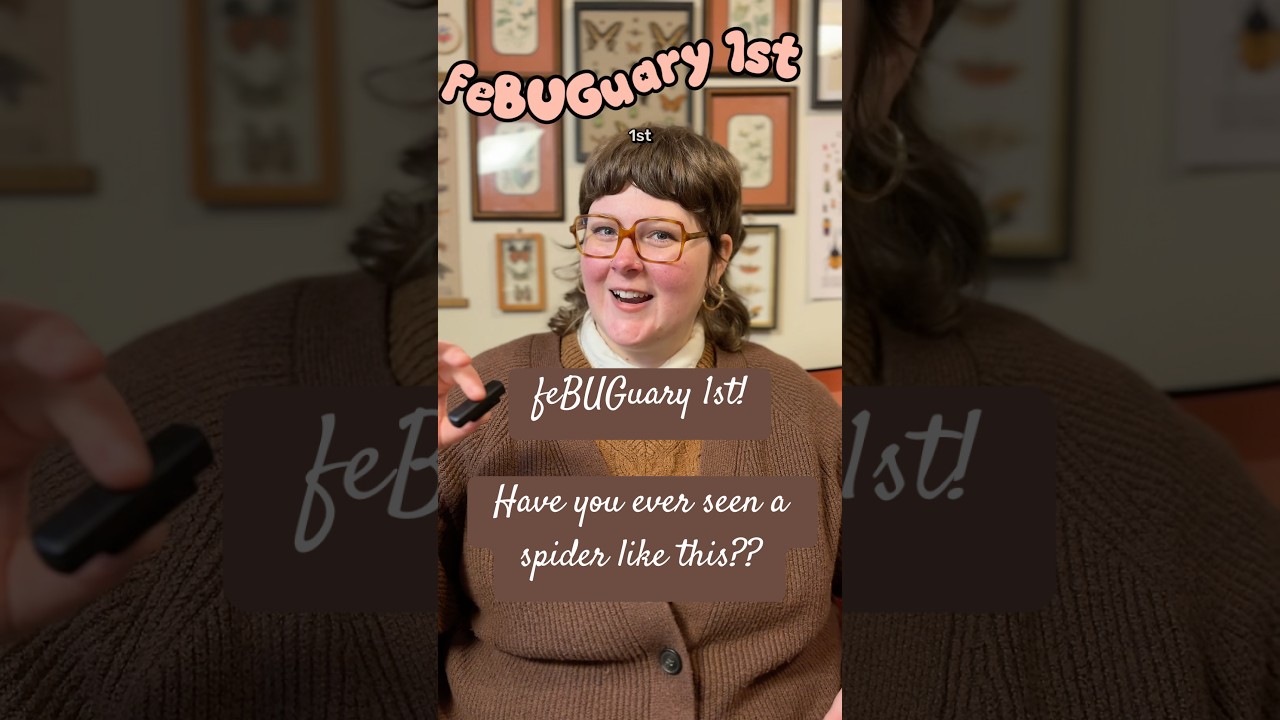
Emily sits in front of a wall decorated with insect specimens and art as she speaks directly to the camera. She is a white woman with shoulder-length brown hair and short bangs. She is wearing square glasses, gold hoops, a white button down, a brown knit vest and a brown knit cardigan. Her facial expressions convey awe and enthusiasm. As she speaks, images of the Pelican spider appear on screen. Pelican spiders are mottled brown and white in color. Their legs are extremely long and slender, especially the front two. A long neck-like appendage holds their head high over their body, and two sausage-like fangs, the same length as their neck, hang down from their head.
–
Approximate transcript:
You know what a spider looks like, right? Eight legs, three body parts, lots of eyes, giraffe-like neck, pelican beak… oh, did I lose you? It’s FeBUGuary 1st, and today we’re talking about Pelican Spiders. I’ll be showing images of spiders in 3 seconds. If that’s not your thing, now is a good time to scroll. Pelican spiders are living fossils that came to be over 300 million years ago when Pangea was still all stuck together. They used to be abundant, all over the place, but then Pangea split, the continents drifted, and lots of species died out. Now, they’re only found in South Africa, Madagascar, and Australia. So, why do they look like this?? Well, Pelican spiders are highly evolved spider hunters. To catch another spider, they find a web and jiggle it, imitating stuck prey–and when that spider comes down to investigate, they strike! They stretch that neck forward and use their looong fangs to reach over the spider's head and grab them by the abdomen, injecting them with venom at the same time. The other spider can’t bite them back from upside down air jail, and so, they’re safe. Sometimes, it pays to be long. That’s all this time, friends. Keep looking for the little things!
–
Key words: #febuguary2026 insects arachnids entomology arachnology bugs insect facts archaeidae living fossil assassin spider Afrarchaea Austrarchaea Eriauchenus Madagascarchaea Zephyrarchaea febuguary 2026

Информация по комментариям в разработке