The Beginning – England’s Rise
Before the 18th century, there was no single British nation.
People identified as English, Welsh, Scottish, or Irish, each having their own language, culture, and traditions.
However, by the 1600s, England grew powerful — in wealth, politics, and the military.
After the English Parliament seized power from the monarchy in 1688, England became the central force that would soon reshape the entire British Isles.
⚖️ The Act of Union 1707 – England and Scotland
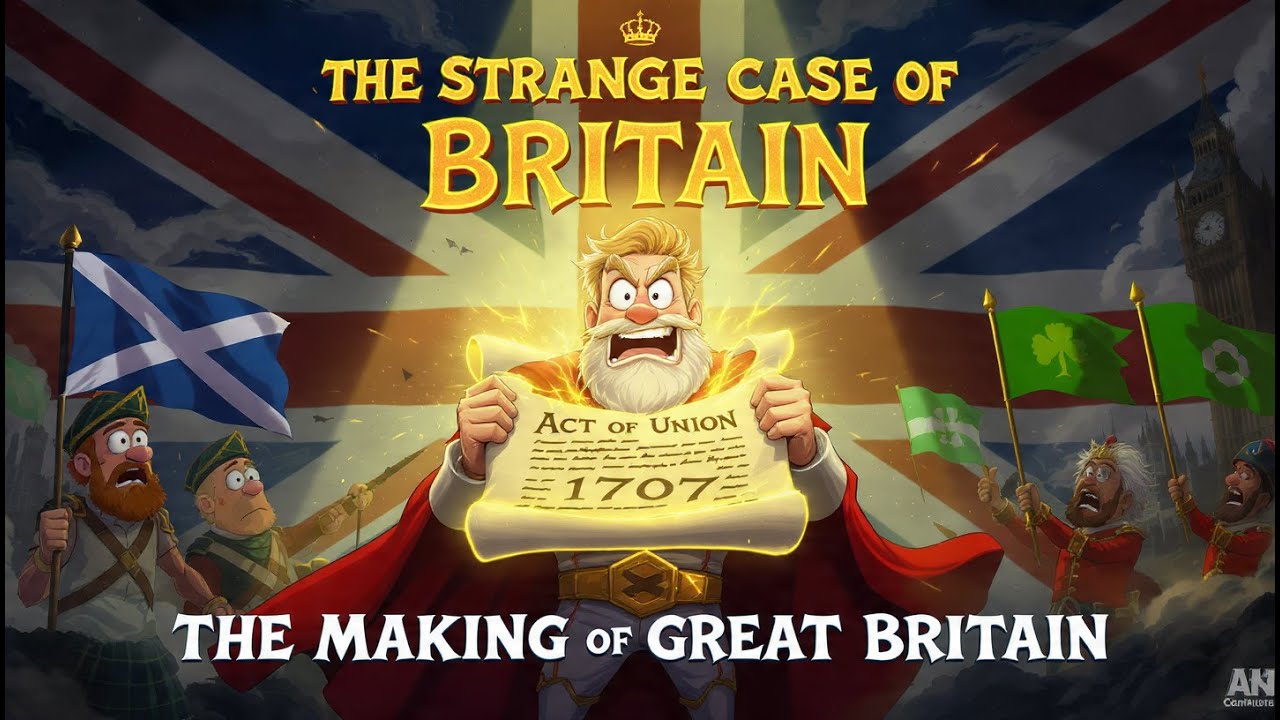
In 1707, the Act of Union joined England and Scotland, creating the United Kingdom of Great Britain.
But this union wasn’t truly equal — it was largely dominated by England.
Scotland’s political institutions, language, and culture were suppressed.
The Catholic Highland clans who resisted English control faced brutal punishment — many were forbidden to wear traditional dress or speak Gaelic.
Large groups of Scottish families were even driven out of their lands.
☘️ Ireland – A Story of Struggle
While England and Scotland were politically united, Ireland’s story was tragic.
Ireland remained deeply divided between Catholics and Protestants.
The English supported Protestant groups, giving them political dominance over the majority Catholic population.
In 1798, a young revolutionary named Wolfe Tone led the United Irishmen in a rebellion for freedom.
The revolt failed, and in 1801, Ireland was forcibly merged into the United Kingdom.
🇬🇧 The Making of a “British Nation”
By the 19th century, a new British identity was carefully created — built around English symbols and power.
The British flag (Union Jack) combined symbols of England, Scotland, and Ireland.
The national anthem, “God Save Our Noble King,” praised the English monarchy.
The English language spread across schools, courts, and administration.
This created a shared identity — but one dominated by English influence.
The older nations — Scotland, Wales, and Ireland — survived only as subordinate partners in this union.
🧠 Summary of Key Points
The British nation evolved gradually, not through revolution.
England was the central power that unified other regions.
Act of Union (1707) joined England and Scotland → formed Great Britain.
Ireland joined forcibly in 1801 after failed revolts.
A new British identity was built using English culture, symbols, and language.
Union Jack, English Parliament, and national anthem represented unity under English control. strange case of britain#unification of britain#act of union 1707#ireland rebellion 1798#england scotland ireland#british identity#british nation formation#rise of nationalism europe#nationalism in britain#united kingdom history#great britain unification#british flag union jack#english parliament history#upsc history#ssc cgl gk#nda cds gk#tgpsc appsc history#banking gk#yashmita reddy channel#class 10 history nationalism europe#british culture formation

Информация по комментариям в разработке