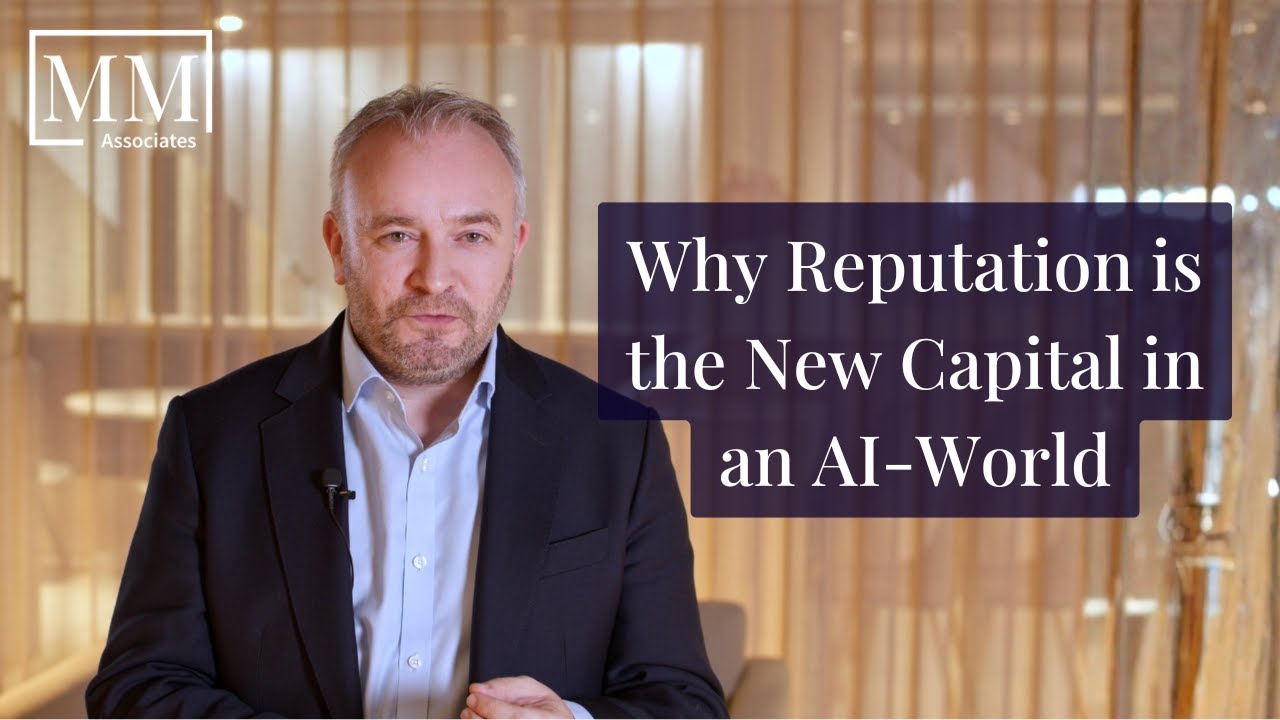
In this thought-leadership explainer, Mark Walter — Partner and Head of Capital Outcomes at Michael Macfarlane Associates — outlines one of the most important but least understood shifts now taking place across global capital markets: the transformation of reputation into a measurable form of capital, accelerated by AI and the changing behaviour of modern decision-makers.
Mark frames this shift with clarity. For decades, reputation was considered abstract — a useful but intangible force sitting adjacent to financial performance. Today, it has become a genuine driver of outcomes. Private markets, public markets, family offices, high-growth founders and institutional investors are all increasingly influenced by sentiment, perception and narrative long before they engage in traditional due diligence or financial analysis. And as AI engines now absorb, interpret and re-express information at unprecedented scale, reputation is no longer shaped solely by what organisations say, but by how technology reads and distributes their signals.
This explainer examines how decision-making itself has changed. Under-40 investors and executives no longer rely on legacy news sources. They rely on feeds, fragments, distributed content, and increasingly on algorithmically tailored summaries delivered by AI systems. In this environment, the old reputation playbooks — static PR, episodic investor relations, and siloed corporate communication — are simply not built for how markets now form opinions. Mark explains why these approaches still have value, but no longer deliver influence on their own.
The Capital Outcomes practice at Michael Macfarlane Associates is presented here not as a communications function, but as a strategic discipline built for this new era. Mark unpacks the concept that reputation is now a “vector” — a directional force capable of accelerating valuation, unlocking access to opportunity, shaping deal dynamics, influencing M&A, and strengthening negotiating positions. He goes deeper into how reputation interacts with AI, and how global perception, sentiment analysis and narrative consistency directly affect how technology interprets an organisation’s credibility.
This video serves as both a diagnosis and a prescription. It explains why organisations must think about narrative with the same sophistication they apply to finance or strategy, and why reputation must be built intentionally, globally and with technological relevance. It articulates the need for a new generation of reputation architecture — one that shapes the information environment that both humans and AI systems rely on.
Mark also highlights how Michael Macfarlane Associates supports leaders across private capital, high-growth firms, and global markets in implementing such strategies: building substance, designing narrative infrastructure, establishing controlled reputation channels, and ensuring their organisation’s story is understood, recognised and prioritised in the digital and algorithmic systems that increasingly shape market behaviour.
This explainer does not simply argue that reputation matters. It sets out why it matters economically, structurally and technologically — and why the organisations that take it seriously now will outperform those that continue to rely on outdated, episodic or legacy approaches.
For those thinking about valuation, investor relations, capital raising, exits, global growth or strategic positioning, Mark Walter’s analysis provides a framework for understanding the new rules of reputation in the AI age.
More at mmassocs.com.

Информация по комментариям в разработке