[As Delivered]
Your Excellency, David Choquehuanca, Vice-President of the Plurinational State of Bolivia,
Your Excellency, Sônia Guajajara, Minister of Indigenous Peoples of the Federative Republic of Brazil,
Your Excellency, Paula Narváez, President of the Economic and Social Council,
Mr. Li Junhua, Under Secretary-General for Economic and Social Affairs,
Ms. Hindou Oumarou Ibrahim, Chairperson of the United Nations Permanent Forum on Indigenous Issues,
Excellencies,
Ladies and Gentlemen,
I express my sincere gratitude for your invitation to address this 23rd Session of the Permanent Forum on Indigenous Issues.
At the outset, I warmly congratulate you, Chairperson, Ms. Hindou Oumarou Ibrahim, on your deserved election – a testament to women’s capacity for leadership. I wish you every success in fulfilling your important mandate.
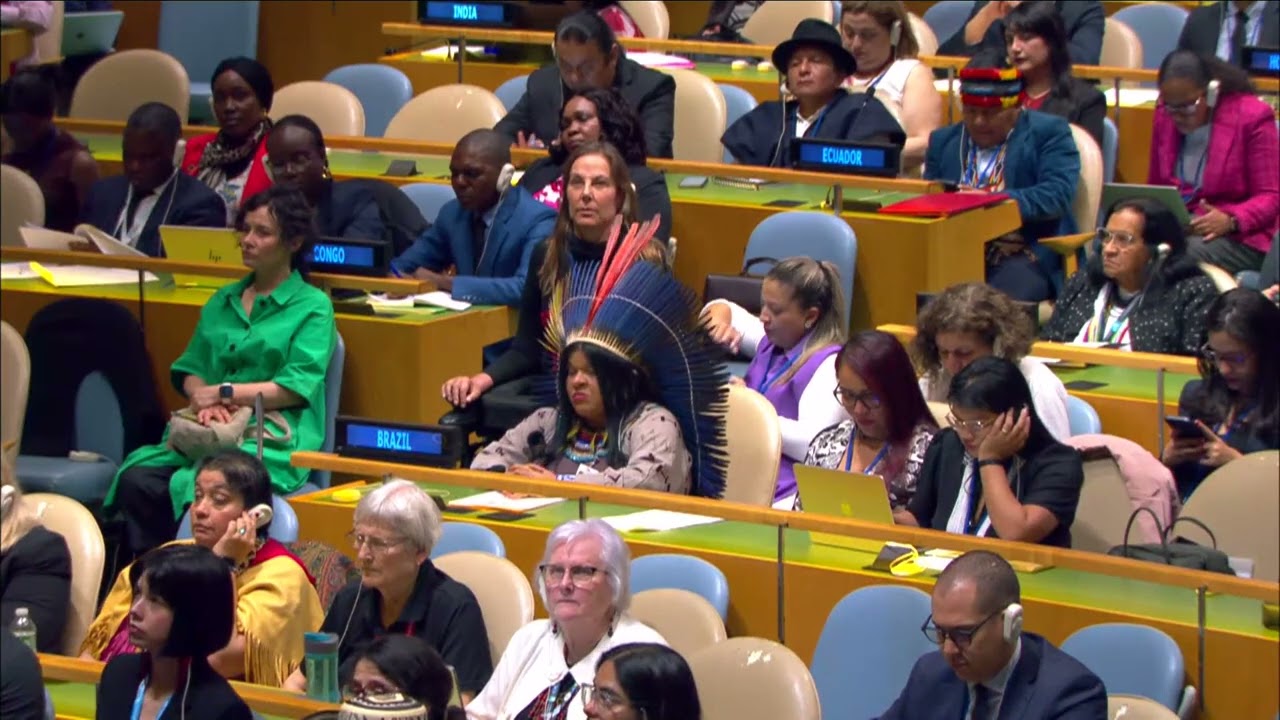
It would also be remiss if I do not welcome all the Indigenous People present – including the distinguished Chief of the Onondaga Nation, Tadodaho Sid Hill.
This is indeed a special moment and I thank you all for being here. An important consequence of which is ensuring the representative character of this Forum – enriching both our intergovernmental deliberations and their outcomes.
Excellencies,
The Permanent Forum is a befitting way to celebrate the remarkable diversity of indigenous peoples – and the most prominent global platform to discuss indigenous issues spanning economic and social development, cultural, environmental, education, health, and the human rights spheres.
Simultaneously, it provides an important moment to highlight the many peculiar challenges indigenous peoples confront in their daily lives.
At each session, this Forum candidly reviews the progress achieved and the obstacles faced in upholding the human rights of indigenous peoples. But we must also make full use of this opportunity and effectively guide our discussion, by addressing such important questions as:
• What progress have we made for indigenous communities?
• What can we learn from each other’s experiences?
• How do we ensure effective participation of Indigenous Peoples in the work of the United Nations system, so that their voices are always heard?
• And, crucially, how do we ensure that our national, regional, and global endeavors align with the objectives of the United Nations Declaration on the Rights of Indigenous Peoples?
Excellencies,
The central philosophy of the 2030 Agenda for Sustainable Development is to “leave no one behind”.
To that end, it urges us to pay special attention to vulnerable communities – those who are most susceptible to being marginalized, left out and indeed, left back.
We will have failed dismally to achieve the SDGs if we overlook the plight of indigenous peoples – or neglect to uphold their rights and dignity, and moreover, to promote their well-being.
Furthermore, we must acknowledge how these challenges intersect with the various gendered forms of discrimination – and barriers encountered, especially by indigenous women and girls.
Accordingly, not only must we ensure that indigenous women and girls are protected from violence; they must also be guaranteed equal access to quality education, healthcare, and economic resources - including land and natural resources.
We have much to learn from Indigenous Peoples – who have long proven themselves to be responsible custodians of the natural resources of the planet; and who, thankfully, preserve 80% of the world’s remaining biodiversity.
For instance, the integration of traditional indigenous knowledge and innovations into agricultural and forestry practices can offer far reaching benefits to us all, including combatting climate change and food insecurity, and preventing desertification and land degradation.
Building on the longstanding contribution to sustainability by indigenous communities around the world, we all have a collective responsibility to ensure our actions do not damage the ecosystems that the indigenous peoples in particular depend on, as do we.
[cont.]
*** *
To read the PGA's speech in its entirety, please visit: https://www.un.org/pga/78/
YouTube: / @unpga78
X (Twitter): www.twitter.com/UN_PGA
Instagram: www.instagram.com/unpga
LinkedIn: / un-pga78

Информация по комментариям в разработке