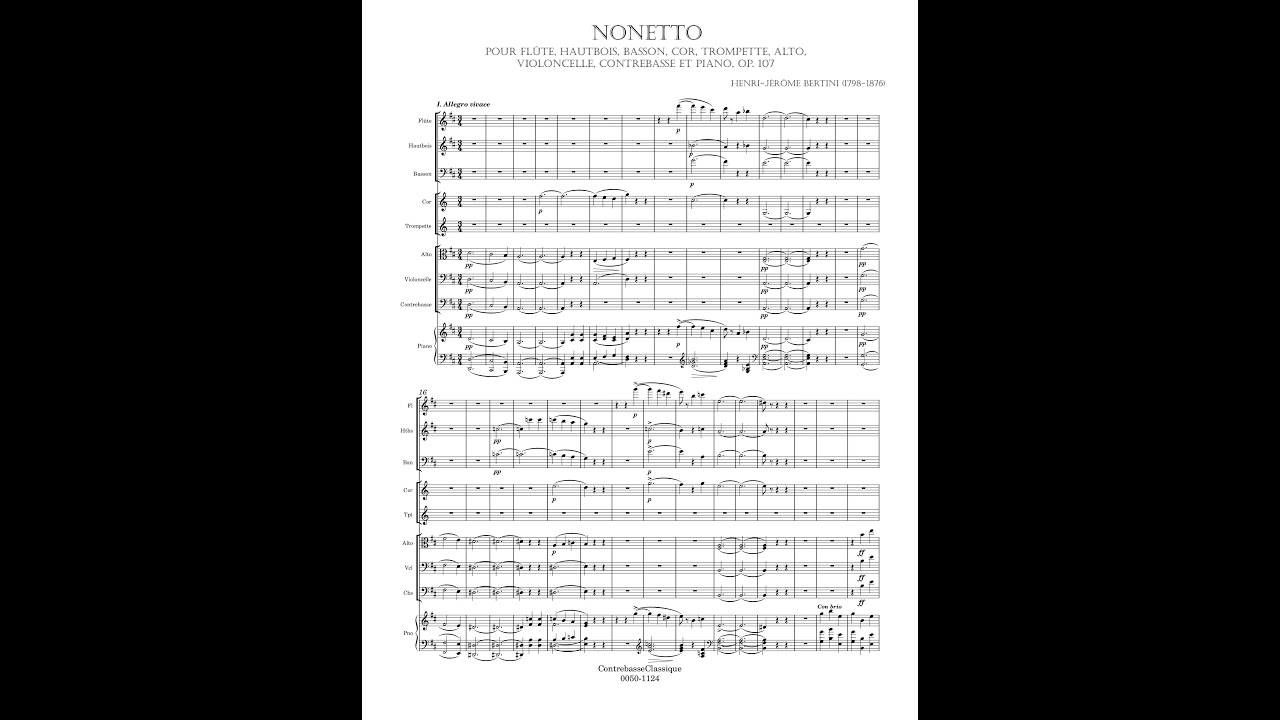
Henri-Jérôme Bertini (1798-1876) – Nonetto pour trompette, cor, flûte, hautbois, basson, alto, violoncelle, contrebasse et piano, Op. 107 (1840)
Linos Ensemble
Musique : • Bertini: Nonetto in D Major, Op. 107 & Pia...
This Score is available in PDF on the ContrebasseClassique website. Click here for all details: https://www.contrebasseclassique.com/...
Details from Wikipedia (https://en.wikipedia.org/wiki/Henri_B...)
Henri Jérôme Bertini (28 October 1798 – 30 September 1876) was a French classical composer and pianist. He was born into a family of musicians and attracted the attention of François-Joseph Fétis when he toured Europe as a child prodigy. As an adult he was admired both as a soloist and as a chamber musician; it was said that he played with Johann Nepomuk Hummel's simplicity and elegance without sacrificing the brilliance of the instrument. As a composer he had an original style that was rich in musical ideas, attractive melodies, and effortless harmonies. In 1856, he retired from the music scene and settled in the Dauphiné in south-east France.
The Nonetto opus 107 for flute, oboe, bassoon, French horn, trumpet, viola, cello, double bass, and piano, composed in 1835, is one of Bertini's major works. Berlioz wrote a review in Maurice Schlesinger's widely distributed and very influential La Revue et Gazette musicale de Paris of a performance at a music evening given by the Tilmant brothers on 6 May 1838:
That same evening a Nonetto by Bertini for piano, viola, cello, oboe, flute, horn, bassoon, trumpet and bass, was performed. It is a great and beautiful composition in which each instrument contributes to the whole according to its importance and idiomatic qualities, without trying to stand out individually. The piano itself is only entrusted those parts which contribute to the musical sense of the moment, and makes no effort toward brilliance for brilliance's sake. Beethoven himself followed this philosophy in his immortal trios. Amongst other movements, this Nonetto includes an adagio entitled La Melancolie which provides more than its title might indicate; it is so grandiose, at times so majestically sombre, that the sentiment of melancholy one expects is overshadowed by ideas of a much higher and rare order. In no way do I mean to quibble with the title, God forbid; all I wish to say is that this admirable work is not only melancholic, but also much more. In the Scherzo and Finale one finds details of graceful melancholy as well as vivacious charm, but the Adagio rises up in the centre of the work like the Mont Blanc among its neighbouring peaks; it dominates all; it is a sublime and profound meditation which provides an almost painful impression that cannot be forgotten.
Berlioz later made further comments about this evening in the July 6 edition of Le Journal des débats:
The Nonetto by Bertini... is the work of a great musician with a lively and ardent imagination, who will grow stronger and more powerful if he refrains from his attempts to encourage applause as he occasionally sought to do in the first movement. His peroration was all too obvious and he is seen to be too preoccupied with achieving success and producing effects. This detracts from the free flowing of his thoughts. This fault does not exist in the other parts of the Nonetto. In composing these the author, fully involved in his subject, undoubtedly forgot that he was actually writing for his public, and concerned himself only with the task at hand and the ultimate unity of the work. Which of these last three movements is our favourite? The Adagio, above all, is without question a noble and magnificent inspiration whose sombre poetry reminds us of the sublime greatness of Beethoven's Sonatas. This is admirable.
The Nonetto was reduced to a quintet (flute or violin, violin, viola, cello and piano) by Charles Schwencke, a pianist and composer from Hamburg who was living in Paris. This appears to have been done for amateur musicians: the flute part, which can be replaced by a violin, contains frequent octave transpositions to make it easier to play.

Информация по комментариям в разработке