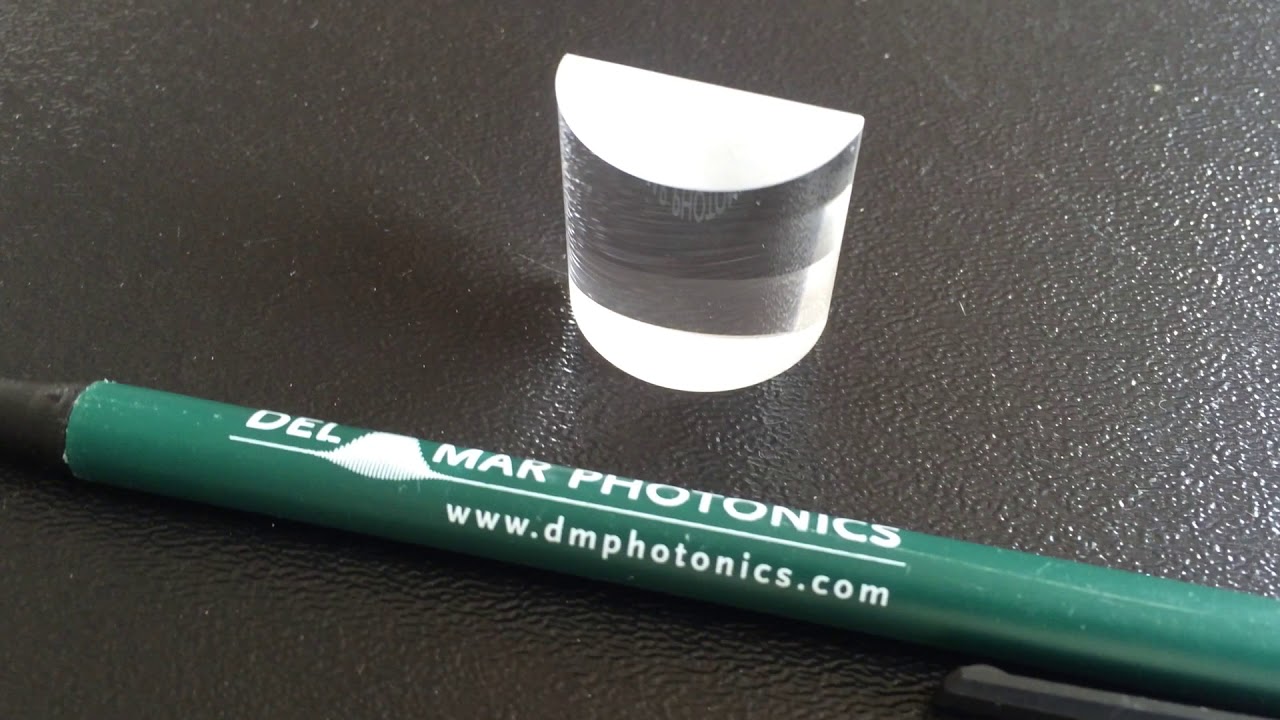
Hemi cylindrical prism for surface plasmon resonance SPR setup - [email protected]
Request a quote at [email protected]
Featured research:
Experimental setup to excite and detect SPR. A light of He – Ne laser with p polarization is incident in a hemicylindrical BK7 prism, which is mounted on a rotatory stage, and is reflected towards an optical photodetector mounted in a second rotatory stage. The photodetector signal and motion control are driven by the custom data acquisition. The signal is recorded and analyzed by a computer with Labview software.
The refractive index is an important optical parameter of samples, which can be defined in terms of real and imaginary parts. The imaginary part is equal to the extinction coefficient, which means there is energy loss per unit in a certain direction caused by absorption and scattering. The refractive index of nonabsorbing or weakly absorbing liquids is relatively easy to measure by means of refraction [1], but when the liquid samples are absorbed, the difficulty in finding the complex refractive index increases. Different optical techniques have been applied in studying absorbing liquids; including reflection measurement [2], total internal reflection, and Brewster angle measurements [3]. But, as absorption increases, the use of these techniques becomes more and more complicated and inaccurate. Due to its simplicity and sensitivity, surface plasmon resonance (SPR) is an effective research method that determines the refractive index (both real and imaginary) of samples in the solid [4,5], rough surface [6], gas [7], and liquid forms. In the fields of SPR, some work has been done to determine the complex refractive index of absorbing liquids; including some theoretical models to determine the real and imaginary parts of the refractive index [8,9] to enhance absorption-sensitivity using a multilayer system [10], as well as to measure the refractive index for biomolecular sensing purposes [11 – 13]. Most of these methods found a total value of the complex refractive index to describe or identify the absorbing samples, which are difficult to describe. In this paper we used parameters, such as the width and position of the SPR produced by the influence of the complex refractive index obtained through the SPR technique that was used to determine the quality or adulteration of tequila beverages. The high sensitivity of the method is due to the resonant dependence of the parameters on a laser beam reflected from a metal surface and on the refractive index changes of an adjacent medium. The shift of a resonant angle, corresponding to the intensity minimum of the reflected beam, is used as an information parameter. Recently, some techniques have been applied to analyzing tequila beverages. These include gas chromatography [14], spectrometry [15], and chemi- luminescence [16] to monitor the concentration of regulated compounds (ethanol, methanol, higher alcohols, ethyl acetate, acetaldehyde, furfural, and metal contents, among others) that are related to the flavor constituents Raman spectroscopy to measure its alcoholic content [17], and ultraviolet-visible (UV-VIS) absorption spectroscopy [18] to discriminate between tequila beverages. All of these techniques give important information about the constituents or other characteristics of tequila, but on the other hand, require many samples or are either too expen- sive or complicated. In the present research, we stu- died the SPR in the vicinity of the absorption band of different types of tequilas, measuring reflectivity as a function of two parameters: width and resonant angle. From the reflectivity distribution on these parameters, we find it is possible to differentiate tequilas, since the SPR curve is mainly determined by the tequila sample under examination. One hundred percent pure agave tequila, in its three presentations, white, aged, and extra-aged [19], was employed as the sample for this study. We used samples of bottled tequilas from four well-known trademarks: Tequila Herrradura (He), Tequila Centenario (Ce), Tequila Cazadores (Ca), and Tequila Don Julio (DJ), in the three presentations of white (Herradura Blanco, HB; Cazadores Blanco, CB, Centenario Blanco, CEB and Don Julio Blanco, DJB), aged (Herradura Reposado, HR, Cazadores reposado, CR; Centenario Reposado, CER; and Don Julio Reposado, DJR), and extra-aged (Herradura Añejo, HA; Cazadores Añejo, CA; Centenario Añejo, CEA; and Don Julio Añejo, DJA) tequilas with alcohol contents from 35% to 46%. These were chosen because of their importance to the local economy, with considerable sales profits due to the fact that they are some of the most consumed alcoholic beverages.
https://www.researchgate.net/figure/E...

Информация по комментариям в разработке