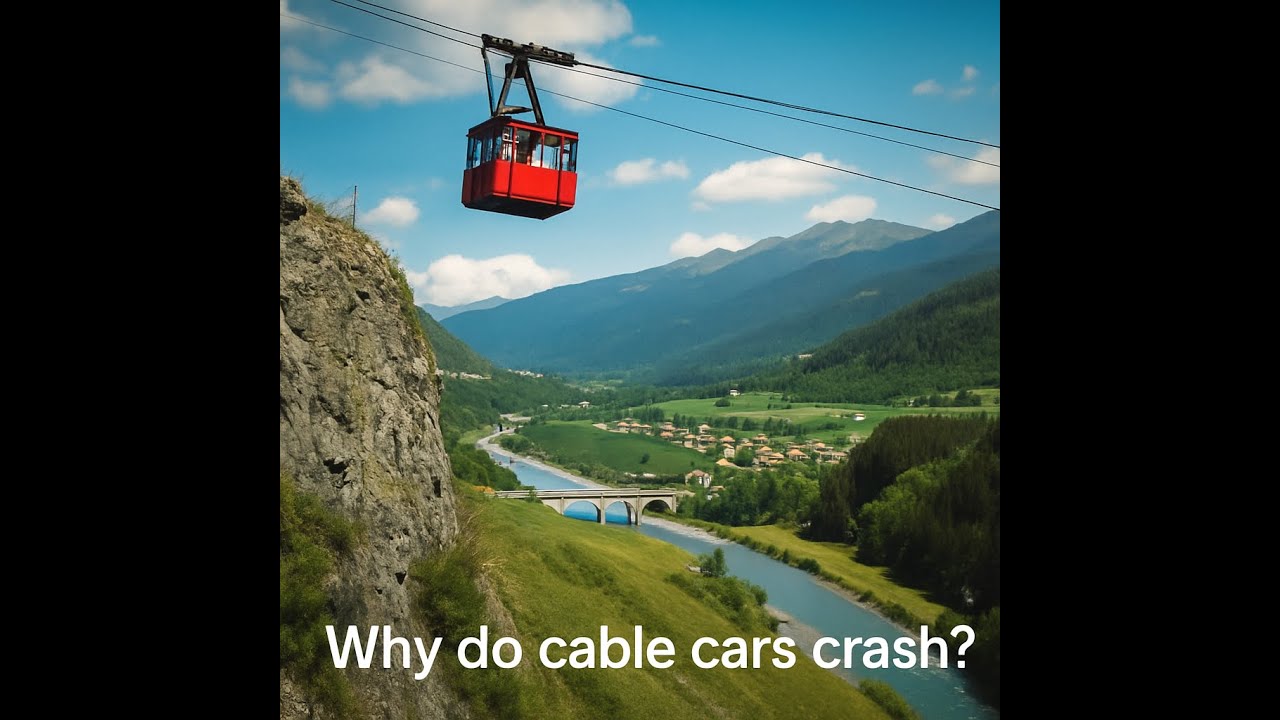
“Why Do Cable Cars Crash? And Are They Still Safe?”
When a cable car crashes, it makes the news — and it shocks people. It’s unexpected, rare, and deeply unsettling. But moments like the recent tragedy in Italy, on Monte Faito, leave many asking the same thing:
Are cable cars safe? And how do they go wrong?
Let’s break it down clearly and calmly.
⸻
What is a cable car, and how does it work?
A cable car is an aerial lift that uses strong steel cables to move cabins across valleys or up steep slopes.
Some systems pull cabins with a moving cable. Others clamp cabins to a looped line that never stops moving.
Each system is carefully balanced, with anchored cables, electric motors, brake systems, and counterweights.
They’re built with layers of safety — including backup motors, emergency brakes, and strict weather rules.
⸻
So what causes a crash?
There are three main causes:
1. Mechanical failure — something like a snapped cable or a brake that doesn’t engage.
2. Human error — a mistake during maintenance, or someone overriding a safety feature.
3. External forces — like a fallen tree, lightning, or even an earthquake.
Most systems are designed to survive these — but when more than one thing fails at once, that’s when accidents can happen.
⸻
Let’s look at two examples.
In 2021, a tragic crash on the Stresa–Mottarone line in Italy killed 14 people. A support cable snapped, and the emergency brake had been disabled — by humans — to avoid earlier disruptions.
In 2025, the Monte Faito incident is still under investigation, but early signs point to a system or control failure. It’s a painful reminder that no system is perfect — but also how rare these failures are.
⸻
So just how rare are they?
Cable cars carry millions of people every year, all over the world — from the Alps to city centres.
Accidents make headlines because they’re shocking — but statistically, cable cars are among the safest ways to travel.
You’re more likely to have a serious accident on a staircase or in your car than in a cable car.
⸻
Why are they so safe?
Because safety is built in from the start.
• Daily inspections
• Routine brake and cable testing
• Trained operators watching every movement
• Automatic shutdown in bad weather
• And backup systems, ready to stop the cable if anything goes wrong
Modern cable cars often include live diagnostics, remote monitoring, and failsafe brakes.
⸻
So what’s changing now?
Every serious crash leads to better design.
Today, systems are improving with smarter sensors, more automated safety protocols, and stronger global safety standards.
Cable car makers are learning from each event — so the next system is safer than the last.
⸻
So, are cable cars safe?
Yes. Statistically and technically, they’re among the safest forms of transport available.
But no system is flawless. The key is vigilance, investment, and honest investigation when things go wrong.
⸻
Thank you for watching. If this helped you understand the topic better, please leave a comment, or share it with others.
We all rely on trust in the systems we use. The more we understand them — the safer we make them for everyone.
⸻
Let me know if you’d like a visual storyboard or this formatted for a short-form version. I can also help match visuals to each part of the script if you’re building the video.

Информация по комментариям в разработке