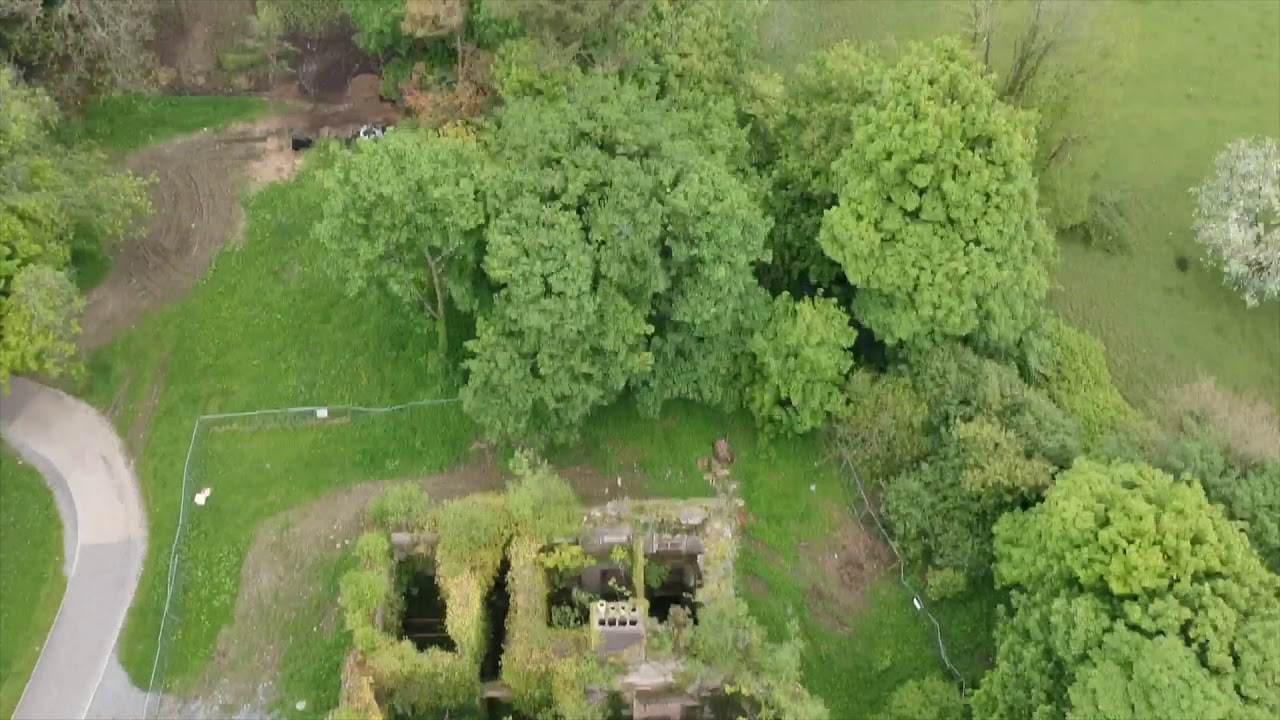
Boom Hall, now in a ruined state located on the Culmore Road overlooking the River Foyle, was built for the Alexander family in 1779, founders of the Bank of Ireland. Field Marshal Alexander of Tunis was one of the family, as was Bishop William Alexander, husband of Mrs Cecil Frances Alexander the famous hymn writer. The site overlooks the position of the Siege Boom built across the River Foyle in 1689.
It is proposed to develop the Boom Hall area along the lines of the world famous Eden Project in Cornwall.
Sir Tim Smit, Eden Project Co-Founder, said: “Derry is a world city on the banks of one of the most beautiful rivers anywhere. The invitation to participate in developing a project that creates the cultural, social and economic excitement that can redefine its future makes the hair stand up on the back of your neck.
“We stand on the shoulders of giants who have sacrificed much to create this platform and the fact that the two top universities have dared to commit to work together with a closeness many thought unimaginable gives me real confidence that Derry’s time is coming. We are hugely excited at the international collaborations we can bring to a site that will be not only a global leisure destination but also a mould-breaking centre for science and human health learning, education and research.”
BOOM HALL, near the city of Londonderry, was built ca1772 by James Alexander to the designs of Michael Priestly.
He had returned from India.
Alexander was later to purchase the estate of Caledon, County Tyrone.Boom Hall estate eventually passed to James, 3rd Earl of Caledon.
The Hall was occupied in the early 1830s by the Very Rev Thomas Bunbury Gough, Dean of Derry.
The lessee was Daniel Baird and the lessor was the Honourable The Irish Society.
Daniel Baird lived there from 1849 until his death in 1862; and his widow Barbara continued to live there until her death in 1879.
Baird was a very successful businessman, merchant and ship owner who rose to prominence from fairly humble origins in the 1830s ~ the Cookes and McCauslands were friends and business rivals.
A one-time Mayor of Londonderry and alderman of the city, he was also High Sheriff of Tyrone, where he had acquired an estate of around 5,000 acres in and around Newtownstewart.
When Daniel Baird died, his entire estate was left in trust to his only surviving descendant, his grandson Daniel Baird Maturin-Baird, then aged 13; with his widow and second wife Barbara (nee Delap) having “the benefit and living of Boom Hall for her natural life”.
On her death, Boom Hall passed into Daniel Maturin-Baird's full control.
He was aged 30 by this time and had established a life for himself in London and chose not to live at Boom Hall, instead leased the house, grounds and contents to the Cooke family (John and Joseph Cooke were both trustees of Daniel Baird’s will).
Meanwhile Mr Maturin-Baird built himself a new house on the Newtownstewart estate.
It is believed that the Cooke family continued to live there until around 1920.
Charles Edgar Maturin-Baird inherited the estate in 1924.
It was then leased to Michael Henry McDevitt, whose family ran a hosiery business, until the war when it was requisitioned by the Royal Navy.
The WRNS left the house in a deplorable state and Mr Maturin-Baird received compensation for damages.
Prior to the war, Michael Henry McDevitt had expressed an interest in buying the house, and after repairs had been carried out in 1946-47, the estate was sold.
Mr Maturin-Baird had, by this time, acquired an estate in East Anglia.
Interestingly, McDevitt chose only to buy the house, contents and immediate surroundings of around 26 acres along with the stable block, but not the stack yard or majority of parkland, which originally totalled 135 acres.
The remaining land was sold to various purchasers in the 1950s ~ although it is believed that the Maturin-Bairds still own the foreshore, as it would appear that this was never sold.
A fire in the early 1970s destroyed the roof, since when Boom Hall has gradually decayed.
When Miss McDevitt died, the property was left to a niece who sold off the land separately, and then the bricks and mortar to a ‘developer’.
It is thought that the local Council now owns the stable-block and some of the surrounding land, though not the building itself.
The site of Boom Hall is still a valuable open space, though it has lost many of its attributes. It is of interest because the core of the late 18th century house remains, with some fine mature trees and a walled garden.
The Foyle bridge sweeps above the grounds, which go down to the shore of the River Foyle.

Информация по комментариям в разработке