By January 1945, Allied bombers were flying at altitudes where no German fighter could effectively follow. The Luftwaffe's entire defensive network was being rendered useless not by tactics or firepower, but by physics. While Germany's air force struggled to survive at thirty thousand feet, one engineer was already building the solution.
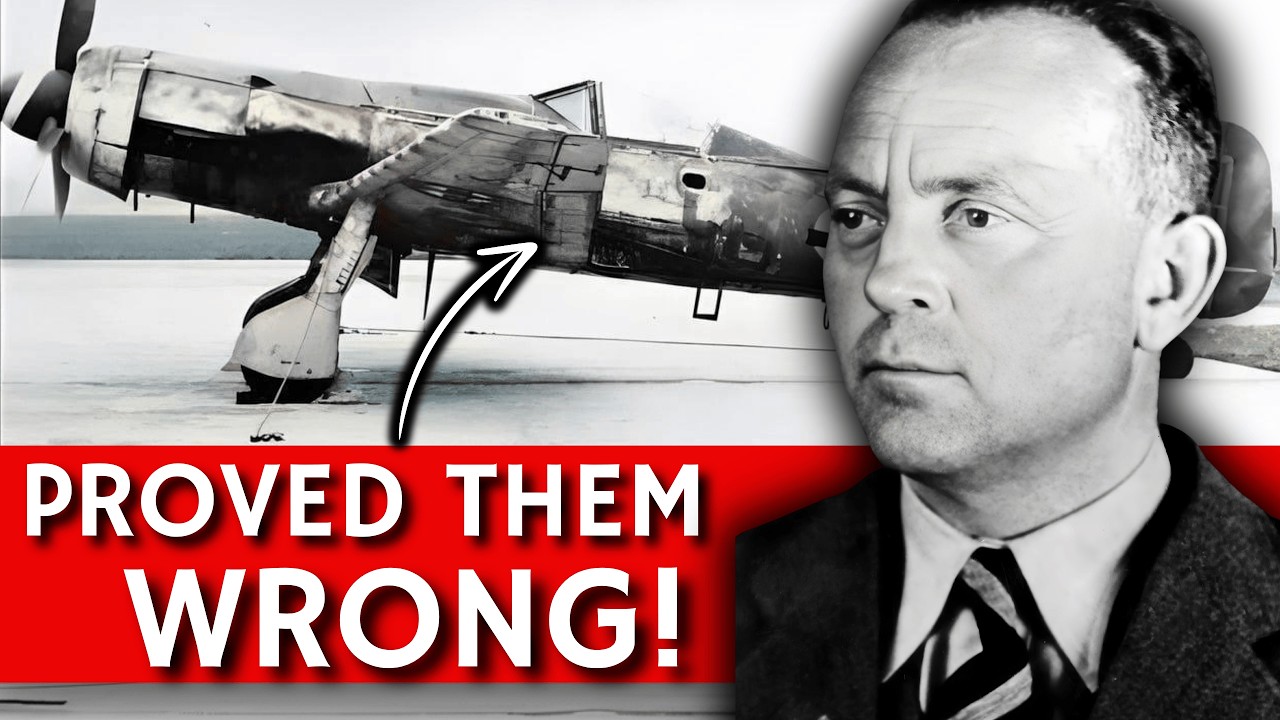
Kurt Tank, the chief designer at Focke-Wulf, had spent two years developing an aircraft specifically engineered for the extreme upper atmosphere. The result was the Ta 152 H-1, a high-altitude interceptor powered by the Junkers Jumo 213E engine with a three-stage supercharger capable of delivering over 1,750 horsepower at 40,000 feet. With a pressurized cockpit, extended high-lift wings spanning nearly forty-eight feet, and an MW 50 methanol-water injection system that pushed emergency output beyond 2,200 horsepower, the Ta 152 H-1 outperformed every Allied fighter in the altitude band where Germany needed it most.
On January 22, 1945, Tank flew the aircraft himself to 41,000 feet, confirming speeds that exceeded the P-51D Mustang by over 65 miles per hour at that altitude. The engineering was flawless. The problem was everything else.
By April 1945, only around 150 Ta 152 H-1 units had been produced against a need for hundreds per month. Fuel shortages, destroyed infrastructure, undertrained pilots, and an industrial base already crushed by Allied bombing meant that Germany's most capable piston-engine fighter never had the conditions it needed to change anything.
This video examines the full technical and historical story of the Ta 152 H-1, from the altitude crisis that made it necessary, to the engineering decisions that made it remarkable, to the systemic failures that made it irrelevant. It is a story about what happens when an engineer solves the right problem at the wrong moment in history.
Topics covered in this video:
Kurt Tank and the Focke-Wulf design bureau
The Luftwaffe altitude problem in late World War Two
Junkers Jumo 213E engine and three-stage supercharger technology
Ta 152 H-1 wing design, pressurized cockpit, and MW 50 injection system
Comparison with the P-51D Mustang at high altitude
The January 1945 test flight to 41,000 feet
German aviation fuel shortages and production collapse in 1945
Jagdgeschwader 44 and late-war Luftwaffe operations
Kurt Tank's postwar career in Argentina and India
Sources
Green, William. Warplanes of the Third Reich. Doubleday, 1970.
Smith, J. Richard, and Antony L. Kay. German Aircraft of the Second World War. Putnam Aeronautical Books, 1972.
Nowarra, Heinz J. Focke-Wulf FW 190 and Ta 152. Schiffer Military History, 1987.
United States Strategic Bombing Survey. The Effects of Strategic Bombing on the German War Economy. European War Report, 1945.
Ethell, Jeffrey L. Frontline Fighter: The Focke-Wulf Fw 190. Jane's Publishing, 1984.
National Air and Space Museum, Smithsonian Institution. Ta 152 H-1 Aircraft Record and Restoration Documentation.
Disclaimer: Under Section 107 of the Copyright Act 1976, allowance is made for "fair use" for purposes such as criticism, comment, news reporting, teaching, scholarship, and research. Fair use is a use permitted by copyright statute that might otherwise be infringing. I do not own some or all of the video materials used in this video. In the case of copyright issues, please contact me at historymediachannel1@gmail.com for credit or removal.
#WorldWarTwo #Luftwaffe #KurtTank #Ta152 #GermanAviation #WWIIHistory #FighterpilotHistory #WarHistory #AviationHistory #WWII #FockeWulf #GermanFighter #MilitaryHistory #SecretWeapons #WW2Aviation #HistoryChannel #AltitudeFighter #AircraftHistory #WWIIEngineering #GermanEngineering #WW2Fighters #MilitaryAviation #HistoricalDocumentary #WW2Germany #PistonEngine #RareHistory #ForgottenHistory #HistoryDocumentary #AviationGeek #PlaneHistory











Информация по комментариям в разработке