Промт:
Ultra-realistic cinematic 8-second video in 8K 60fps, path-traced lighting, extreme detail. Scene: outer space, black infinite void filled with scattered stars and faint cosmic glow. The central subject is the Moon, shown in breathtaking realism. Its surface is crisp and detailed — visible craters, ridges, subtle shadows, and faint bluish-gray tones with patches of white dust. Lighting is natural: sunlight glancing across its curvature, casting deep shadows into craters. The silence of space is heavy, immersive, yet punctuated by ASMR textures of cosmic events.
Action begins:
At 0.5 seconds, from the top right of frame, a massive glowing meteor emerges. The meteor is irregular, jagged, with cracks glowing molten orange and red. Its surface texture is detailed with rock, metallic glints, and fiery plasma trails streaming behind it. It streaks across space with intense velocity, leaving a trail of vaporized debris that shimmers in reflected sunlight. The camera slightly tracks the meteor as it grows larger, creating tension.
Collision moment:
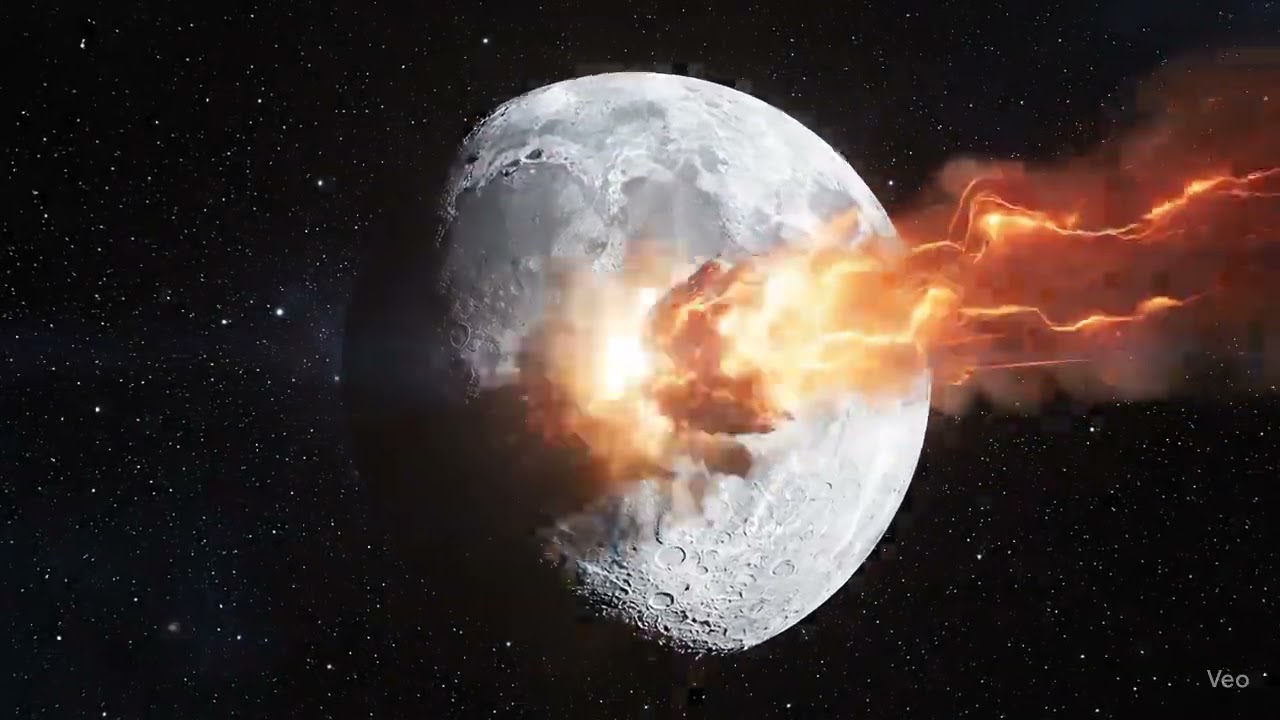
At 3 seconds, the meteor strikes the Moon with catastrophic force. The exact point of impact glows white-hot — blinding burst of energy, sparks, and molten rock shooting outward. A colossal shockwave ripples across the Moon’s surface, visible as waves of dust and fractured terrain spreading in concentric circles.
Explosion:
By 4–5 seconds, the Moon begins to split apart. Cracks streak across its surface in glowing fissures, bright orange magma veins snaking outward. Enormous chunks of lunar rock break free and drift into space. Smaller fragments scatter violently, tumbling across the frame. A glowing halo of dust, molten shards, and plasma expands rapidly outward, illuminated by the explosion.
Destruction sequence:
Large fragments rotate slowly, revealing jagged surfaces and glowing edges.
Fine dust particles and micro-debris fill the scene, shimmering as they catch starlight.
A fiery burst expands into a glowing shock sphere, visible against the black void.
Final moment:
At 7–8 seconds, the Moon has been reduced to drifting fragments. The camera slowly pulls back, showing debris floating in all directions — from massive glowing chunks to tiny sparkling dust motes. The meteor’s impact point is still glowing at the center of the expanding cloud. The screen is filled with radiant debris, creating a cosmic field of light and shadow. Fade to black as particles drift silently.
Camera progression (8 seconds):
0–2s: Wide shot, Moon centered, meteor entering frame from top right.
2–3s: Camera tracks meteor, focus shifts as it nears the Moon.
3–4s: Extreme close-up of impact zone — shockwave and explosion dominate.
4–6s: Medium shot of the Moon fracturing, huge debris breaking apart.
6–8s: Slow pullback, wide cosmic view of drifting lunar fragments and glowing dust cloud.
ASMR soundscape:
Meteor flight: low-frequency rumble layered with faint sizzling plasma crackle, airy hiss trailing behind.
Impact moment: sharp, explosive crack with ultra-detailed texture — rock shattering, molten bursts hissing.
Moon breaking apart: deep resonant rumbles, creaking rock, cascading avalanche-like cracks, glowing fissures emitting crackling energy.
Debris scattering: micro-impacts, fine granular dust sizzling in stereo, faint flutter of particles drifting past microphone range.
Final seconds: low cosmic drone, subtle reverberation, faint echo of fragments moving into silence.
Visual style:
Hyper-photorealistic PBR textures on Moon surface (16K lunar maps), meteor rock with glowing lava veins, physically accurate particle systems for debris. Volumetric scattering for dust halo. Filmic grading with high dynamic range, subtle bloom on glowing fissures, lens flare on impact flash, light grain for cinematic realism.
Restrictions:
No cartoonish or stylized look, no logos, no surreal distortions. Strictly photorealistic, cinematic, ASMR-focused space destruction sequence

Информация по комментариям в разработке