8 November 2022. Zhejiang Art Museum.The 4th Hangzhou Triennial of Fiber Art — “Being Theoria.”
I am the filmmaker behind Masters in the Forbidden City and Every Treasure Tells a Story. But on this day, I am simply a humble child with a phone in hand, wandering through the galleries.
———
Ten Thousand Things · Origins of Fiber.
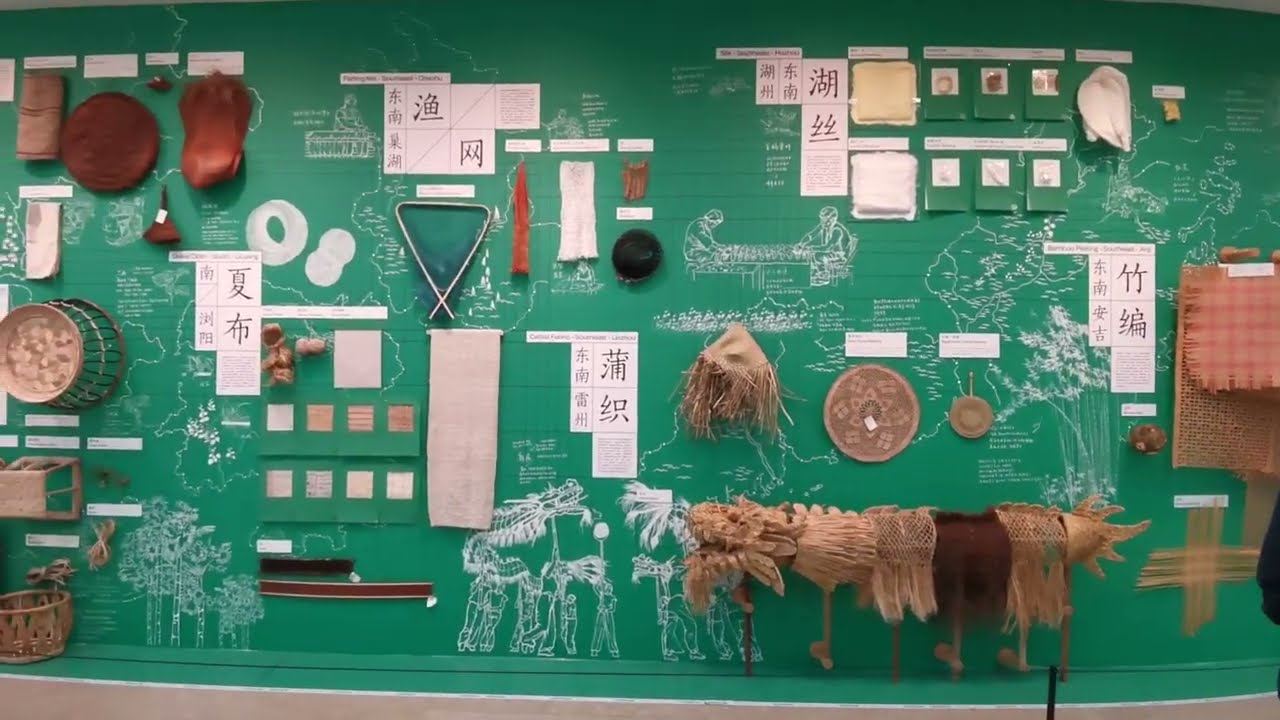
The exhibition opens with a field-work archive.
Yak felt from Tibet. Bark paper from Yunnan. Fireweed cloth from Xishuangbanna. Palm weaving from Leizhou. Rattan from Nanhai. Grass linen from Liuyang. Fishing nets from Chaohu. Silk from Huzhou. Bamboo weaving from Anji. Dong cloth from Qiandongnan and Guangxi…
People took what the land gave, transforming local constraints into creation. South and north, flora and fauna—all things bear their own woven patterns. We live in a world of fiber. We just haven’t looked down in a long time.
Two friends accompanied me. They run a homeware business.
One said: “I don’t get this art. Might as well go shopping—at least you can buy food.”
The other said: “Actually, this is quite relevant—rattan, bamboo, grass linen. We use these in our store. I learned a lot today.”
I stood between them, thinking: these two sentences, together, are the best artwork in the show.
———
Then, another hall.
Cuneiform on the walls, illegible. Zilvinas Kempinas’ Flow—electric fans suspending loops of magnetic tape in midair. Two black lines floating, intertwining, separating, like hands forever reaching but never holding . In the dyeing workshop installation, lengths of white cloth hung from the ceiling, silent as waterfalls.
This is the part one “doesn’t get.”
Can’t read cuneiform. Don’t know why the tapes float. Don’t understand why the cloth has to hang like that.
But after leaving the hall, I kept thinking about those two tapes.
How they stay suspended, keep moving, never fall.
———
Where do we begin to understand an exhibition, an art?
We begin with what we do understand—rattan, bamboo, silk, Dong cloth. Your grandmother’s dowry. The mat you sat on as a child. The goods on your store shelf.
And we begin with what we don’t understand—cuneiform, floating tapes, falling cloth. They offer no explanation. They only wait for you to stand there, and be struck by something you cannot quite name.
Two friends, one homeware business.
One said: “I don’t get it.”
The other said: “It’s our business.”
Both were right.
Art is sometimes about making things clear.
And sometimes, it is about discovering what you do not understand—
and being willing, because of that, to stay a little longer.
#慢下来看世界 #万物生长 #我在故宫修文物 #如果国宝会说话 #美术馆 #脑洞大开 #杭州 #浙江 #分享给有艺术细胞的你 #捕捉生活中的美 #治愈 #用镜头留住每一个美好的瞬间 #电影感 #氛围感 #山水 #人间烟火 #秋天 #纤维艺术 #万物与纤维的因缘 #缓存在
#SlowDownSeeTheWorld #AllThingsGrow #MastersInTheForbiddenCity #EveryTreasureTellsAStory #ArtMuseum #CreativeMind #Hangzhou #Zhejiang #ForTheArtisticSoul #CapturingBeautyInLife #Healing #CapturingBeautifulMoments #Cinematic #Ambience #Landscape #EarthlyVibes #Autumn #FiberArt #TenThousandThingsOriginsOfFiber #BeingTheoria #WanderingWithYeJun #YeJunsWorld #NotesOfAWanderer #WhereToBegin
2022年11月8日,浙江美术馆。第四届杭州纤维艺术三年展——“缓存在/Being Theoria”。我是那个拍过《我在故宫修文物》《如果国宝会说话》的人,但这一天,我只是一个拎着手机、在展厅里走来走去的笨小孩。
———
万物·纤维因缘。
展览的第一幕,是一场田野考察的文献装置。
西藏的牦牛毡,云南的树皮纸,西双版纳的火草织布,雷州的蒲织,南海的藤编,浏阳的夏布,巢湖的渔网,湖州的湖丝,安吉的竹编,黔东南和广西的侗布……
人们因地制宜,取诸万物。将本地特产的限制,转化为创造的机缘。天南海北,动植皆文。 我们生活在一个“纤维”的世界里,只是太久没有低头看。
同行的两位朋友,做家居用品生意。
一个说:看不懂艺术,不如去逛街,逛街还能买吃的。
另一个说:跟咱们关系很大啊——藤编、竹编、夏布,这些我们店里也会用到。看了很有收获。
我在旁边听着,觉得这两句话加在一起,就是今天最好的展品。
———
然后,是另一个展厅。
楔形文字刻在墙上,没人能读懂。支勒维纳·康匹纳的《流动》——电风扇吹着悬浮的磁带环,两条黑色的线在空中游移、缠绕、分离,像永远在对话却永远无法紧握的手。大染坊里,一块块白布从高处垂下,沉默如瀑。
这是“看不懂”的部分。
看不懂楔形文字,看不懂磁带为何漂浮,看不懂白布为什么要挂成这样。
但走出展厅,我还在想那两条磁带。
想它们一直悬着,一直动,一直没掉下来。
———
我们可以从何处开始了解一个展览、一种艺术?
从看得懂的部分开始——那些藤编、竹编、湖丝、侗布,它们是你外婆的嫁妆,是你小时候坐过的凉席,是你店里正在卖的货。
也从看不懂的部分开始——楔形文字、磁带环、垂坠的白布。它们不解释自己,只是等你站在那里,被某种说不清楚的东西击中。
做家居用品的朋友,一个说“看不懂”,一个说“跟我们有关系”。
两句话都是对的。
艺术有时候是让你明白一些事,有时候是让你发现自己不明白——并因此,愿意再多站一会儿。
———
【策展背景补充】
2022年10月18日至12月4日,第四届杭州纤维艺术三年展“缓存在/Being Theoria”于浙江美术馆举行。总策展人刘畑,艺术总监施慧,展览总监应金飞。
本届三年展将“纤维”重新定义为世界的基本结构与人类思想的原型,而非仅仅是媒介或材料的范畴。主题“缓存在”试图提出对“艺术”本体的重新理解——艺术的存在方式,是一种尚未定型的、介于“有”与“无”“行动”与“休息”之间的临时地带。
展览不设分割板块,而以绞丝旁汉字为线索串联:文(纹)、绪、线、织、网、结、综……这些线索彼此交缠,呈现为若干个供人停留、沉思的“缓存空间”。
特别项目“万物·纤维因缘”是策展团队持续一年的田野考察成果,足迹遍及浙江湖州、杭州、海宁,云南西双版纳,广东雷州、佛山、南海等地,记录了中国境内不同族群的纤维技艺与生存智慧。这一项目以文献装置的形式,呈现于展厅入口——它并非展览的“前言”,而是展览借以开篇的世界理解。
参展艺术家包括安·汉密尔顿、施慧、支勒维纳·康匹纳、周雯静、爱丽丝·凯特、Raqs媒体小组等60余位/组国际艺术家。支勒维纳·康匹纳的作品《流动》创作于2009年,两条独立的磁带环由电风扇吹动悬浮,形成永不定型、重复却永不相同的关系形态。













Информация по комментариям в разработке