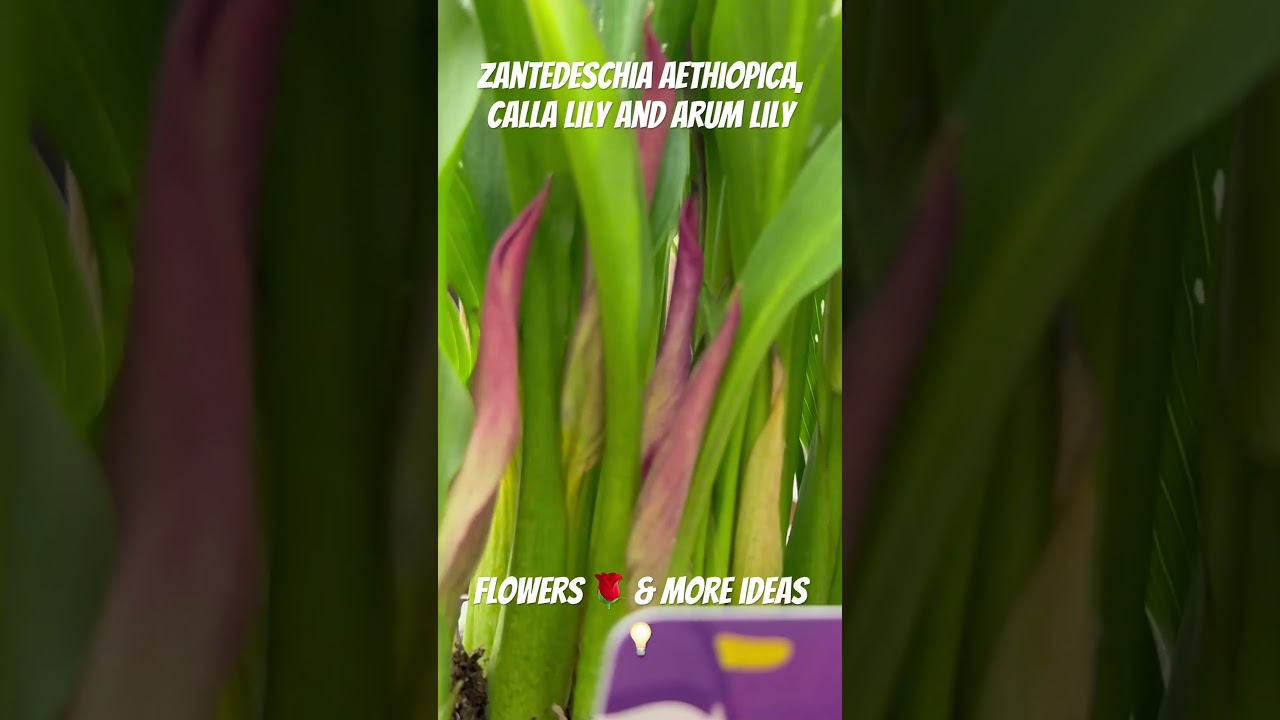
Zantedeschia aethiopica, calla lily and arum lily *Flowers 🌹 & more ideas 💡*
Source: Wikipedia
✍️
Zantedeschia aethiopica, commonly known as calla lily and arum lily, is a species of flowering plant in the family Araceae, native to southern Africa in Lesotho, South Africa, and Eswatini.[2]
Zantedeschia aethiopica
Conservation status
Least Concern (IUCN 3.1)[1]
Scientific classification Edit this classification
Kingdom:
Plantae
Clade:
Tracheophytes
Clade:
Angiosperms
Clade:
Monocots
Order:
Alismatales
Family:
Araceae
Genus:
Zantedeschia
Species:
Z. aethiopica
Binomial name
Zantedeschia aethiopica
(L.) Spreng., 1826
Synonyms
Calla aethiopica L.
Richardia africana Kunth
Richardia aethiopica (L.) Spreng.
Colocasia aethiopica (L.) Spreng. ex Link
Description
✍️
Inflorescence and spathe
Zantedeschia aethiopica is a rhizomatous herbaceous perennial plant, evergreen where rainfall and temperatures are adequate, deciduous where there is a dry season. Its preferred habitat is in or on the banks of streams and ponds. It grows to 0.6–1 m (2.0–3.3 ft) tall, with large clumps of broad, arrow shaped dark green leaves up to 45 cm (18 in) long. The inflorescences are large and are produced in spring, summer and autumn, with a pure white spathe up to 25 cm (9.8 in) and a yellow spadix up to 90 mm (3+1⁄2 in) long.[3] The spadix produces a faint, sweet fragrance.[4]
Zantedeschia aethiopica contains calcium oxalate, and ingestion of the raw plant may cause a severe burning sensation and swelling of lips, tongue, and throat; stomach pain and diarrhea may occur.[5][6]
Distribution and habitat
✍️
Z. aethiopica is native to southern Africa, specifically Lesotho, Mozambique, South Africa, and Eswatini. It has naturalised in Kenya, Madeira, Azores, Malawi, New Zealand, Tanzania, Zambia, coastal California, in western Europe from the Iberian peninsula to Ireland, and Australia, particularly in Western Australia where it has been classified as a toxic weed and pest.[7][8] The majority of invasive populations are located in coastal prairies and wetlands near human settlements.[9] It is also a highly invasive species in riparian zones and pastureland of Western Australia and New Zealand.[9] The cultivar 'Green Goddess' is listed in the New Zealand National Pest Plant Accord, which proscribes its cultivation, sale, and distribution.
The reproduction of Z. aethiopica involves seeds dispersal by birds and vegetative propagation through rhizomes that can spread when soil or garden cuttings are moved.[9]

Информация по комментариям в разработке