#UGC #SupremeCourt #EducationNews #CampusControversy #StudentRights #CasteDebate #HigherEducation #IndiaNews #PolicyUpdate
*UGC’s New Rules: Justice for Some, Discrimination for Others?
*Campus Shock: Why Supreme Court Halted UGC’s 2026 Regulations
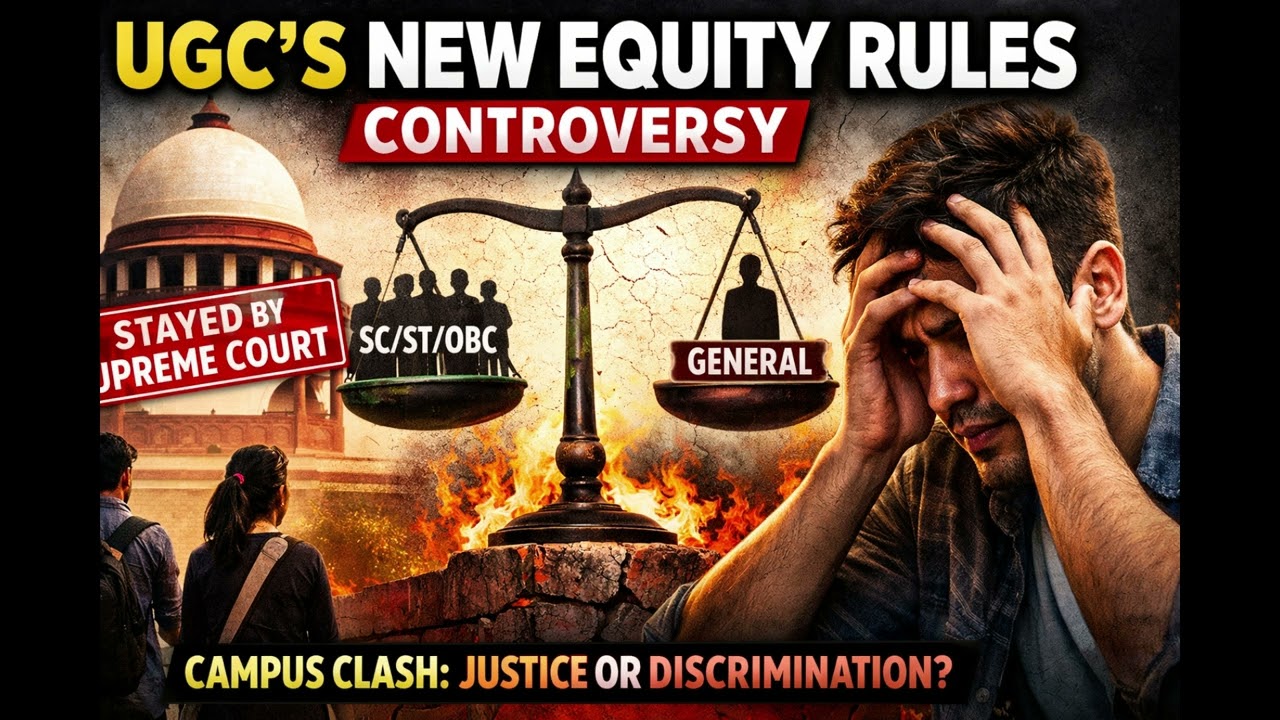
The Supreme Court has stayed UGC’s new 2026 Equity Regulations after nationwide controversy. Are the new rules a strong step against caste discrimination — or do they risk creating fresh divisions on campuses? Full analysis inside the video.
A routine gazette notification from the University Grants Commission rarely makes headlines. But this time, it has triggered a nationwide debate — drawing sharp reactions from students, parents, political leaders, and even the Supreme Court of India.
At the centre of the storm are the University Grants Commission’s 2026 Equity Regulations, notified on January 13. These new rules were meant to strengthen protections against discrimination in higher education institutions. However, instead of bringing clarity and consensus, they have sparked confusion and controversy.
The regulations were framed following a directive from the Supreme Court in September 2025. The court had asked the UGC to strengthen its 2012 anti-discrimination framework while hearing a public interest petition filed by Radhika Vemula and Abeda Salim Tadvi — the mothers of Rohith Vemula and Payal Tadvi.
Both students had died by suicide, allegedly after facing caste-based discrimination. The petition argued that existing safeguards were too weak and demanded a more robust system with real accountability.
Responding to this, the UGC introduced sweeping changes. Under the 2026 regulations, all higher educational institutions must establish Equal Opportunity Centres. These centres will be overseen by Equity Committees, which must include representation from Scheduled Castes, Scheduled Tribes, and Other Backward Classes, along with faculty members, students, and civil society representatives.
The new framework also introduces strict timelines. Complaints must be reviewed within 24 hours. A report must be prepared within 15 days. Institutional heads have just seven days to act. Institutions that fail to comply could even be barred from offering degree programmes.
Additionally, universities are required to set up 24-hour helplines, create “equity squads” to monitor vulnerable areas on campus, and appoint “equity ambassadors” in departments, hostels, and libraries to report violations.
Supporters say these measures finally give teeth to anti-discrimination laws. But critics argue the language of the regulation is vague and potentially exclusionary.
One major point of contention is the removal of a clause from the draft version that would have penalised false complaints. The final notification does not include any such provision, raising fears that the mechanism could be misused.
Another concern is the separate definition of “caste-based discrimination,” which specifically mentions SC, ST, and OBC communities.
Critics argue this creates the impression that only these groups can be victims under the regulation, leaving out students from the general category who may also face discrimination. Some have even described this as opening the door to “reverse discrimination.”
The Supreme Court, while staying the implementation of the 2026 rules until March 19, observed that the drafting could create confusion and unrest among students. The court also questioned why ragging — a widespread form of harassment — was not explicitly covered under the new framework.
For now, the older 2012 regulations remain in force. Unlike the 2026 version, the 2012 rules define discrimination more broadly but lack strict enforcement timelines.
As the matter returns to the Supreme Court, the larger question remains: How can India build a campus environment that strongly protects the marginalised while ensuring fairness and due process for all?
The answer may shape the future of equity and inclusion in Indian higher education.

Информация по комментариям в разработке