Donations are welcome. I am putting every dime to getting to Antarctica and show you whats there. Here is the link to Donate. =) Thanks.
https://donorbox.org/eric-clark-s-tra...
Il Porcellino (Italian "piglet") is the local Florentine nickname for the bronze fountain of a boar. The fountain figure was sculpted and cast by Baroque master Pietro Tacca (1577–1640) shortly before 1634,[1] following a marble Italian copy of a Hellenistic marble original, at the time in the Grand Ducal collections and today on display in the classical section of the Uffizi Museum. The original, which was found in Rome and removed to Florence in the mid-16th century by the Medici, was associated from the time of its rediscovery with the Calydonian Boar of Greek myth.[2]
Tacca's bronze, which has eclipsed the Roman marble that served as model,[3] was originally intended for the Boboli Garden, then moved to the Mercato Nuovo in Florence, Italy; the fountain was placed originally facing east, in via Calimala, in front of the pharmacy that by association gained the name Farmacia del Cinghiale (Italian for "boar"). To gain more space for market traffic it was later moved to the side facing south, where it still stands as one of the most popular features for tourists. The present statue is a modern copy, cast in 1998 by Ferdinando Marinelli Artistic Foundry and replaced in 2008, while Tacca's bronze is sheltered in the new Museo Stefano Bardini in Palazzo Mozzi.[4]
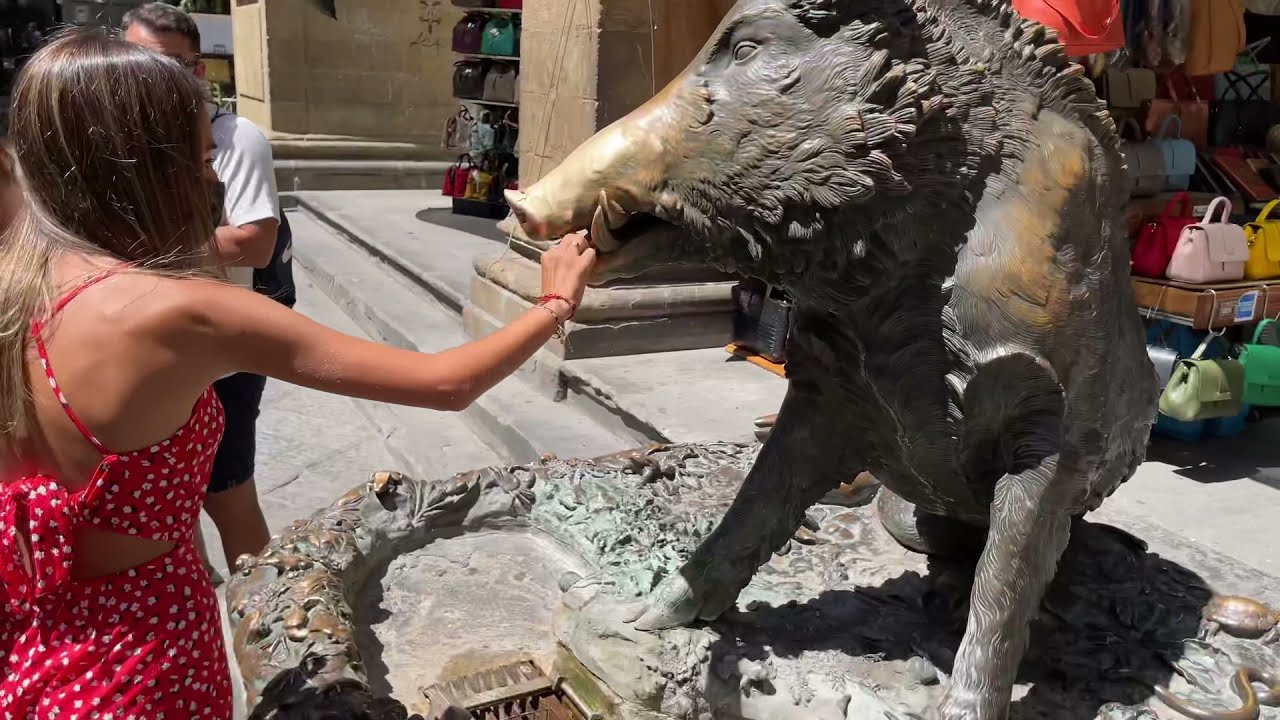
Visitors to Il Porcellino put a coin into the boar's gaping jaws, with the intent to let it fall through the underlying grating for good luck, and they rub the boar's snout to ensure a return to Florence, a tradition that the Scottish literary traveller Tobias Smollett already noted in 1766,[5] which has kept the snout in a state of polished sheen while the rest of the boar's body has patinated to a dull brownish-green.[citation needed]
Ask any Florentine where “Il Porcellino” is and they’ll reply without hesitation: “in Piazza del Mercato Nuovo”. And they are right of course, the bronze boar stands a short distance from Piazza della Signoria and the Ponte Vecchio, a curious tourist attraction that everyone likes to stroke!
The poor boar’s nose is worn out from all the patting by people wanting to cash in on the statue’s luck. But what’s it really all about?
The good luck ritual (the real ritual!)
Tradition has it that it’s good luck to touch the statue’s nose, so every day hundreds of people give the boar a stroke hopeful that some of the good fortune will brush off on them. But hardly anyone knows the full ritual: while rubbing the nose with one hand you should hold a coin in the animal’s open mouth and let it drop there. If the coin falls through the grating, it’s good luck “guaranteed”. If not, you should try again.
The statue’s history
Like many other famous pieces of art scattered around Florence, the statue is actually a copy. The original is found in the rooms of the Bardini Museum, a bronze fountain made in the first half of the 1600s by a pupil of Giambologna Pietro Tacca, a commission of Cosimo II de’ Medici.
Although we all call it “Il Porcellino”, the fountain is actually a wild boar (look closely and you’ll agree!) and it was placed in that spot for practical reasons. The loggias of Piazza del Mercato Nuovo were a marketplace for bartering and trading among fine cloth merchants and they needed the water to wash themselves and to drink.
Fun fact
“Il Porcellino” is famous all over the world. In fact, copies of the statues are dotted around the globe, such as in the gardens of Belgium’s Enghien Castle and in Place Richelme in Aix-en-Provence, France. Munich boasts two copies!
There’s even a reproduction in Sydney, Australia, opposite the hospital. It was donated by Florentine noblewoman Marchesa Fiaschi Torrigiani, who pledged the statue to the hospital in 1968 in memory of Piero Fiaschi, an Italian doctor working in Australia. Sydneysiders also believe that stroking the boar’s nose brings good luck, just like the real statue, and their ritual brings tangible benefits: the coins go to the hospital.

Информация по комментариям в разработке