Prehistoric Survival: How Ancestors Mastered Fishing Evolution
The wind off the glacial meltwater doesn’t just chill the skin; it bites deep into the marrow, a constant reminder that in the Prehistoric era, comfort is a myth and Survival is a full-time occupation. You stand at the edge of a nameless river, your toes sinking into the freezing silt. You are not a king, nor a conqueror. You are a gatherer, a hunter, and today, you are a fisherman. But you have no rod, no reel, and no steel hooks. All you have is the collective memory of your lineage, a sharpened stick, and a hunger that has gnawed at your belly since the last moon.
To an untrained eye, the river is just moving glass. To you, it is a complex map of ripples, shadows, and temperature gradients. This is the story of how our Ancestors conquered the waters, not with technology, but with a terrifyingly patient understanding of the natural world.
The Lunging Strike: The Spear
Before the invention of the net, there was the lunging strike. You grip a shaft of fire-hardened blackthorn. You find a rock that breaks the flow, creating a pocket of still water where a heavy trout might rest. You understand something fundamental about the world: refraction. You know that where the fish appears to be is a lie told by the water. To hit the heart, you must aim beneath the shimmering image, striking at the phantom that exists only in the logic of the deep. With a speed born of desperation, you thrust. The splash is violent. You pin the creature to the riverbed—the first spark of a caloric fire that will keep your family alive.
The Birth of Engineering: The Weir
But a single Spear strike is a gamble. To feed a clan, you need more than luck; you need a trap. As the seasons shift, your tribe moves from the spear to the Weir. This is the birth of engineering. You spend days hauling heavy river stones, piling them into a V-shaped wall. This isn't just a pile of rocks; it’s an architectural feat of hydrological manipulation. The weir funnels the fish into a narrow "killing zone." You weave baskets from flexible willow branches. By dawn, the traps are heavy, pulsing with life. This allowed the tribe to stop wandering, dry the meat, and store the calories needed to survive the looming winter.
Hand Fishing and The Spirit of Nature
The sensory world of the prehistoric fisherman was one of intense proximity. In the muddy bends of the river, our ancestors practiced what we now call noodling. It is a terrifying dance. You reach your arm into a dark, underwater hole, inviting the creature to bite you. When the jaws clamp down, you haul the beast into the air. This intimacy with the prey created a spiritual bond, a belief that the fish was a gift from Nature, requiring a ritual of thanks.
The Gorge and The Hook
As the millennia crawled by, the tools became more sophisticated. You sit by the fire, holding a small sliver of bone, sharpened at both ends—a gorge. You embed the bone inside a chunk of fatty meat. When a predatory fish swallows it, the gorge flips sideways, anchoring itself. Later, this evolved into the "J" shape—the first true fishhook. These artifacts are evidence of a mind capable of abstract thought, bridging the gap between the visible world of the shore and the invisible world of the depths.
The Net: Catching the Future
The invention of cordage changed everything. Before nets, the river was an adversary; with nets, it became a pantry. Imagine the labor required to twist fiber into a mesh. This was communal work. When the Net was cast, it wasn't just catching fish; it was catching the future. The ability to harvest in high volumes led to the first permanent settlements. We settled down because the river provided a reliable source of protein.
Fire Fishing: The Night Harvest
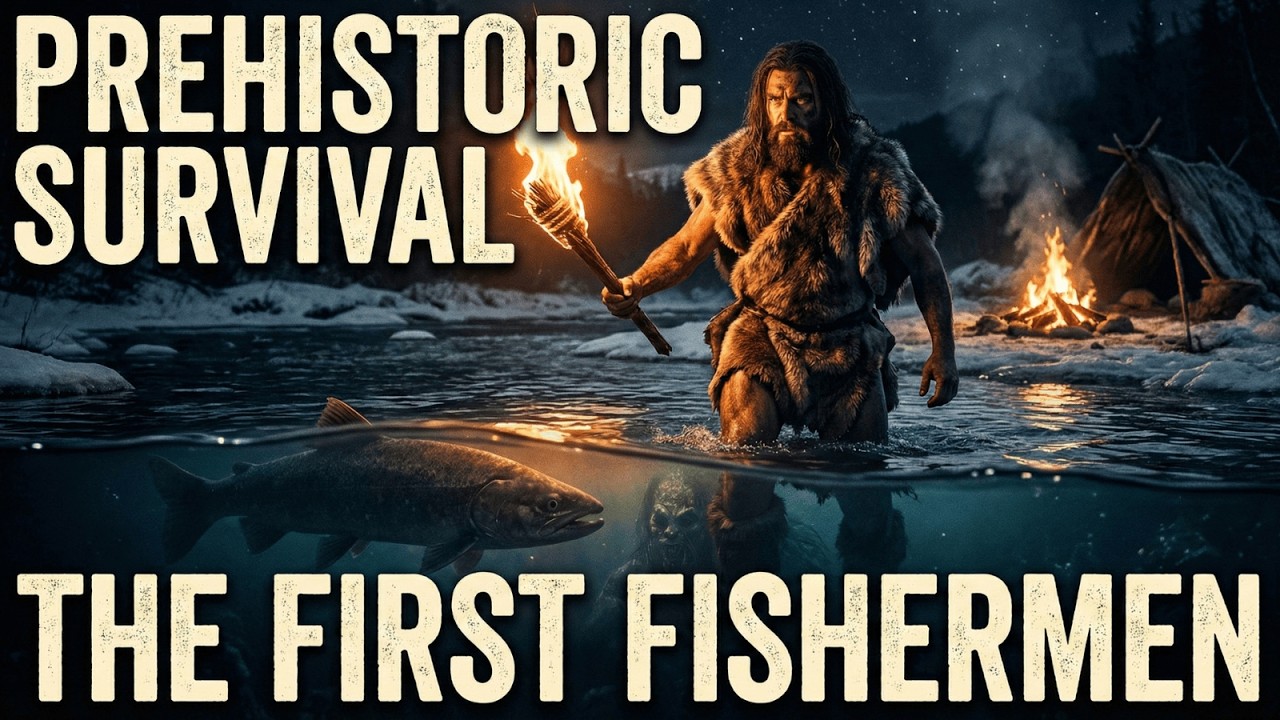
When the sun disappears, Fishing takes on a supernatural quality. You tie bundles of pine to make torches. As you wade into the shallows, the orange glow paralyzes the fish. In this flickering light, the shadows of your kin move like ghosts. It is a high-stakes game; if the torch goes out, you are blind in a landscape of predators. But the reward is a bounty that ensures the children will live to see another spring.
The Cognitive Revolution
The Evolution of these methods reflects the evolution of our brains—from the raw physical power of the spear to the calculated engineering of the weir. We became part of the river's ecology, as much a predator as the heron. We learned to preserve the catch, smoking it over low fires. This surplus was the foundation of trade. The humble fish became the currency of a growing civilization.
The Paleolithic world was not a place of mindless brutality; it was a world of profound connection. To catch a fish was to touch the pulse of the planet. Our ancestors' success allowed us the luxury of time—time to think, create art, and wonder about the stars.
#Prehistoric #SurvivalSkills #FishingHistory #AncientWisdom #HumanEvolution















Информация по комментариям в разработке