Tools (Recommended):
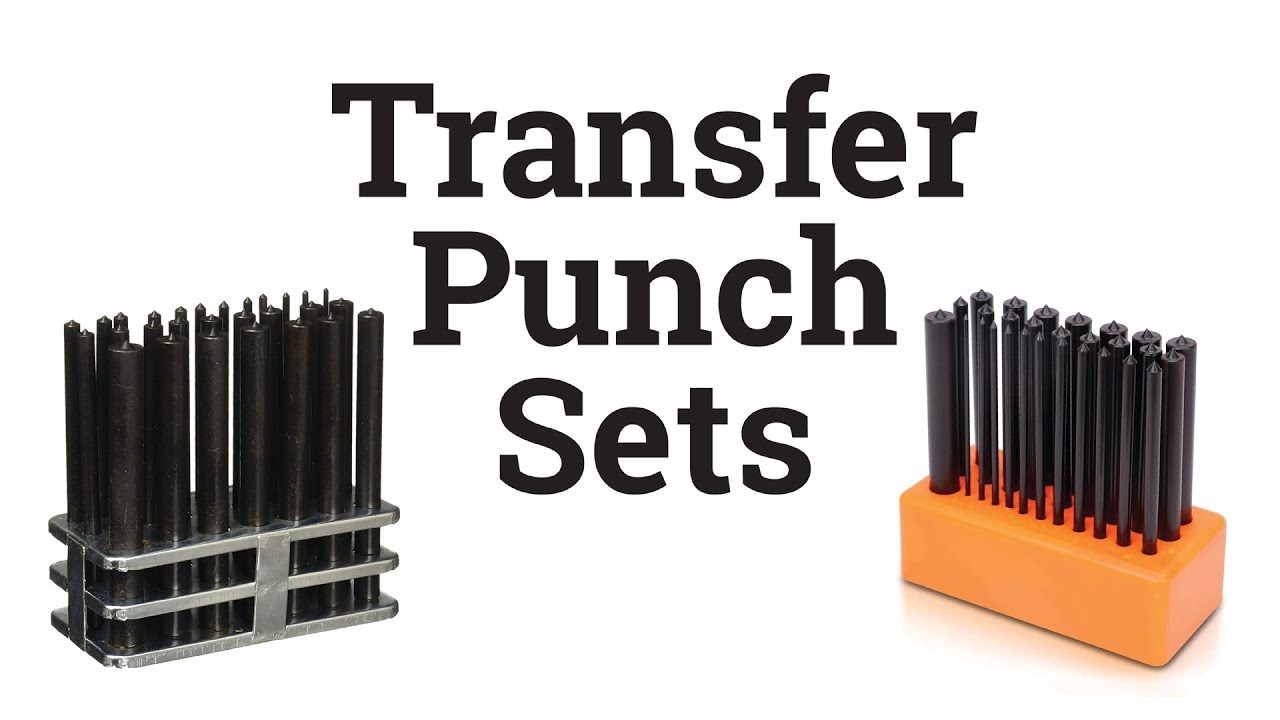
HHIP 8600-0041 28 Piece Transfer Punch Set, 3/32" - 1/2”
http://www.amazon.com/exec/obidos/ASI...
Grizzly G5655 25-Piece Transfer Punch Set, Metric
http://www.amazon.com/exec/obidos/ASI...
Tools (Other):
HORUSDY 28-Piece Transfer Punch Set, 3/32" - 1/2”
http://www.amazon.com/exec/obidos/ASI...
Transcript:
Transcript: Hi, I'm Sean Michael Ragan, and this is Cool Tools. I realize I've been on something of a punch kick lately. Punch drunk, maybe? I covered optical punches back in January, then spring punches just two weeks ago, and today, we're gonna be talking about these: transfer punches! So, to those of you who are sick of hearing about punches, I'm sorry, and I promise this will be the last punch-related video, maybe not for all time, but at least for a good long while. Or you can, I dunno, punch me. Anyway, as I've mentioned before, I make a lot of parts out of flat stock, whether its metal, wood, plastic, or whatever, and my favorite trick for doing that is to design the profile in a drawing program, print it out at 1:1 scale, then stick the paper to the raw stock and use it is a template to cut the part. Even if I'm just copying a part, rather than designing a whole new one, I'll often use this trick because I can slap the part on a flatbed scanner then trace a fairly accurate vector profile by dropping the scan into the bottom layer in my drawing software. The reason I do it that way instead of just tracing around the part directly onto the stock, is that it allows me to precisely locate the centers of the holes for drilling by zooming in very close on my monitor, which is much easier than trying to freehand it. Unless you have a transfer punch, which is designed to do exactly this. Here I'm cutting a metal backplate out of a scrap of heavy gauge aluminum sheet for this door foot pull so I can install it on a wooden screen door without worrying that the fasteners are going to pull out or through the door if somebody steps on it too hard. I'm just gonna use a bit of carpet tape to stick the master part to the stock, then I'll take my transfer punch, which has the same diameter as this hole with a small, sharp point in the center. Set it on an anvil, and go bop, bop, bop. While the parts are still stuck together, I'll trace the outer profile with a scribe, then drill three holes, cut to shape, and there it is, perfect hole alignment. Now, these holes just happen to be 15/64", but obviously for general use you need a whole set of transfer punches. Here's one I got off Amazon that includes 28 punches that go from 3/32" to 1/2" by 1/64" increments. Actually, it covers that range by 64ths and then adds one more larger punch that's 17/32" in diameter, so the last step up in size is by 1/32" rather than 1/64". Anyway, here's another set I got off Amazon for two dollars more that seems to be identical in every way except for the case. I usually prefer metal cases to plastic so I bought 'em both to see if this case was enough better to justify spending the extra money, and it definitely is. I've never had a plastic tool case that held up very well over the long haul, and though a metal case can of course be broken as well, I find metal cases a lot easier to repair than plastic cases if they do break. I also prefer the layout of the punches in the metal case. Here you can see they've actually put the biggest punch down here by the smallest punch, I guess to save space? But that's pretty irritating if you're a bit OCD, like I am. Also, if you look closely you'll see that the punches in the metal case are laid out boustrophedon, which is a 50-cent word describing this zig-zag back and forth order between rows, which is how a lot of ancient writing was done. Most modern writing of course goes left to right on each row, which is how these punches in the plastic case are arranged. I find the zig-zag layout both more elegant and more intuitive for this purpose since, whatever punch you may be working with at the moment, the next biggest and the next-smallest sizes are always immediately adjacent. It's worth noting that outer diameters of these and other transfer punches are actually very slightly undersized, typically with about a thousandth of an inch clearance all the way around, so that they'll fit very closely into an on-size hole but not bind in it. If you do a lot of really fussy work, you're gonna want a set of metric punches as well, and for some reason those are a lot less common on Amazon, though I did eventually find a comparable model distributed in the US by Grizzly which you'll also find linked down below. OK, thank you for watching. As always, there are affiliate links in the description field down below this video; if you've seen something here you like, please do check those links out, as well as our blog and our podcast.








Информация по комментариям в разработке