Climate Impacts of Aviation and Pathways for Mitigation.
The imperative to address climate change has reached a critical juncture, underscored by the global target of limiting the Earth’s temperature increase to 2°C above pre-industrial levels, widely regarded as the upper, potentially irreversible threshold, while striving to remain below 1.5°C. However, this more stringent target was already breached in 2024, underscoring the urgent need for immediate and effective mitigation efforts across all sectors, including aviation. The aviation industry contributes to climate change not only through CO₂ emissions but also through other non-CO₂ effects, such as contrails and ozone formation. Pathways toward mitigating aviation-induced climate impacts include improving operational efficiency, supportive policy and regulatory frameworks, large-scale adoption of sustainable aviation fuels (SAF), and the development of zero-emission aircraft powered by advanced propulsion technologies, such as electric and hydrogen-based systems (combustion or fuel-cell). Yet the maturity, scalability, and availability of these measures vary considerably. For example, SAF currently accounts for only around 0.5% of total jet fuel consumption, while hydrogen-powered aircraft remain a medium- to long-term solution requiring major technological and infrastructural readiness.
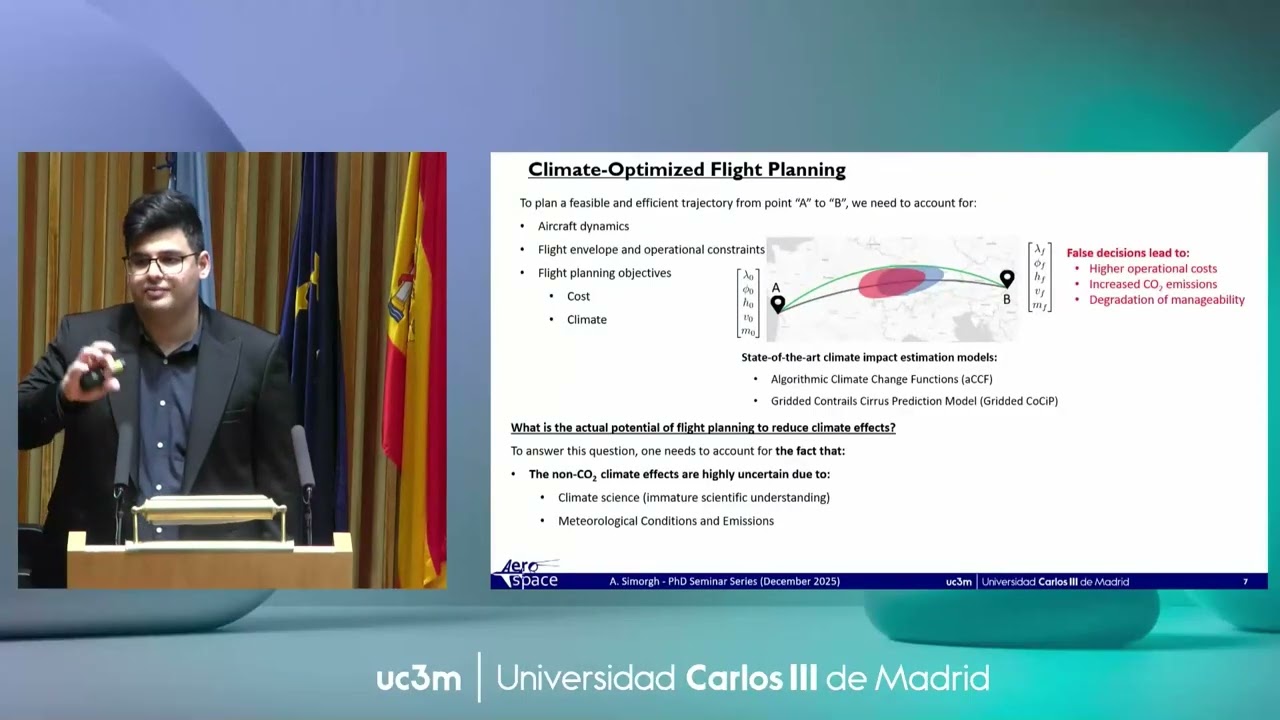
In this talk, I will first discuss operational measures, particularly climate-informed flight planning, as one of the most immediate measures to mitigate the non-CO2 climate impacts of aviation, which account for two-thirds of aviation’s effective radiative forcing. In fact, these non-CO2 effects depend strongly on atmospheric conditions at the time and location of emissions, thus offering opportunities for mitigation through climate-aware flight planning. However, identifying climate-sensitive areas for incorporation into flight planning tools to generate climate-friendly trajectories is complex and associated with significant uncertainty. Such uncertainty, if not accounted for a priori within flight planning, can lead to inefficient flight trajectories. In my PhD research, we made a pioneering effort in identifying relevant sources of uncertainty in quantifying climate effects and developing state-of-the-art robust 4D flight planning approaches to generate climate-optimized trajectories with an enhanced level of confidence.
The international climate goals (e.g., EU Green Deal and ICAO’s goal of achieving net-zero carbon emissions by 2050) cannot be achieved with a single mitigation measure (e.g., climate-aware flight planning) and require informed, evidence-based decisions on the deployment of emerging technologies, the evolution of fuel supply chains, and the design of regulatory instruments. A comprehensive pre-implementation assessment is therefore essential to evaluate not only the scale of potential climate/environmental benefits but also to anticipate the operational implications of integrating next-generation fleets, which introduce new performance characteristics, infrastructure requirements, and regulatory adaptations that will reshape air traffic operations. However, the current state of the literature and scientific understanding remains insufficient to support such analysis. Critical gaps exist in the detailed performance characterization of next-generation aircraft (e.g., SAF-powered and H2-powered aircraft), emissions and their associated climate impacts, and system-level evaluations of how mixed fleets, combining new aircraft types, can operate seamlessly within the air transport system. In the second part of my presentation, I will focus on my current work, which aims to identify the challenges and opportunities associated with next-generation aircraft and their integration into network operations based on innovative, science- and evidence-based solutions aligned with Europe’s target of achieving climate neutrality by 2050.

Информация по комментариям в разработке