Clark’s nutcracker seed harvesting habitat use in Yellowstone National Park: A hierarchical distance sampling approach
Thomas McLaren
Speaker Bio:
Tommy McLaren graduated with his Bachelors of Science degree in Fish and Wildlife Management from Montana State University in 2013. Since then his work has taken him across the western United States , to areas including Arizona, Colorado, Wyoming, and Oregon. During that time, his work has focused on the intersection of conservation and research, as it relates to conifer forests, sagebrush and grassland ecosystems. Specifically, Tommy has had the chance to work in several national parks and monuments, such as Saguaro, Yellowstone and Grand Teton as a seasonal biological technician. During that time, he was involved in projects including sagebrush restoration, native plant community monitoring, mountain red fox tracking, and nesting raptor surveys. Additionally, Tommy spent time working with avian conservation groups including Teton Raptor Center and Bird Conservancy of the Rockies performing monitoring and research field work. Recently, Tommy graduated with his Masters of Science degree from the University of Colorado Denver while working working in the Tomback Forest Ecology Lab and he has just recently started a new position working as a biologist with the Klamath Bird Observatory in Ashland, Oregon.
Tommy’s research interests involve understanding wildlife-habitat relationships, particularly in relation to variable food resources and leveraging statistical models to more fully understand the process by which ecological data are generated.
In his free time, Tommy enjoys rock climbing, birding and generally wandering in the woods. In particular, he enjoys hiking in the mountains and looks forward to exploring Oregon and the region around Ashland.
Abstract:
Clark’s nutcrackers (Nucifraga columbiana) contribute to conifer forest regeneration in western North America by harvesting and caching seeds from many conifer species. The seeds of whitebark pine (Pinus albicaulis) are a particularly important resource to nutcrackers in many western ecosystems, but additional conifer seed resources are frequently used depending on local availability. Variability in annual cone production, causes fluctuations in nutcracker seed resource availability. These fluctuations may necessitate the use of multiple conifer seed resources, particularly in years of low annual cone production. In this study, we investigated how nutcrackers use conifer forest community types within Yellowstone National Park to determine all potential seed resources.
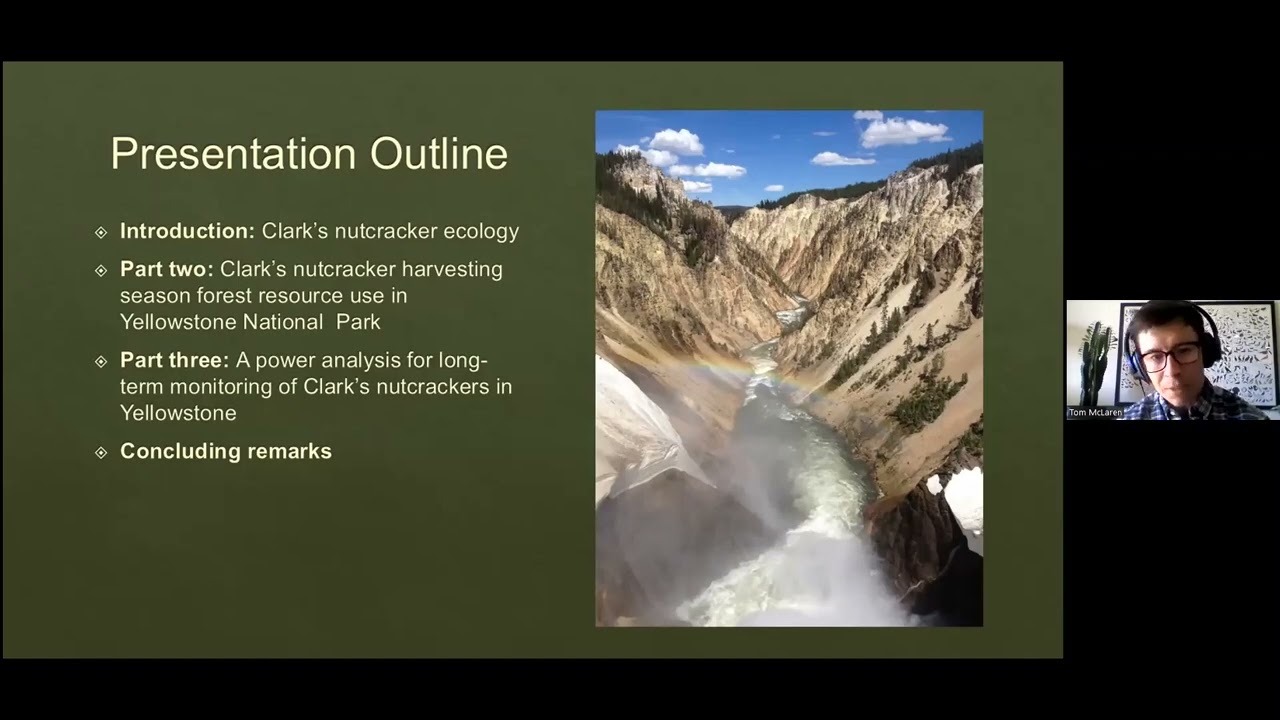
In 2019 and 2020, we established eleven transects in five different forest community types including whitebark pine, lodgepole pine, Engelmann spruce, limber pine and Douglas-fir. Each transect consisted of five point-count stations, and used distance sampling methods, conifer cone production indices, and behavioral observations to determine habitat and seed resource use. Data were collected between 2019 and 2021. Using annual cone production indices collected at our study sites, we analyzed how cone production varies between conifer species and across years. To determine which forest community types in the park are used by nutcrackers during the harvesting season and how variation in cone energy availability influences their use within and across years, we applied a hierarchical approach to habitat use modeling using distance observations to estimate nutcracker detectability. We compared models for nutcracker abundance containing variables for: forest community type, seed harvesting time period, year and cone energy index. In addition to producing a model of nutcracker habitat use, we are conducting a statistical analysis of the existing study design to determine its ability to detect a decline in the nutcracker population over time.
We found that cone crops were generally larger at our study sites in 2020 and 2021 compared to 2019, supporting annual variability in conifer cone production. Our analysis suggested conifer stem density impacted bird detection, indicating that nutcrackers were less detectable in densely forested areas. We found that overall, nutcracker density was best predicted by forest community type and survey time period. Nutcracker density was highest in whitebark pine stands during mid-harvesting season, supporting the importance of the mutualism between the two species and was comparably low for all other forest community types. These results, along with behavioral observations collected during our point count surveys support the importance of white pines, and whitebark pine in particular, as seed resources for Clark’s nutcracker. Results of our power analysis for long term nutcracker monitoring will provide the park with important planning information in light of the continued threats to whitebark pine within the Greater Yellowstone Ecosystem.

Информация по комментариям в разработке