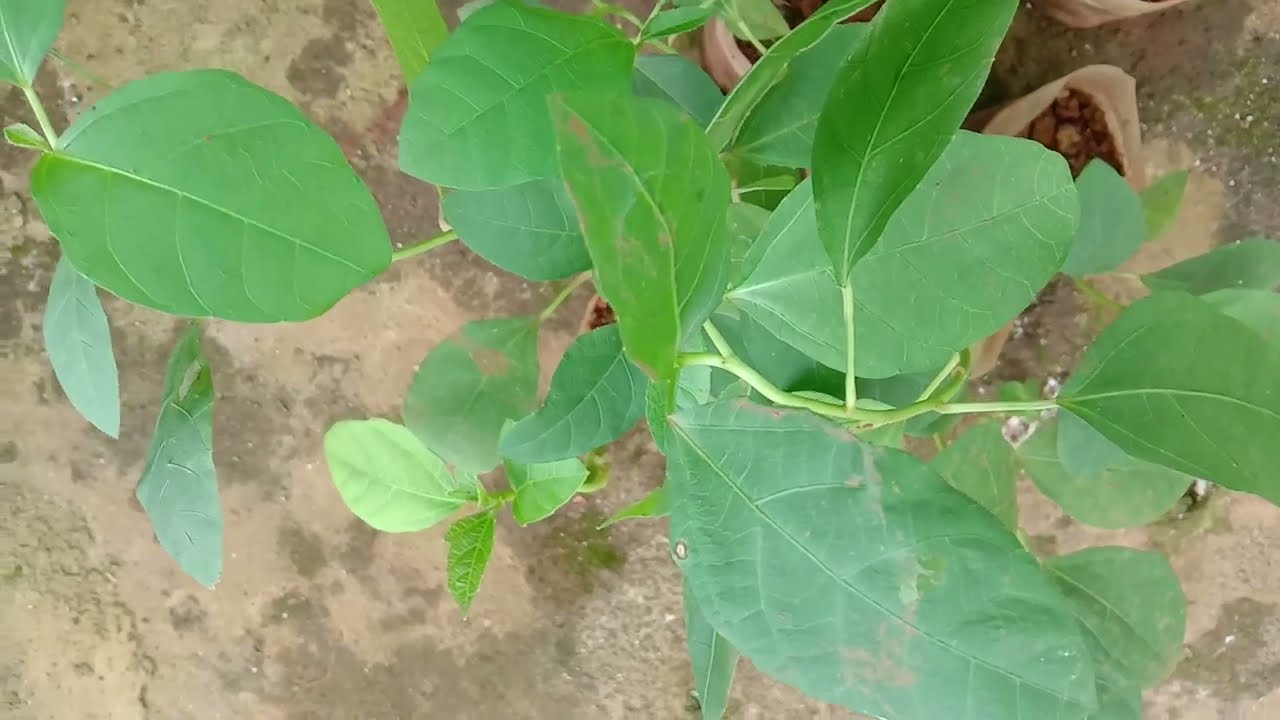
Baliospermum montanum, a Medicinal plant (Sanskrit : हस्तिदंती Hastidanti), commonly known as Red physic nut, Wild castor, Wild croton and Wild sultan seed, Danti, Naga Danti, നാഗദന്തി, saplings.
Therapeutic uses
The roots and leaves of Baliospermum are cathartic, pungent, thermogenic, purgative, anthelmintic, and diuretic.
The roots are used in dropsy, anascara, and jaundice.
Decoction of leaves is used for treating asthma. Seeds are purgative, used externally as stimulant, and are rubifacient. The oil from the seeds is hydrogogue, cathartic, and used for external application in rheumatism.
Morphological characteristics
The plant is a stout, monoecious undershrub up to 3.5 m high, with toothed leaves and stiff branches arising from the root.
The upper branches bear small, lanceolate leaves, while the lower branches have large, and often broad, ovate, three- to five-lobed leaves with rounded base.
Petioles are 5–15 cm long.
Floral characteristics
The flowers of the plant are unisexual.
In male flowers, the calyx is globose, 2.5 mm long, four to five partite, glabrous or slightly pubescent, membranous, finely mottled with a disc of six glands. Stamens are about 20 in number.
Female flowers have ovate-lanceolate and pubescent sepals, and a disc about 2.5 mm in diameter.
Fruit is a three-lobed capsule, about 8–13 mm long and usually hairy. Seeds are mottled, smooth, and have oily endosperm.
Flowers appear during January–February, while fruits mature a month later.
Distribution
The species is distributed throughout tropical and subtropical areas receiving rainfall above 1000 mm, that is, in Himalayan foothills, Kashmir to Khasi hills, and particularly in Vindhyas southward.
It is very common in North and East Bengal, Chhota Nagpur, and peninsular India.
Climate and soil
Danti prefers humid climate for better growth.
Well-drained sandy loam soils with pH normally ranging from 6.5 to 7.5 are good for its cultivation. But it can also grow in soils with pH up to 8.2.
This is a shade loving plant but can be grown in open sun when cultivated. Low rainfall areas are not conducive for its growth.
Propagation material
Danti can be easily propagated by seeds and terminal cuttings.
The best season for seed collection is from February to April.
The seeds are collected when the outer tri-lobed covering around fruits starts turning brown and dry.
Информация по комментариям в разработке