What happens when a simple flight change turns into a two-hour call plus an on-the-wrong-plane fiasco?
In this video, you’ll hear firsthand how exhausting it can be for Deaf customers to navigate chatbots, wait on relay services, and rely on third party interpreters. Endless loops. Long holds. Even booking errors. All for something that should be simple.
That experience sparked a better solution.
360 Direct Access is a sign language contact center built to close the gap between companies and the Deaf community. With one line of code, our WebRTC video widget connects Deaf customers directly to Deaf representatives in their primary language.
No relay delays.
No interpreter misunderstandings.
No code switching.
Companies like LG Electronics and Fulton Bank are already embedding this directly into their customer experience.
This is about being understood. About equitable service. About combining technology with human connection.
The future of customer experience is direct, visual, and human. Learn more at 360directaccess.com.
--
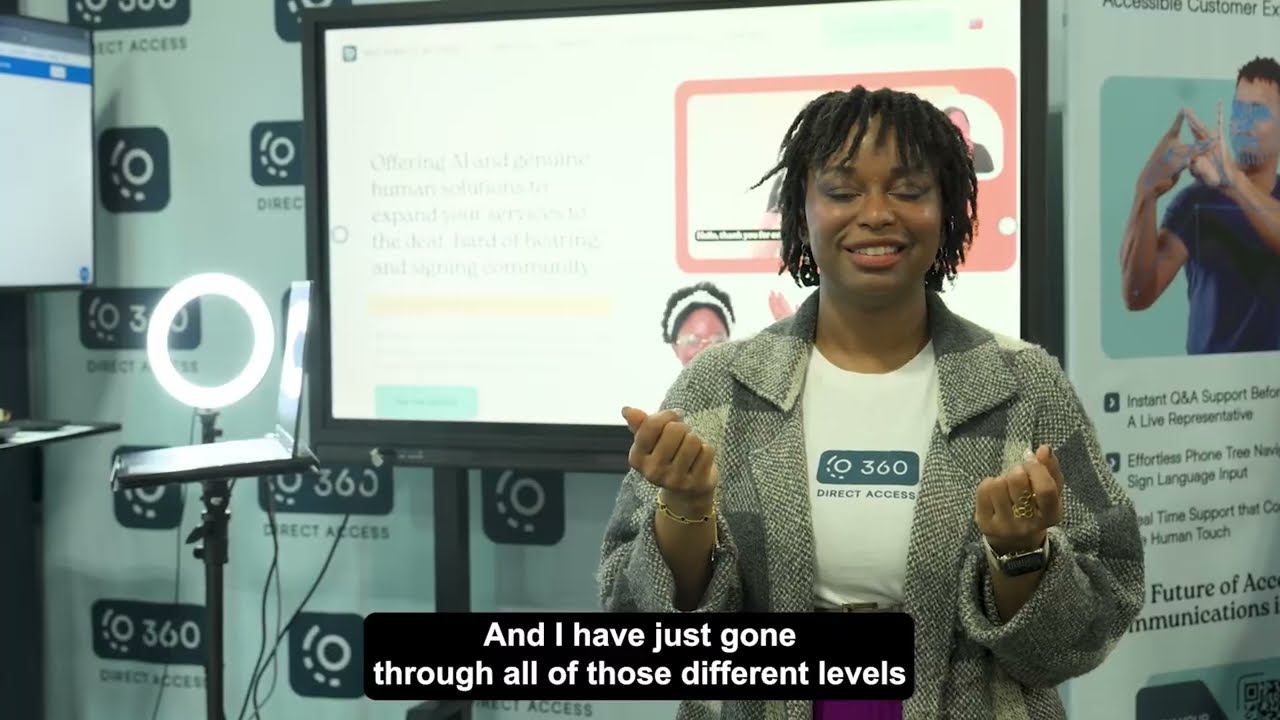
VD: A compilation of video clips showing the 360 Direct Access booth at the CES 2026 conference that contains several interviews, engaging with booth visitors, and showcasing the new AI sign language recognition software and avatar.
Transcript: I’m someone who has often worked with airlines and with retail companies, negotiating and trying to resolve issues. I’ve gone through all the different levels of solutions just to try to get the answer I need through chat, but it keeps asking questions. It says, “Sorry, do you want a refund?” or “There’s no refund opportunity available.” It goes round and round, and that can be very exhausting. Then you try to transfer to a live agent, and that takes five to ten minutes. 360 Direct Access is a contact center solution for sign language. We work with large companies that have a gap between their organization and the Deaf community. This enables Deaf individuals to receive equitable service. It all started when I was in an airport. I was in a very busy airport trying to change my flight. When I connected with a video relay service interpreter, it took 45 minutes to connect. Then I waited another 45 minutes to reach the airline representative. The interpreter made a mistake, and I was booked on the wrong flight. That left me thinking, there has to be a better way. Often, when I make a phone call through an interpreter, I have to code switch my signing and repeat myself far too many times. As kind as interpreters are, and I truly appreciate them, they do not always understand what I am saying. For the Deaf community, we cherish being understood. We want to be understood. The barriers and lack of accessibility are two major challenges. There is also the attitude that we are not capable, when in fact we are. One of the biggest challenges is helping people realize that we are humans first. We have developed a WebRTC video solution that includes a widget requiring only one line of code, which can be placed on any website. For example, we work with LG Electronics. A Deaf individual visiting their website can click the widget, open a video window, and communicate directly with a Deaf representative without going through a third party interpreter. This service allows us to be seen, to be heard, and to resolve issues quickly and efficiently. Many people think English chat is the solution, but English is a second language for most of the Deaf community. ASL is not a visual form of English. They are two separate languages. We can do anything. The challenge is having the right access to technology to get things done. This solution increases accessibility. It will not only benefit the Deaf community, but it has the potential to revolutionize the industry through empowerment and meaningful impact. We are not just building accessibility tools. We are creating jobs, which is critical in a world where AI is causing layoffs. There can feel like a disconnect between where technology is heading and human needs, but we are offering human based solutions that collaborate with our community and center the visual experience. This is not just for the Deaf community. It benefits everyone. People need human connection, and this platform provides it. We now have the technology to create equitable experiences that disrupt the communication industry. The future is coming. The future is here.










Информация по комментариям в разработке