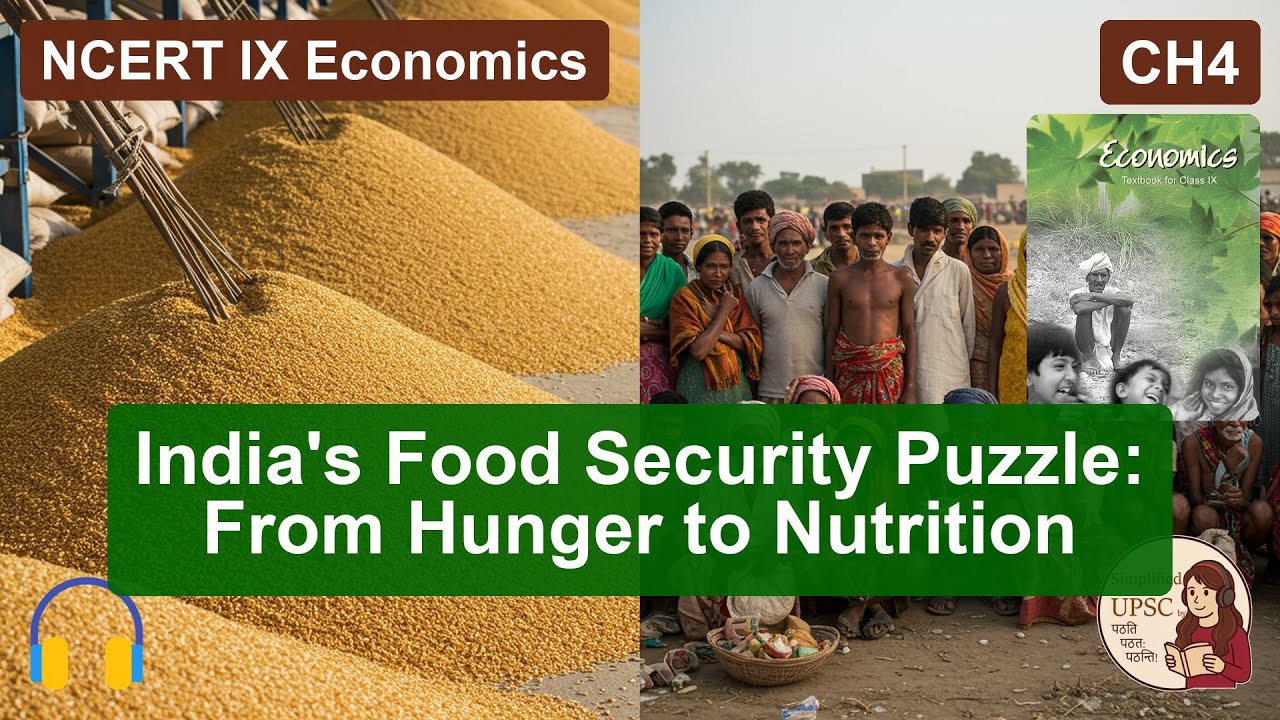
Welcome to Simplified UPSC by पठति पठत: पठन्ति! In this comprehensive discussion, we'll decode the profound paradox of hunger in India: Why does starvation persist even with mountains of grain in government warehouses?
This lecture covers NCERT Class 9 Economics, Chapter 4: Food Security in India (भारत में खाद्य सुरक्षा). We explore this topic not just academically, but through the lens of policy, administration, and UPSC GS Paper 3 analysis.
We analyze the three critical pillars of food security—Availability, Accessibility, and Affordability—and how they fail during calamities like the 1943 Bengal Famine. We detail the social groups most vulnerable to chronic and seasonal hunger. The core of India’s policy response—the Buffer Stock system (managed by FCI via MSP) and the vast Public Distribution System (PDS)—is examined, alongside crucial debates surrounding MSP's environmental impact (the 'Golden Handcuff' analogy) and the massive economic cost and leakage within the PDS. Finally, we explore decentralized solutions, like the cooperative model (Amul), and the shift towards achieving Nutritional Security, moving beyond mere calorie intake.
Join our Community for free detailed notes, PYQs, and early access to videos: https://t.me/simplifiedupscbyppp
If you found this discussion valuable, please Like, Share, and Subscribe to Simplified UPSC!
📝 SUMMARY 📝
This expert lecture decodes the paradox of food security in India using NCERT Class 9, Chapter 4. It defines the three pillars (Availability, Accessibility, Affordability) and analyzes vulnerability factors and types of hunger. The core discussion focuses on India's primary interventions: the Buffer Stock system (FCI/MSP) and the Public Distribution System (PDS), tracing its evolution from universal to targeted coverage (NFSA 2013). The lecture critically examines major policy challenges, including the distortionary effects of MSP, the massive economic cost of subsidies, and widespread corruption and leakage (ghost beneficiaries) in the PDS. Finally, it highlights successful cooperative models (Amul, Grain Banks) and emphasizes the necessary policy shift from mere food security to holistic nutritional security, urging aspirants to think critically about these complex administrative and environmental challenges.
⏰ TIMESTAMPS ⏰
00:00 - Introduction & UPSC Relevance
01:44 - Decoding the Paradox: What is Food Security?
02:04 - The Three Pillars: Availability, Accessibility, and Affordability
02:59 - Food Security during Calamities & The Famine of 1943
03:47 - Who are the Food Insecure? Social Dimensions of Vulnerability
04:29 - Chronic Hunger vs. Seasonal Hunger
05:43 - Components of India’s Food Security System
05:51 - Buffer Stock and Minimum Support Price (MSP)
06:21 - The MSP Policy Dilemma and Environmental Impact
07:53 - Public Distribution System (PDS)
08:27 - Evolution of PDS: Universal, Targeted, and NFSA 2013
09:44 - The Paradox of Surpluses: Challenges in PDS
10:02 - Leakage, Corruption, and Ghost Beneficiaries
10:28 - The Massive Economic Cost of Food Grains (Subsidy Burden)
11:05 - The Alternative: Role of Cooperative Societies (Amul Model)
12:35 - Conclusion: From Food Security to Nutritional Security
#UPSC #NCERT #Economics #FoodSecurity #PDS #MSP #GS3 #IAS #UPSCPreparation #CivilServices #SimplifiedUPSC #IndiaEconomy #FoodPolicy #BufferStock #FCI #NutritionalSecurity #NFSA #TargetedPDS #Poverty #DevelopmentStudies #Class9Economics #BengalFamine #EconomicCost #Subsidies #Leakage #Corruption #AAY #TPDS #FoodGrains #SocialJustice #Vulnerability #SeasonalHunger #ChronicHunger #Amul #CooperativeModel #FoodSecurityAct #PolicyDilemma #FoodDistribution #AgriculturePolicy #IndiaFamine #Affordability #Accessibility #Availability #GovernmentSchemes #RuralDevelopment #ExamPrep #IAS2024 #IPS #Hindi #Educational

Информация по комментариям в разработке