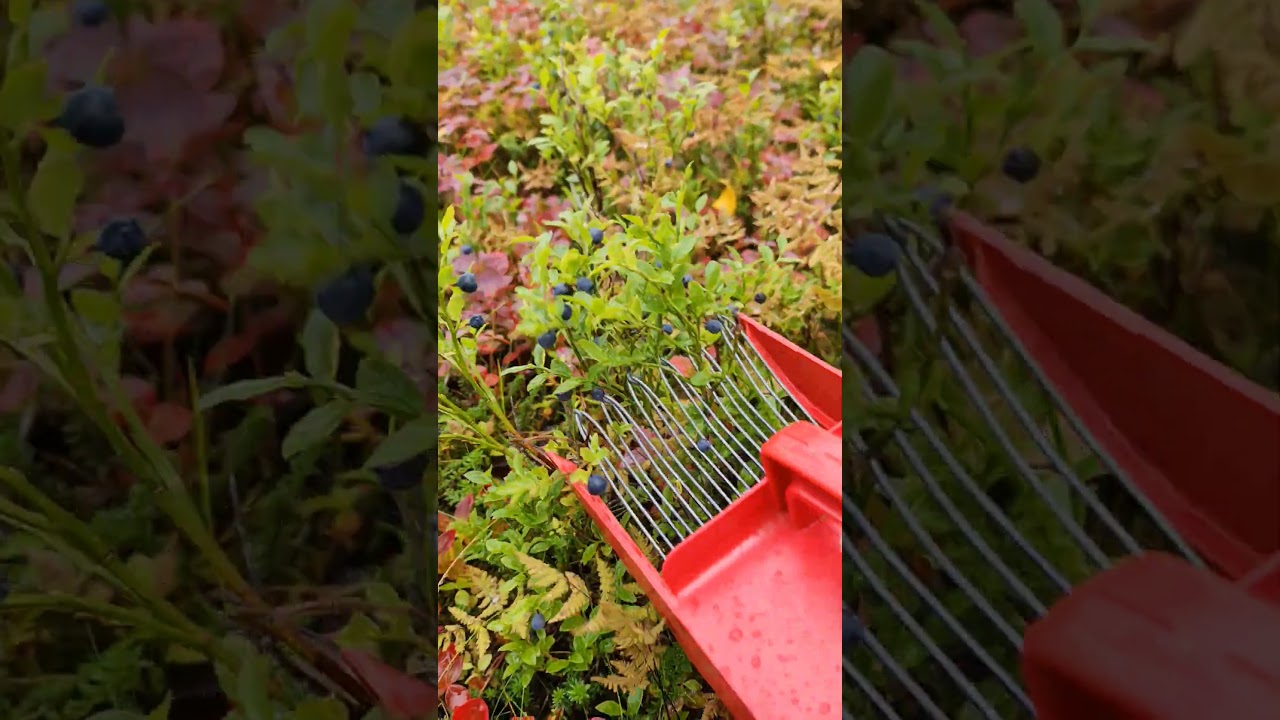
In Northern Norway autumn is the time to harvest the wild blueberries that grow in the forest and mountains. So in late August and early September we go to nature to pick berries. And to help we use a special tool. called " berry-picking rake". In the north the quality of the berry tends to be quite good and they taste delicious! Usually we freeze them and use them throughout winter as a nutritional feast!
A fun fact is that these berries are not the same as the one Americans call blueberry. They are European Blueberry. Wikipedia explains more:
Vaccinium myrtillus or European blueberry is a species of shrub with edible fruit of blue color, known by the common names bilberry, blaeberry, wimberry, and whortleberry. It has much in common with the American blueberry (Vaccinium cyanococcus). It is more precisely called common bilberry or blue whortleberry, to distinguish it from other Vaccinium relatives. Regional names include blaeberry (Scotland & Northern England), urts or hurts (Cornwall & Devon), hurtleberry, huckleberry, myrtleberry, wimberry, whinberry, winberry, blueberry, and fraughan.
Since many people refer to "blueberries" whether they mean the bilberry (European blueberry) Vaccinium myrtillus or the American blueberries Vaccinium corymbosum, there is confusion about the two closely similar fruits. For instance, in the Scandinavian languages, Vaccinium myrtillus and other bilberries are called blåbär (or blåbær), which literally means blueberry. Therefore many Scandinavians will call bilberry blueberry when speaking English.
Adding to the confusion is the fact there are also wild American bueberry varieties, sold in stores mainly in the US and Canada. These are uncommon outside of North America. Even more confusion is due to the huckleberry name, which originates from English dialectal names 'hurtleberry' and 'whortleberry' for the bilberry.
One can distinguish the European species from their American counterpart by the following differences:
European blueberries have dark red, strongly fragrant flesh and red juice that turns blue in basic environments; American blueberries have white or translucent, mildly fragrant flesh
European blueberries grow on low bushes with solitary fruits, and are found wild in heathland in the Northern Hemisphere; American blueberries grow on large bushes with the fruit in bunches
European blueberries are usually harvested from wild plants, while the American counterpart is usually cultivated and are widely available commerciallycultivated American blueberries often come from hybrid cultivars, developed about 100 years ago by agricultural specialists, most prominently Elizabeth Coleman White, to meet growing consumer demand; the bushes grow taller and are easier to harvest.
Bilberry fruit will stain hands, teeth and tongue deep blue or purple while eating (it was used as a dye for food and clothes), while American blueberries have flesh of a less intense color, and are thus less staining
When cooked as a dessert, European blueberries have a much stronger, more tart flavor and a rougher texture than American blueberries.
#shortswithcamilla #blueberry #blueberries #bilberry #berrypicking #berries #food #harvesting #nature

Информация по комментариям в разработке