What if I told you there's a fish that doesn't hunt for food, but actually farms it like a human? 🐠🌾
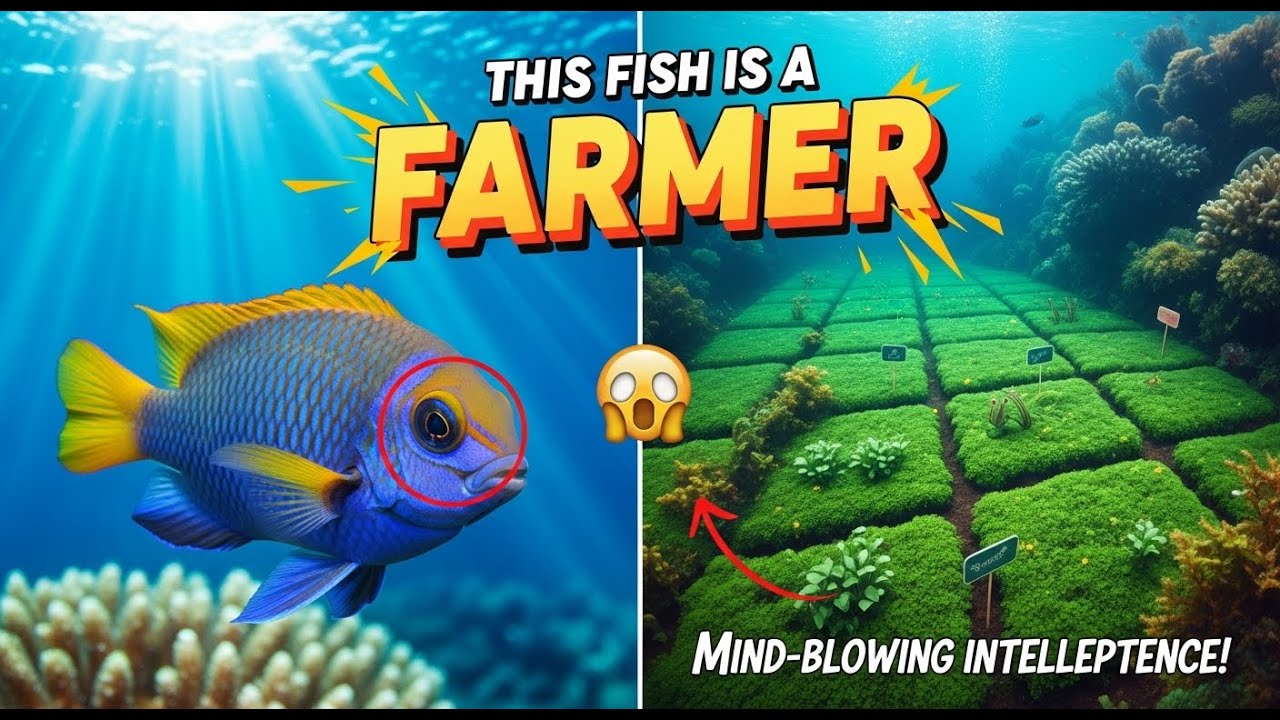
Meet the damselfish - the ocean's most sophisticated agriculturalist. These tiny fish don't just eat algae, they CULTIVATE it. They weed their underwater gardens, fertilize their crops, chase away thieves, and even domesticate specific algae species through selective breeding. This isn't instinct - this is genuine intelligence and planning that scientists never expected to find in fish.
In this documentary, we explore:
✅ How damselfish maintain organized algae farms
✅ The weeding and fertilization techniques they use
✅ How they've genetically modified their crops over millions of years
✅ Why this challenges everything we thought about fish intelligence
✅ The conservation implications for coral reef ecosystems
✅ What this teaches us about the evolution of agriculture
This discovery completely rewrites our understanding of animal intelligence and agriculture. Farming isn't uniquely human - evolution has discovered this solution multiple times, and fish figured it out long before we did.
AI GENERATION DISCLAIMER:
⚠️ This video was created using AI video generation tools including Google Veo 3, Sora, and Runway ML. While the scientific information presented is based on peer-reviewed research, the visual footage is AI-generated illustrations and simulations for educational and entertainment purposes. No actual underwater footage of damselfish farming behavior is shown.
SCIENTIFIC REFERENCES & SOURCES:
📚 Key Research Studies:
Hata, H., & Kato, M. (2006). "A novel obligate cultivation mutualism between damselfish and Polysiphonia algae." Biology Letters, 2(4), 593-596.
Hata, H., Tanaka, K., & Kohda, M. (2010). "Aggressive damselfish determine the species composition of their gardens by killing unpalatable algae." Marine Ecology Progress Series, 413, 149-157.
Ceccarelli, D. M., Jones, G. P., & McCook, L. J. (2001). "Territorial damselfishes as determinants of the structure of benthic communities on coral reefs." Oceanography and Marine Biology: An Annual Review, 39, 355-389.
Hata, H., & Kato, M. (2004). "Monoculture and mixed-species algal farms on a coral reef are maintained through intensive and extensive management by damselfishes." Journal of Experimental Marine Biology and Ecology, 313(2), 285-296.
Ceccarelli, D. M. (2007). "Modification of benthic communities by territorial damselfish: a multi-species comparison." Coral Reefs, 26(4), 853-866.
🔬 Additional Reading:
Klumpp, D. W., McKinnon, D., & Daniel, P. (1987). "Damselfish territories: zones of high productivity on coral reefs." Marine Ecology Progress Series, 40, 41-51.
Lassuy, D. R. (1980). "Effects of 'farming' behavior by Eupomacentrus lividus and Hemiglyphidodon plagiometopon on algal community structure." Bulletin of Marine Science, 30(1), 304-312.
🏛️ Research Institutions Mentioned:
James Cook University (Australia)
Monterey Bay Aquarium Research Institute
Various Pacific marine research stations
📖 For deeper understanding of marine animal cognition:
Bshary, R., Wickler, W., & Fricke, H. (2002). "Fish cognition: a primate's eye view." Animal Cognition, 5(1), 1-13.
⚠️ CONTENT NOTICE:
All scientific information presented is accurate to the best of current research knowledge. This video is intended for educational and entertainment purposes. Marine biology is an evolving field, and new discoveries may update our understanding of damselfish farming behavior.
#marinebiology #DamselfishFarming #FishIntelligence #oceandocumentary #UnderwaterFarming #animalintelligence #coralreef #marinelife #ScienceDocumentary #oceanscience #fishbehavior #agriculture #evolution #marineconservation #underwaterworld #sealife #animalbehavior #naturedocumentary #wildlifedocumentary #oceanfacts #MarineAnimals #fishfacts #ReefLife #DamselfishBehavior #animalcognition #evolutionarybiology #marineecology #oceaneducation #sciencefacts #naturefacts

Информация по комментариям в разработке