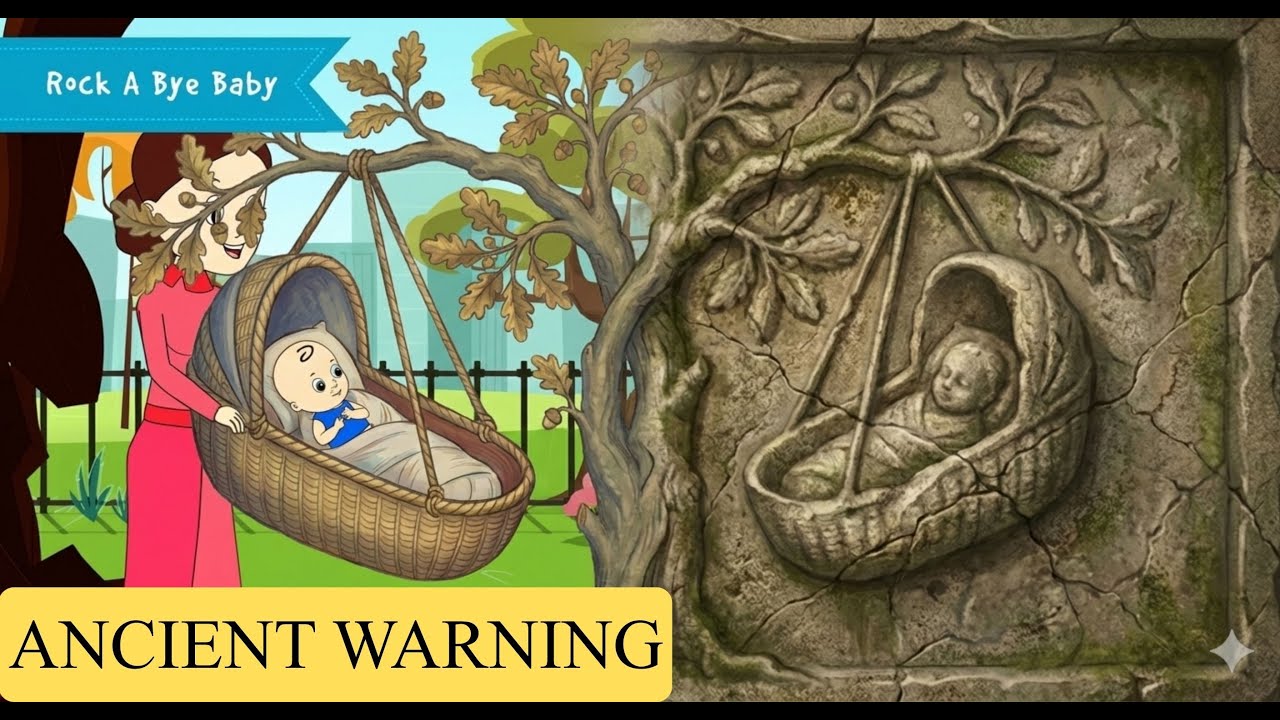
There are songs that move through us without resistance, melodies inherited so early that they feel less like words and more like instinct. “Rock-a-Bye Baby” is one of these songs. It appears in nurseries and hospital rooms, passed from one exhausted generation to the next, trusted because it soothes, because it always has. Yet when listened to closely, the lullaby reveals an image that is quietly disturbing: a child placed not in safety, but in a treetop, suspended above the ground, rocked by the wind until the bough breaks and the cradle falls. This documentary explores why a song meant to calm contains such an image, and why that image has endured for centuries without explanation. Moving beyond familiar interpretations, the film traces the lullaby’s imagery across folklore, ritual, and cultural memory, uncovering a recurring pattern that appears in Northern European folk songs, early colonial accounts, and pre-modern belief systems. The cradle in the tree emerges not as nonsense, satire, or accident, but as a symbol of childhood itself: elevated, protected, and yet profoundly vulnerable. In societies where infant mortality was a daily reality, songs like “Rock-a-Bye Baby” may have served a deeper function, allowing parents to acknowledge danger without surrendering to it, to ritualize fear rather than deny it. The rocking motion echoes the womb, while the fall reflects an ancient understanding that survival was never guaranteed, only hoped for. The documentary examines how trees functioned as liminal spaces in myth and ritual, suspended between earth and sky, life and death, and how placing a child within that space may once have been an act of protection, offering, or preparation. Over time, the original meanings faded, but the structure remained. What survives is not an explanation, but a pattern, repeated because it still resonates. By following the lullaby’s imagery backward through history, this film suggests that “Rock-a-Bye Baby” is not simply a children’s song, but a fragment of cultural memory, carrying forward an acknowledgment of fragility, love, and loss that words alone could not safely hold.
00:00 — The familiarity of the lullaby and the unease hidden within its words
03:41 — Early printed versions and the mystery of the song’s origin
06:17 — Parallel imagery in European folk songs and cradle traditions
09:52 — Elevation, vulnerability, and the symbolic role of trees
12:08 — Infant mortality and the function of dark imagery in lullabies
15:33 — Ritual, memory, and the idea of the inevitable fall
17:46 — How meaning fades while patterns endure
19:29 — Why the song still feels right, even when it disturbs
The lullabies we inherit often tell us more about those who first sang them than about the children who hear them now. If this film prompted you to reconsider a song you thought you understood, or to reflect on the ways fear and care coexist in cultural memory, you’re invited to share your interpretation. These stories endure because they leave space for thought rather than answers. By joining the channel, you become part of an ongoing conversation about folklore, symbolism, and the quiet structures that shape human experience across generations. Each documentary is an attempt not to resolve these mysteries, but to sit with them, to listen carefully, and to understand why they continue to return when the lights are low and the world is silent.
#folklore
#mythology
#culturalmemory
#lullabies
#symbolism

Информация по комментариям в разработке