India has taken a giant leap in the field of construction over the past 15-20 years. And infrastructure development is feather to the cap. A large number of cities are constructing metro projects. Similarly, an average of about 35 km of road is constructed every day in the country, which perhaps is the most rapid expansion in the world. In most urban habitats, it becomes inevitable to go for long elevated viaducts, as effective means of transport. These elevated viaducts easily clear the congested roads and other inhabitations, at ground level leaving them unhindered. However, certain difficulties may be faced in locating the substructures and foundations caused due to underground/ elevated utilities, land encroachments, important establishments etc. Once the difficulties are surmounted, the elevated viaducts tend to provide seamless connectivity. Needless to mention that they create additional movement area, without jeopardizing the existing ground level network.
Elevated Viaducts
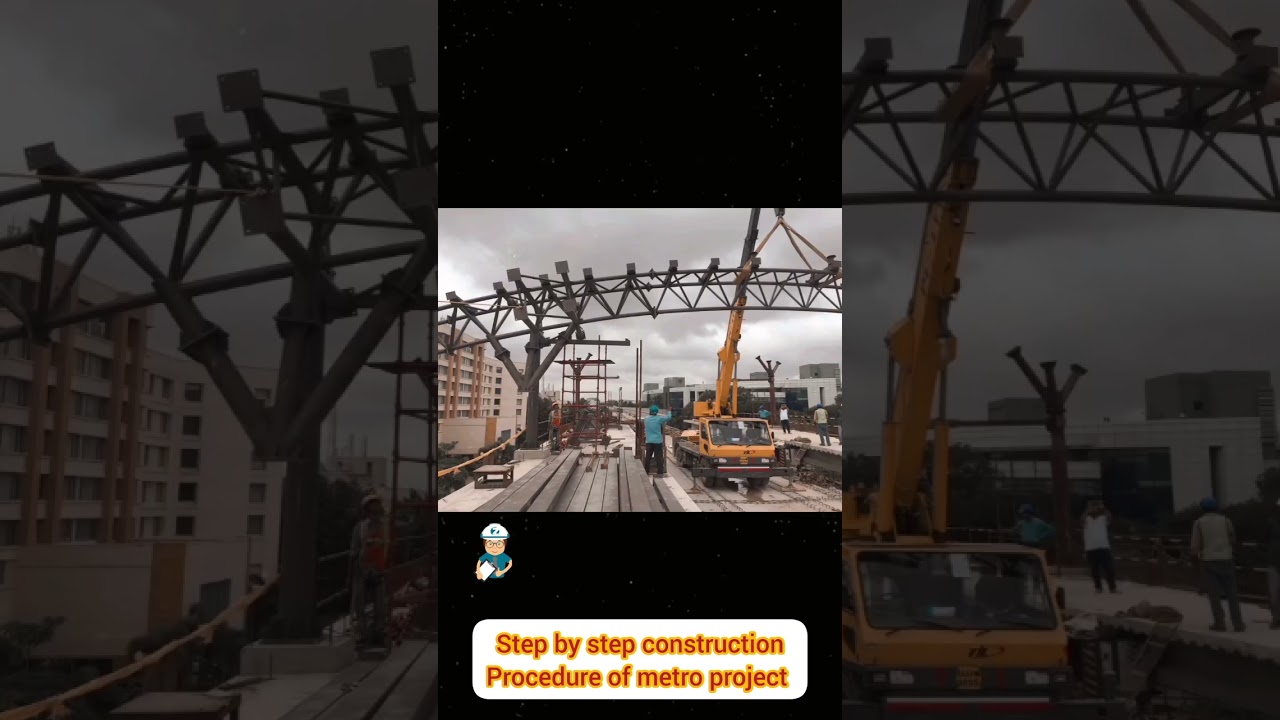
Broadly elevated viaducts have been conceptualized as Precast Segmental Box Girder which are Epoxy Jointed and Internally Prestressed (bonded prestressing), except in some stretches, where prestressed I-girder in combination with cast-in-situ RCC deck slab & diaphragm have been used, see fig 2. However, at diverging track location, either cast-in-situ voided slab superstructure or girder-slab superstructure have been used. At places where the viaduct crosses over an existing road, Portals and Pier Bents using high strength concrete have been provided, see fig 3. Launching of segments has been carried out using overhead and underslung launching girders, see fig 4 & 5. It is worth mentioning here that in the case of a Metro Viaduct, the riding quality comes from the continuity of the track, unlike a road viaduct where continuous superstructure is preferred for better riding quality. Hence, most of the metro viaduct comprises simply supported span superstructures, except at the locations of larger obligatory spans, where 3-4 span continuous superstructures have been provided for controlling depths of the superstructure and for feasibility of construction.
Bangalore Hosur Elevated Expressway
The project of Bangalore-Hosur Elevated Expressway provides a vital high speed link between South East Bangalore and the famous Electronic City, that houses world famous IT industry. The project comprises 10 km long elevated viaduct, a complex traffic interchange, two flyovers and several vehicular and pedestrian underpasses (VUPs and PUPs), apart from ground level roads. Owners laid emphasis on riding quality and made it mandatory for the contractor and designer to keep the spacing of expansion joints as large as 262 m. The elevated viaduct has been constructed using precast segmental superstructure, continuous over spans (29m+6×34m+29m=262m). Sharply curved interchange superstructure at Electronic City has been conceptualized as cast-in-situ RCC (Reinforced Cement Concrete) voided slab with spans ranging between 20 m and 35 m. The VUPs and PUPs have been constructed using Box Pushing method. Speed of erecting superstructure for each span of the 262m long module was about 3 ½ days. As the single box girder carried two carriageways, the speed is said to be 1.75 days per carriageway span. Main attributes to the speed of construction were the use of wireless remote controlled launching girder, matching speed of production of precast segments, produced using short bench method.
Evolution of Structural System
It was decided by the concessionaire to divide the construction of the 10 km elevated viaduct into three different contracts, to be executed by different contractors. Each contractor was to have separate precasting yard. It was necessary to ensure that the segment size and weight were in transportable range. At the same time construction speed was of a high importance for a Build Operate and Transfer (BOT) project.
An overall optimization led to the solution of providing 16 m wide twin cell box girder to carry both up & down carriageways over one superstructure see fig 23. This way, the number of precast segments could be reduced to half. Height of the superstructure is generally in the range of 8 m to 12 m. As a result the piers are not very tall. Most piers are supported over pile foundations, comprising 1.2 m dia bored cast-in-situ RCC piles, resting over rocky substrata. However, some of the foundations had to be made into open foundations resting over shallow rock.
#metro
#bangalore #bmrcl #advanced
#civilengineering
#concrete
#concreting
#construction
#trending
#trendingshorts
#trendingvideo
#trendingstatus
#tamiltrending
#kannadatrending
#india
#hinditrending
#elevated

Информация по комментариям в разработке