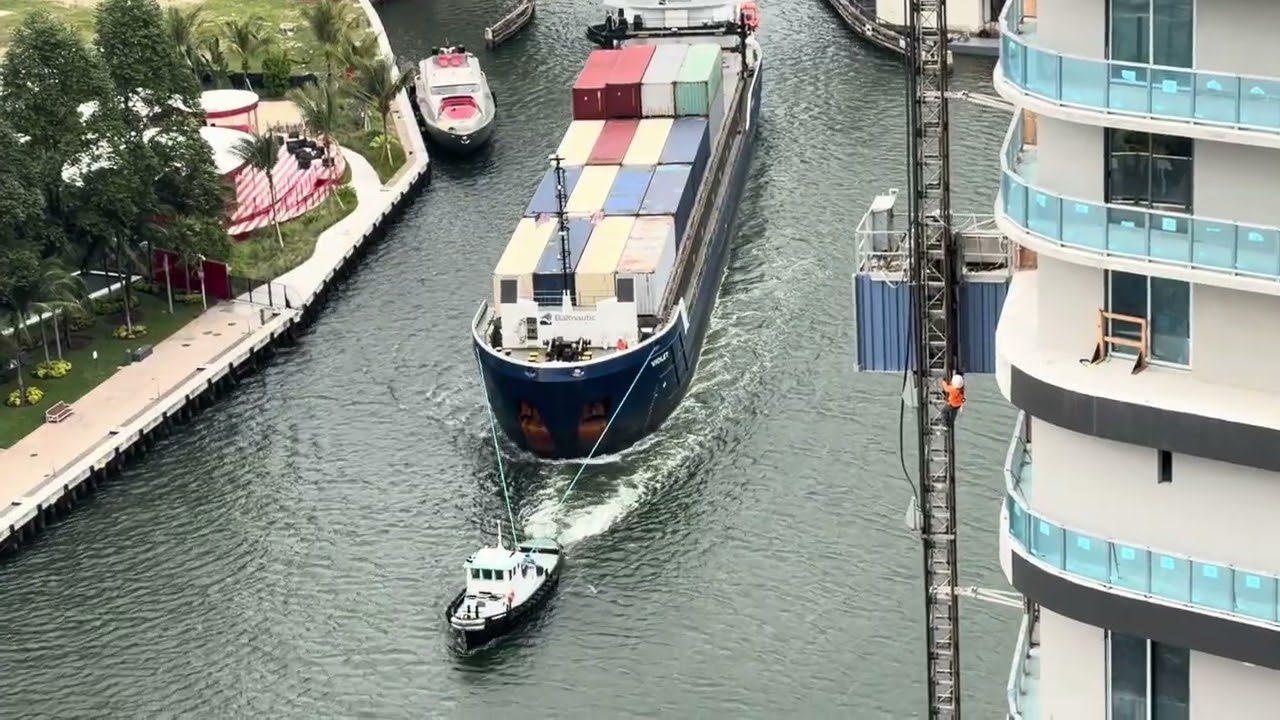
A cargo ship entering the Miami River is one of the cleanest examples of tugboats doing precision work in tight quarters. The river isn’t wide-open water—it’s a narrow, high-traffic working channel with bends, bridges, current, wind, and very little margin for drift. In this video, you’re watching the tug crews manage all the things a big ship can’t do easily on its own: slow down on command, hold a line, rotate efficiently, and stay centered through confined turns.
The job isn’t “pull the ship in.” It’s control of momentum and angles. A ship this size has massive inertia, and the closer it gets to the river, the less room there is to correct a bad setup. The tugs help shape the approach early—checking forward motion, keeping the bow from hunting side-to-side, and preventing the stern from sliding wide in the turns. Small, timely corrections beat big, late ones every time.
Watch the tug placement. You’ll typically see a tug controlling the bow (to steer and hold the ship’s heading) and another managing the stern (to control swing and keep the ship tracking straight). Depending on conditions, they may push, pull, or “hold” the ship on a rail with short bursts of power. That controlled, stop-start rhythm is deliberate—constant throttle isn’t the goal; predictable movement is.
You’re also seeing coordination between the pilot, the ship’s bridge team, and the tug captains. This is a real-time choreography: speed calls, heading adjustments, timing the turns, and reacting to current set, wind gusts, and passing traffic. The Miami River rewards experience because conditions can change fast—especially near bridges and tight bends where wind and current can hit from unexpected angles.
If you want more Miami River tugboat footage—ship assists, docking sequences, barge work, night moves, and breakdowns of tug setups—subscribe and turn on notifications. Drop a comment with what you want to see next.
#Tugboats #MiamiRiver #ShipAssist #CargoShip #PortOperations #Maritime #WorkingWaterfront
Информация по комментариям в разработке