Just a minute :
Slug
Shell-less terrestrial gastropod mollusc
For marine slugs, see Sea slug. For snails, see Snail. For other uses, see Slug (disambiguation).
Quick Facts Scientific classification, Groups included ...
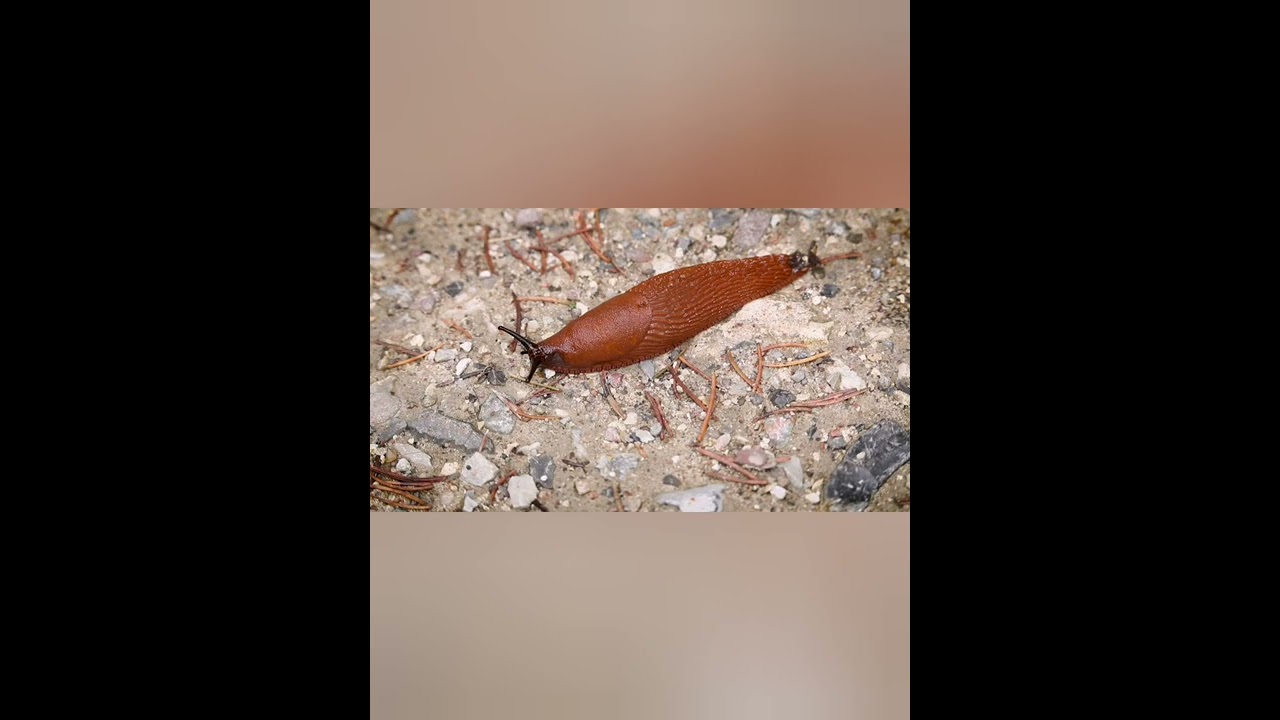
Slug, or land slug, is a common name for any apparently shell-less terrestrial gastropod mollusc. The word slug is also often used as part of the common name of any gastropod mollusc that has no shell, a very reduced shell, or only a small internal shell, particularly sea slugs and semislugs (this is in contrast to the common name snail, which applies to gastropods that have a coiled shell large enough that they can fully retract their soft parts into it).
Various taxonomic families of land slugs form part of several quite different evolutionary lineages, which also include snails. Thus, the various families of slugs are not closely related, despite a superficial similarity in the overall body form. The shell-less condition has arisen many times independently as an example of convergent evolution, and thus the category "slug" is a polyphyletic one.
Taxonomy
Of the six orders of Pulmonata, two – the Onchidiacea and Soleolifera – solely comprise slugs. A third family, the Sigmurethra, contains various clades of snails, semi-slugs (i.e. snails whose shells are too small for them to retract fully into) and slugs. The taxonomy of this group is in the process of being revised in light of DNA sequencing. It appears that pulmonates are paraphyletic and basal to the opisthobranchs, which are a terminal branch of the tree. The family Ellobiidae are also polyphyletic.
Description
Drawing of slug with labels for the foot (bottom side), the foot fringe that surrounds it, the mantle behind the head, the pneumostome for breathing, and the optical and sensory tentacles
The external anatomy of a slug
The external anatomy of a slug includes the following:
Tentacles Like other pulmonate land gastropods, the majority of land slugs have two pairs of 'feelers' or tentacles on their head. The upper pair is light sensing and has eyespots at the ends, while the lower pair provides the sense of smell. Both pairs are retractable.
Mantle On top of the slug, behind the head, is the saddle-shaped mantle, and under this are the genital opening and anus. On one side (almost always the right hand side) of the mantle is a respiratory opening, which is easy to see when open, but difficult to see when closed. This opening is known as the pneumostome.
Tail The part of a slug behind the mantle is called the 'tail'.
Keel Some species of slugs, for example Tandonia budapestensis, have a prominent ridge running over their back along the middle of the tail (sometimes along the whole tail, sometimes only the final part). This ridge is called a 'keel'.
Foot The bottom side of a slug, which is flat, is called the 'foot'. Like almost all gastropods, a slug moves by rhythmic waves of muscular contraction on the underside of its foot. It simultaneously secretes a layer of mucus that it travels on, which helps prevent damage to the foot tissues. Around the edge of the foot in some slugs is a structure called the 'foot fringe'.
Vestigial shell Most slugs retain a remnant of their shell, which is usually internalized. This organ generally serves as storage for calcium salts, often in conjunction with the digestive glands. An internal shell is present in the Limacidae and Parmacellidae. Adult Philomycidae, Onchidiidae and Veronicellidae lack shells.
Note : this video is created with computer
Like | comment | share | subscribe
#Nature #slug #animal #beautifulscenery #birds #photography #beautifulbirds #forest #wildlife #beautifulanimals #animals

Информация по комментариям в разработке