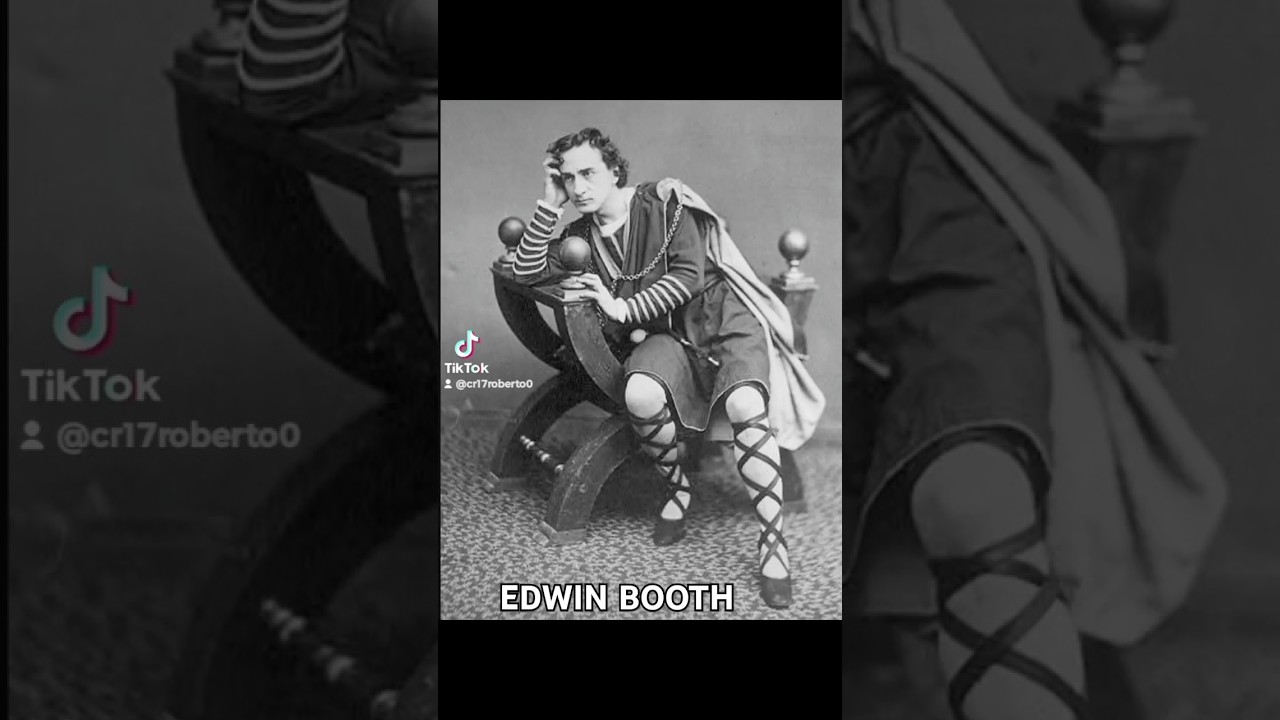
Edwin Booth (November 13, 1833 – June 7, 1893) was an American actor who toured throughout the United States and the major capitals of Europe, performing Shakespearean plays. Some theatrical historians consider him the “greatest American actor” of the 19th century.
Edwin had the talent and fame to become a household name in mid-19th century America. He may have been the greatest actor in the world! As the world turns, Edwin’s achievements are often overshadowed by his younger brother, John. John earned the Booth family name its unfortunate notoriety. Edwin’s younger brother was actor John Wilkes Booth. It was John Wilkes Booth who walked into the Ford Theatre in Washington, D.C., on April 14, 1865 and assassinated the 16th president of the United States, Abraham Lincoln.
Before his brother assassinated Lincoln, Edwin had appeared with his two brothers, John Wilkes and Junius Brutus Booth Jr., in Julius Caesar in 1864. John Wilkes played Marc Antony, Edwin played Brutus, and Junius played Cassius. It was a benefit performance, and the only time that the three brothers appeared together on the same stage. The funds were used to erect a statue of William Shakespeare that still stands in Central Park just south of the Promenade. Immediately afterwards, Edwin Booth began a production of Hamlet on the same stage, which came to be known as the "hundred nights Hamlet", setting a record that lasted until John Barrymore broke the record in 1922, playing the title character for 101 performances.
After John Wilkes Booth's assassination of President Lincoln in April 1865, the infamy associated with the Booth name forced Edwin Booth to abandon the stage for many months. Edwin, who had been feuding with John Wilkes before the assassination, disowned him afterward, refusing to have John's name spoken in his house. He made his return to the stage at the Winter Garden Theatre in January 1866, playing the title role in Hamlet, which would eventually become his signature role.
Edwin Booth saved Abraham Lincoln's son, Robert Todd Lincoln, from serious injury or even death. The incident occurred on a train platform in Jersey City, New Jersey. The exact date of the incident is uncertain, but it is believed to have taken place in late 1864 or early 1865. Robert Lincoln recalled the incident in a 1909 letter to Richard Watson Gilder, editor of The Century Magazine.
"The incident occurred while a group of passengers were late at night purchasing their sleeping car places from the conductor who stood on the station platform at the entrance of the car. The platform was about the height of the car floor, and there was of course a narrow space between the platform and the car body. There was some crowding, and I happened to be pressed by it against the car body while waiting my turn. In this situation the train began to move, and by the motion I was twisted off my feet, and had dropped somewhat, with feet downward, into the open space, and was personally helpless, when my coat collar was vigorously seized and I was quickly pulled up and out to a secure footing on the platform. Upon turning to thank my rescuer I saw it was Edwin Booth, whose face was of course well known to me, and I expressed my gratitude to him, and in doing so, called him by name."
Booth did not know the identity of the man whose life he had saved until some months later, when he received a letter from a friend, Colonel Adam Badeau, who was an officer on the staff of General Ulysses S. Grant. Badeau had heard the story from Robert Lincoln, who had since joined the Union Army and was also serving on Grant's staff. In the letter, Badeau gave his compliments to Booth for the heroic deed. The fact that he had saved the life of Abraham Lincoln's son was said to have been of some comfort to Edwin Booth following his brother's assassination of the president.
In December 2010, Booth's descendants' reported that they obtained permission to exhume the Shakespearean actor's body to obtain DNA samples to compare with a sample of his brother John's DNA to refute the rumor he had escaped after the assassination. However, a spokesperson from the Mount Auburn Cemetery, where Booth is buried, denied reports that the family had contacted them and requested to exhume Edwin's body. The family hopes to obtain DNA samples from artifacts belonging to John Wilkes, or from remains such as vertebrae stored at the National Museum of Health and Medicine in Maryland. On March 30, 2013, museum spokesperson Carol Johnson announced that the family's request to extract DNA from the vertebrae had been rejected.

Информация по комментариям в разработке