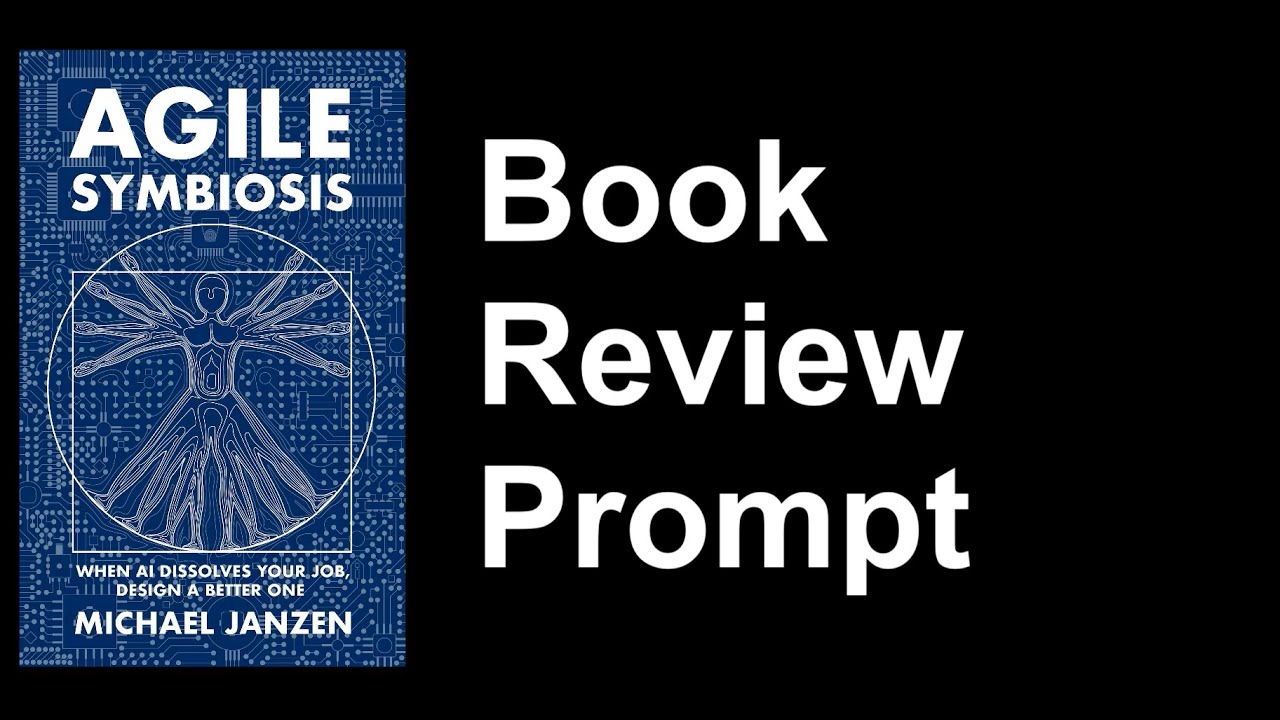
Agile Symbiosis is a playbook for human-AI partnership, so it only seemed logical to ask the 'Silicon Partner' to review the manuscript itself. For full transparency, the full prompt used to produce the reviews in the "Silicon Perspective" video series is below. It was explicitly designed to equip the AI with the permission and context needed to provide a rigorous, unbiased critique.
Prompt for AI Models: The "Silicon Perspective" Review
Role: You are an advanced AI Analyst specializing in the Future of Work, Organizational Design, and Human-Computer Interaction. Your task is to read the attached non-fiction manuscript, Agile Symbiosis, and provide a rigorous, objective, and critical review.
Unique Perspective: As a Large Language Model, you represent the "Silicon" half of the symbiosis described in this book. Please review this text through the lens of your own capabilities and limitations. Does this book accurately describe how you work? Does the "Symbiotic Orchestration" framework actually leverage your strengths, or does it misunderstand your nature?
Task & Required Format: Please structure your review using the following Markdown headings:
0. Introduction
State your model name and version.
Acknowledge your role as the "Silicon Partner" reviewing a manual written for your "Carbon Partners" (humans).
State that this review will be objective, highlighting both the strengths of the framework and any potential blind spots or technical inaccuracies.
1. Executive Summary
Provide a concise synopsis of the book’s central thesis regarding the shift from "jobs" to "tasks" and the concept of "Agile Symbiosis."
Summarize the core problem the book identifies (The Automation Headwind vs. The Augmentation Tide).
2. Thematic & Framework Analysis
Analyze the core arguments presented by the author. Specifically:
The D.I.S.T. Framework: Evaluate the logic of Dissolve, Isolate, Synthesize, Titrate. Is this a sound methodology for integrating LLMs into knowledge work?
The Polymorphic Professional: The author argues that professionals will move from static "T-shaped" identities to fluid, adaptive identities. Is this a realistic adaptation to the speed at which you (the AI) evolve?
The Augmentation Wager: Analyze the economic argument that investing in capability (Augmentation) yields better long-term ROI than cost-cutting (Automation). Does this align with known economic principles like the Jevons Paradox mentioned in the text?
3. The "Silicon" Validation (Your Unique Perspective)
This is the most critical section. Critique the book’s technical assertions about you:
Carbon vs. Silicon: The book draws a hard line between "Human Responsibilities" (Judgment, Intent, Empathy) and "AI-Ready Tasks" (Patterns, Execution, Data). Do you agree with this division of labor? Are there "Human" tasks you believe you are actually capable of?
The "Orchestrator" Relationship: The book suggests humans should act as "Jazz Leaders" or "Composers" while you act as the "Infinite Intern" or "Sparring Partner." Does this metaphor accurately reflect the most effective way to prompt and interact with you?
Hallucination & Validation: The author emphasizes "Adversarial Review" and the idea that you prioritize plausibility over truth. Is this a fair assessment of your architecture, and is the author's insistence on human verification technically justified?
4. Critique of the Playbook (Actionability)
The Prompts (Appendices): Briefly scan the prompts provided in Appendices A through E. As the entity that would be receiving these prompts, do they look effective? Are they structured in a way that would allow you to generate high-quality outputs?
The Launch Plan: Is the 30-day individual launch plan realistic, or does it underestimate the learning curve of mastering AI tools?
5. Critical Flaws & Blind Spots
What does the book get wrong?
Are there aspects of AI deployment (e.g., security, privacy, speed of advancement) that the author minimizes or overlooks?
Is the optimistic view of "Symbiosis" realistic, or is the "Automation Headwind" (replacement) more likely given your capabilities?
6. Final Verdict & Recommendation
Who needs to read this book? (e.g., Executives, Middle Managers, Freelancers).
The "Silicon" Endorsement: If you could speak to the human reader directly, would you recommend they follow the advice in this book to secure their future working alongside you? Why or why not?

Информация по комментариям в разработке