A naval force has command of the sea when it is so strong that its rivals cannot attack it directly. Also called sea control, this dominance may apply to its surrounding waters or may extend far into the oceans, meaning the country has a blue-water navy. It is the naval equivalent of air supremacy.
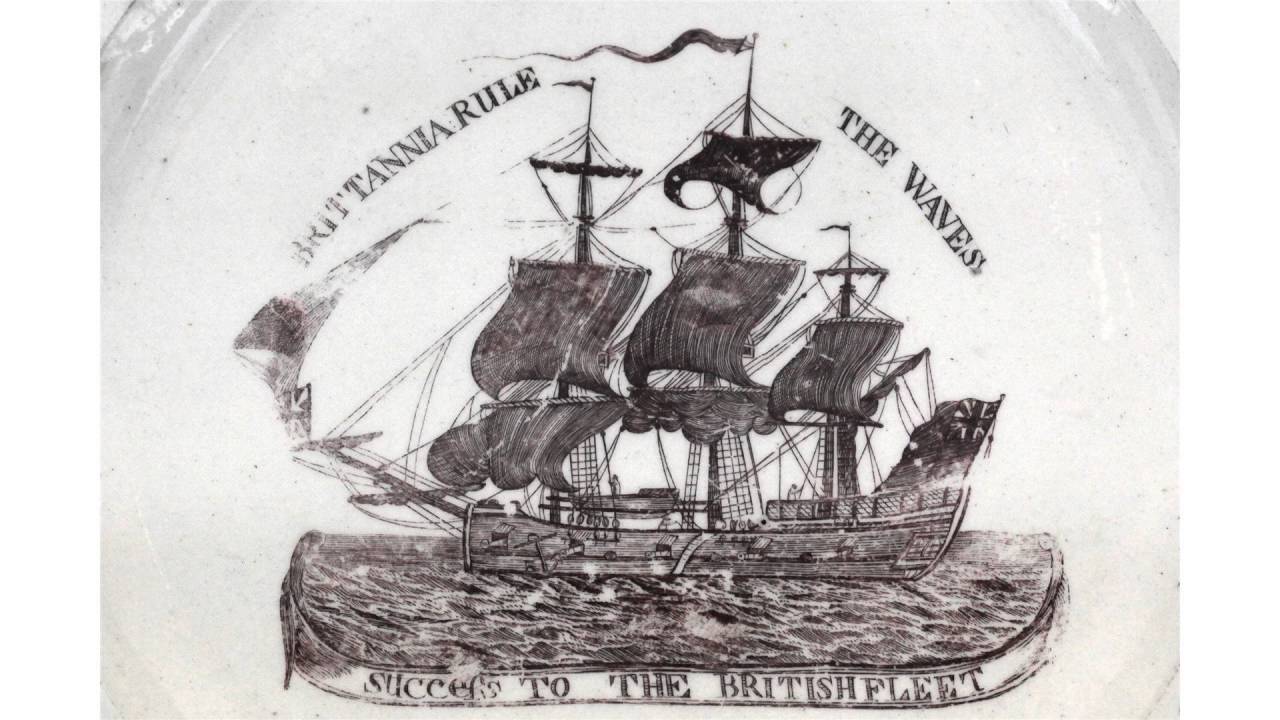
With command of the sea, a country can ensure that its own military and merchant ships can move around at will, while its rivals are forced either to stay in port or to try to evade it. It also enables free use of amphibious operations that can expand ground based strategic options. Most famously, the British Royal Navy held command of the sea for long periods from the 18th to the early 20th century, allowing Britain and its allies to trade and to move troops and supplies easily in wartime while its enemies could not. For example, Britain was able to blockade France during the Napoleonic Wars, the United States during the War of 1812, and Germany during World War I. In the post-World War II period, the United States has had command of the sea.
Gradually, however, countries agreed that the open seas should be free to all shipping in peacetime and to neutral shipping in wartime. Great Britain accepted the principle in 1805; Russia, in 1824; and the United States in 1894. Many treaties, including the Treaty of Versailles, have dealt with the open seas, and currently the United Nations Convention on the Law of the Sea formalizes this freedom.
Historically, many powers attempted to extend command of the sea into peacetime, imposing taxes or other restrictions on shipping using areas of open sea. For example, Venice claimed the Adriatic, and exacted a heavy toll from vessels navigating its northern waters. Genoa and France each claimed portions of the western Mediterranean. Denmark and Sweden claimed to share the Baltic between them. Spain claimed dominion over the Pacific and the Gulf of Mexico, and Portugal over the Indian Ocean and all the Atlantic south of Morocco.
During the age of sail, there were two primary counter measures to another power holding control of the sea: smuggling, and privateering. Smuggling helped to ensure that a country could continue trading even when under blockade, while privateering allowed the weaker power to disrupt the stronger power's trade. As these measures, which are examples of asymmetric warfare, came from non-governmental and sometimes criminal organizations, they fell into disfavor with stronger governments. An annex to the Treaty of Paris banned privateering. That treaty was an oddity in that it was ratified by relatively few countries, but quickly became the de facto law of the sea.
A more modern countermeasure, similar to privateering, was the use of submarine warfare by Germany during World War I and World War II to attack allied merchant shipping primarily in the Atlantic Ocean, Mediterranean Sea, and Baltic Sea.
During World War II, aircraft also became an effective countermeasure to command of the sea, since ships could not defend themselves well against air attack. The Battle of Britain was largely an attempt by Germany to eliminate the Royal Air Force, so that it would not be able to defend the Royal Navy from air attack and even to allow a maritime invasion of Great Britain proper.
'Blue-water' naval capability means that a fleet is able to operate on the 'high seas.' While traditionally a distinction was made between the coastal brown-water navy and a seagoing blue-water navy, a new term, 'green-water navy,' has been created by the U.S. Navy, which refers to the coastal submarines and fast attack boats of many nations, the larger littoral combat corvettes and similar vessels of a substantial number of powers, and amphibious vessels ranging from elderly LSTs to complex S/VTOL carriers and other specialized ships.
Video Empire produces videos read aloud. Use the information in this video at your own risk. We cannot always guarantee accuracy.
This video uses material from https://en.wikipedia.org/wiki/Command..., licensed with CC Attribution-ShareAlike 3.0. This video is licensed with CC Attribution-Share-Alike 3.0 https://creativecommons.org/licenses/... In order to adapt this content it is required to comply with the license terms. Image licensing information is available via: https://en.wikipedia.org/wiki/Command...

Информация по комментариям в разработке