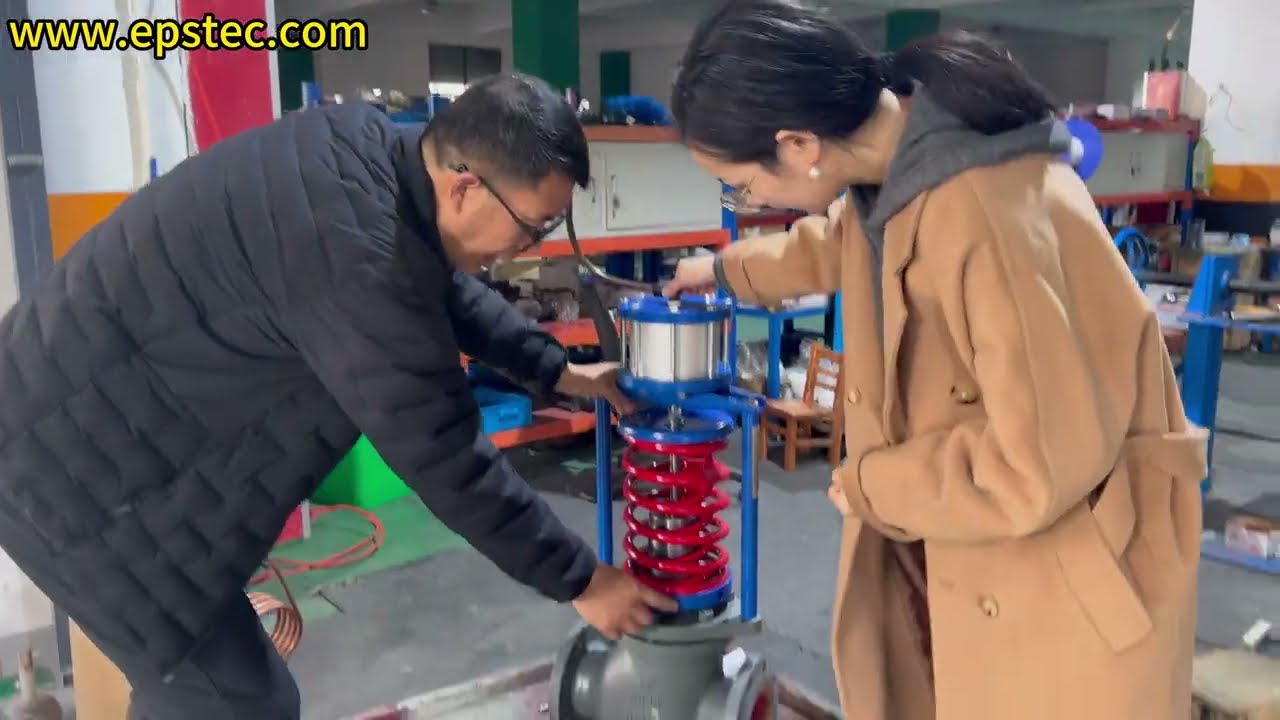
Hi everyone, I am Fiona. In this video, we will show you this double-seat self-operated pressure reducing valve that we exported to India. In the following section, we will briefly disassemble the valve, and Mr. Chen will explain the structure and working principle of a self-operated pressure reducing valve.
From the external appearance, the valve with this square-shaped structure is a double-seat pressure reducing valve. Another type, which has a cylindrical, olive-like shape, is called a single-seat pressure reducing valve. The main difference between them lies in the internal seat structure. The double-seat design features a dual-flow passage, which allows a larger instantaneous flow rate. In the EPS industry, large instantaneous flow is particularly important, because it allows equipment to fill with air quickly during the intake process, avoiding slow filling or sudden closing issues.
In general, pressure reducing valves have two control methods. One is controlled by compressed air, and the other is controlled by steam feedback. In most cases, compressed air control provides better performance because the pressure of compressed air is relatively stable. Steam feedback control may have a delay of about one to two seconds, because there is a transmission process from the detection point to the feedback signal. This copper pipe connection can be used to connect either steam or compressed air.
This section is the pressure adjustment mechanism. On the top, you can see the markings for MAX and MIN. When you rotate it counterclockwise, the spring is compressed and the outlet pressure increases. When you rotate it clockwise, the spring becomes looser and the outlet pressure decreases.
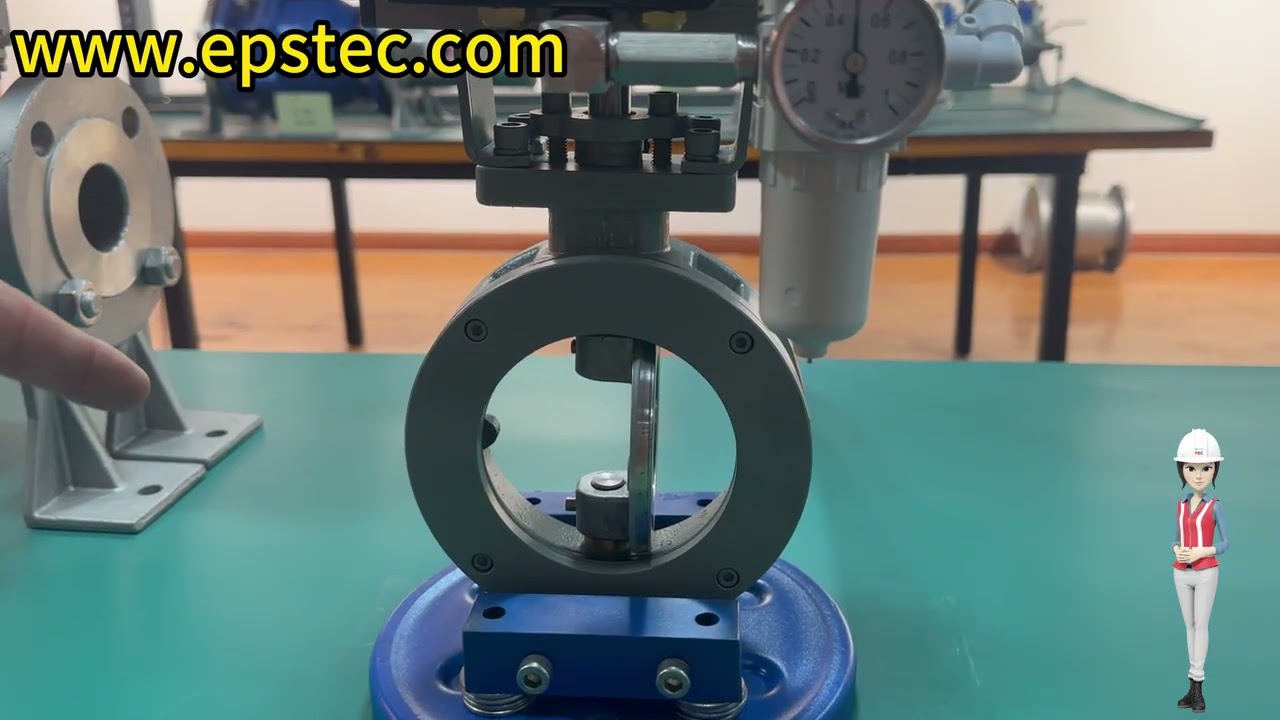
Here we can see the valve core of the pressure reducing valve. Under normal conditions, after precision machining, the surface of this component should be very smooth. The one shown here has not yet undergone final finishing, so the surface feels slightly rough. After precision machining, the surface becomes very smooth, which ensures a good sealing effect.
If the surface of the valve core has minor scratches or small grooves, it usually does not have a significant impact during operation. Once the equipment starts running, the pressure quickly returns to the set value, for example, around four kilograms. This type of sealing is referred to as technical sealing.
Another type is soft sealing, where a sealing ring inside the valve provides the sealing function. If the sealing ring is damaged, it needs to be replaced. In contrast, our design uses a hard sealing structure. Normally, there is no need to replace a sealing ring. The surface can simply be re-machined on a lathe to restore smoothness and allow the valve to continue operating.
During routine maintenance, special attention should be paid to the valve core. Many cases of air leakage are actually caused by damage to the valve core surface. For example, some customers remove the valve core and place it directly on the ground, which can create dents or grooves and affect the sealing performance. Therefore, during disassembly and storage, the valve core should always be handled carefully to avoid impact damage.
For more information about the EPS machine and EPS mold, please contact us by email or mobile phone. We will be happy to answer your questions. See you in the next video.
Contact information:
Mobile/Whatsapp/Wechat: +86 13819136790
Skype:fionaying
Email:info@epstec.com
https://www.epstec.com








Информация по комментариям в разработке