My love of history and anthropology, and my fascination with genetics and ancestry, have led me inevitably to that mythical proto-historic half-millenium in Europe, let's say between the battles of Chalons and Lechfeld, wherein fact and fiction, history and myth, become indistinguishable.
What we have here, as best as I can render it, is a history of the Dumnoni folk, their kings and their Holy Saints. It so happens that in constructing from the scraps of the historical record, granting the benefit of the doubt to such hagiography and such mythology as can be called a history of this period without cringing, a coherent course of events, it becomes necessary to entertain certain elements thereof as historical fact for the sake of making harmonisable what is obliquely referred thereabout in accounts concerning more certain elements. I am referring to the man called Arthur and to the foundation of those states upon the Armorican peninsula which found their origin in the flight of the Britons from their native isle.
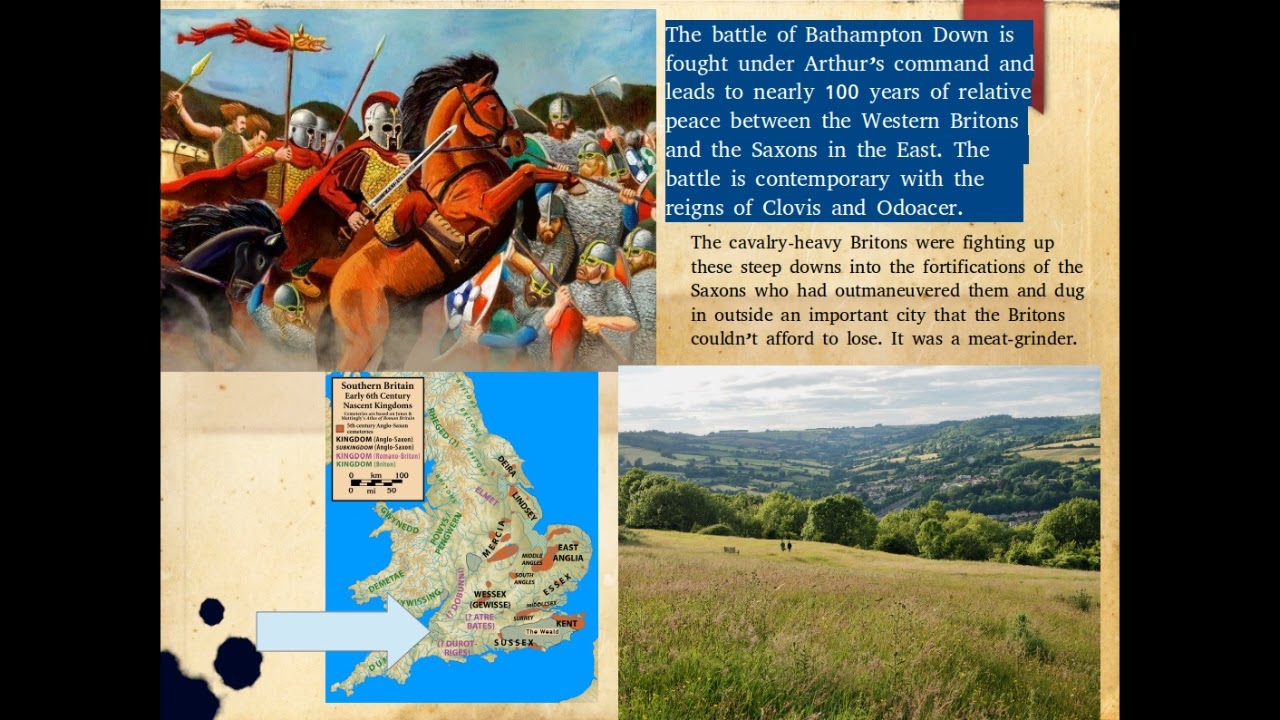
Whether the Armorican states of the period were actually founded by princes from outremer is less salient to us than the coherence of the narrative of Dumnonian legacy. When encountering an early king-list of a continental Domnonée, we simply must inquire at what time was the canonical Saint sister to her earliest king born, at what time her (also Saint) husband, and what the ethnic and personal circumstances of both of their births. And in so enquiring, with respect to the many uncertain chronologies and the scarcity of sources in general, we inexorably come face to face with two names and one event in a known location whose dating becomes the crucial detail to find out, once we suspend our incredulity at the traditional narrative as it is given by the oldest accounts concerning the matter. The names: Ambrose and Arthur; the event: the Din at Bathampton Down, where now stands the University.
So we write, without intending it: a history of the enigmatic duke of the children's stories and legends. Not an idyll fantasy, nor a cynical refusal to speculate: but such a history as can be inferred by the facts attested by ancient sources and the common testimony of neighboring nations. For indeed whenever one enquires, dismissing such legends as came from Geoffrey Monmouth or Chretien Troyes, after the post-Roman account of the Britons living on either side of the Channel west of the Soissons, one encounters a convergence upon a common canon of: unelaborated king-lists, vaguely written Latin Saints’ Lives, and half-references to a certain duke who was kin to the more firmly attested Ambrose Constantinson somewhere in 5th century Britain. A duke who is not the protagonist of this story, not even a Dumnoni by the narrowest sense of the world, but who nevertheless did answer the call to greatness at a pivotal, and vanishingly-poorly-documented, moment in history.
Audio and spoken text is under copyright.
© Logan Strait MMXXV

Информация по комментариям в разработке