00:07 Sonata in G major "L'Inconnue" (Michel de La Barre, 1675-1745)
Grave - Vivement - Tempo 1; Chaconne
08:38 Sonata No. 6 in A minor "La Bouget" (Michel Blavet, 1700-1768)
Adagio; Allegro moderato (Allemande); Allegretto (Les tendres badinages) - 1st Trio - 2nd Trio; Presto (Gai)
17:14 Sonata in D minor (Anne Danican-Philidor, 1681-1728)
Lentement; Fugue; Courante (Croches inégales); Gracieusement (Les notes égales et détachéz); Fugue
Jean-Pierre Rampal, flute / Robert Veyron-Lacroix, harpsichord
This recording presents three works by French composers who served as chamber musicians to Louis XIV or Louis XV, all well-known flute virtuosos.
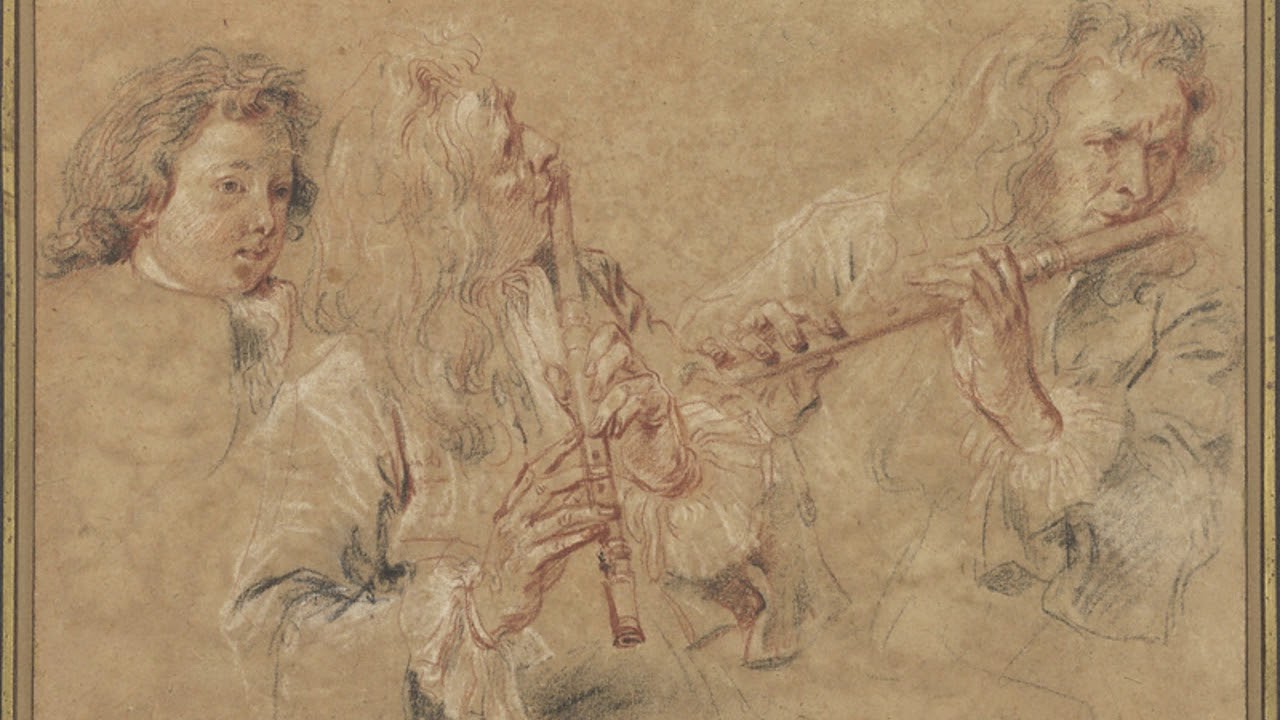
During the Eighteenth Century, the flute was a very popular instrument, particularly among the aristocracy. The most famous amateur flutist was Frederick the Great of Prussia, who gave private concerts and composed many pieces for his instrument. In the early 1700's, the greatest flutists were French. Their achievements were particularly remarkable since at that time the flute was rather rudimentary in construction and was difficult to play in tune. Usually made of wood, it had six finger-holes and one hole with a key.
The sonata for solo instruments and basso continuo began to be cultivated in France only at the end of the seventeenth century, long after it had appeared in Italy, Germany, and England. This may have been partly due to French composers’ reluctance to adopt Italian styles and forms. Around 1700, however, Corelli’s sonatas became so popular in France that French composers began to write sonatas in his style. A remarkable group of French sonata composers were active during the first half of the eighteenth century. These include Jean-Marie Leclair, Senaillé, Boismortier, and Aubert, as well as the three composers represented on this recording. Their works were often performed at the Concerts Spirituels, the first series of public concerts in Paris and perhaps the most important concert series in Europe during the 18th century. They were also performed in many private concerts given in the homes of the aristocracy and the wealthy bourgeoisie.
Michel de La Barre (c. 1675-1743) was the last great flutist of the reign of Louis XIV. Besides serving the king as chamber musician, La Barre played in the orchestra of the Paris Opéra. The dotted rhythmic patterns and rather solemn mood of the Grave and the Tempo I are in the style of the French opera overture. The Chaconne is a series of variations over two patterns in the bass that are repeated throughout the movement. These patterns are first employed in the seventeenth measure of the movement. The Chaconne begins and ends in major, and has a middle section in minor.
Michel Blavet (1700-1768) was the most eminent flute virtuoso of his time. Two years after his death, a contemporary wrote that before Blavet, flutists played only “little melodies which were devoid of expression and which required only a little talent and facility from the performer... One previously had no idea of the perfection possible on this instrument, a perfection for which M. Blavet was responsible. In his sonatas and concertos, this distinguished musician knew how to draw the most agreeable sounds from the flute in an execution that was clear and rapid, exact and brilliant¨.
Blavet was music director ior the Count of Clermont, chamber musician to Louis XV, and first flutist at the Paris Opéra. On March 1, 1753, the Opéra performed Blavet’s comic opera, Le Jaloux corrigé, along with Jean Jacques Rousseau’s Le Devin du village.
The Sonata in A Minor was first published in 1731. Its third movement, Allegretto (Les tendres badinages), is a rondeau with a charming refrain that is presented three times in A minor. After the first statement of the refrain, the main tune is heard in C major. After the second statement of the refrain, a varied form of the main tune is heard in E minor.
Anne-Danican Philidor (1681-1728) was the founder of the Concerts Spirituels. A flutist at the court of Louis XIV, he was also music director for the Prince de Conti.
The Sonata in D Minor was published in 1712 and appears to have been originally written for the recorder. Some striking rhythmic effects may be heard in the first Fugue and in the Courante. The Fugue is in 6/8 meter with two main beats to the measure. Often, however, measures divided into three beats occur in either the top line or the bass. This placing of three beats against two creates a syncopated effect. The Courante employs a more unusual procedure. Although notated in triple meter throughout, the Courante sounds as though it starts in 2/4 and shifts to 3/4 shortly after the beginning of the second part.
ROGER KAMIEN

Информация по комментариям в разработке