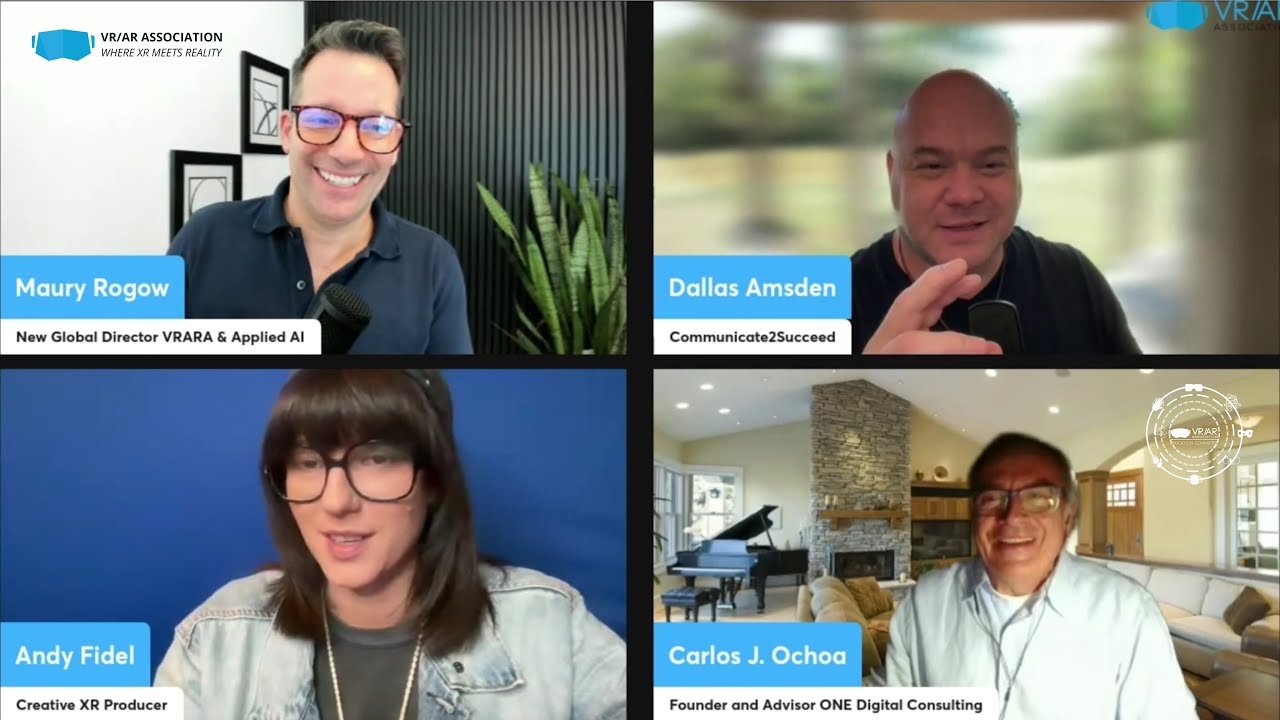
Yesterday, during the VRARA Education Summit 2025, I had the privilege of sitting down with Andy Fidel for a fireside conversation that became far more than a session about technology.
It transformed into a conversation about people — about curiosity, courage, learning, and what it truly means to stay human in a time of exponential change.
Andy had just returned from a world tour through innovation hubs, creative studios, and XR communities across the globe. When I asked how she would summarize what she had witnessed, she spoke with the kind of honesty and clarity that only comes from someone who has lived inside these spaces — not as an observer, but as a builder of human connection.
We reminisced about our early days in AltspaceVR, when virtual worlds still felt raw and magical. She shared how far these spaces have come, where they are still struggling, and why — despite the noise — she still believes in the metaverse as a place where culture, community, and creativity can flourish.
Listening to her felt like revisiting the roots of an entire movement.
We explored how different generations are navigating immersive technologies in education — the enthusiasm of young people, the hesitations of parents, the challenges teachers face as they try to guide students into a future they themselves are still trying to understand.
Andy reminded us that before we ask learners to be “future-ready,” we must first help the adults around them feel confident, informed, and empowered.
One moment that truly stayed with me was when we talked about structure — the need for ethical frameworks, shared rules, and safe pathways so that XR and AI can grow responsibly in our societies.
Andy’s perspective was both grounded and hopeful: she emphasized that while we are still building these frameworks, the opportunity to shape them together has never been greater.
Near the end, I shared a simple analogy that sparked a beautiful response from her.
I said: A car in untrained hands can be dangerous — but with driving schools, traffic rules, and shared systems, it becomes a tool that moves society forward.
And I asked whether she believed we could build something similar for advanced technologies in education.
Her answer was filled with optimism — a reminder that if we lead with ethics, creativity, and compassion, these tools will not divide us.
They will help us learn, connect, and grow in ways we are only beginning to understand.
As we closed the session, I felt something very rare at tech events: a sense of collective purpose.
A feeling that the future of immersive education is not just about headsets or AI models — but about people, and about the connections we build with intention and care.
Thank you, Andy, for your generosity, your vision, and your humanity.
And thank you to everyone who joined us and shared this moment.
Until next time — see you in the metaverse.
Carlos J. Ochoa

Информация по комментариям в разработке