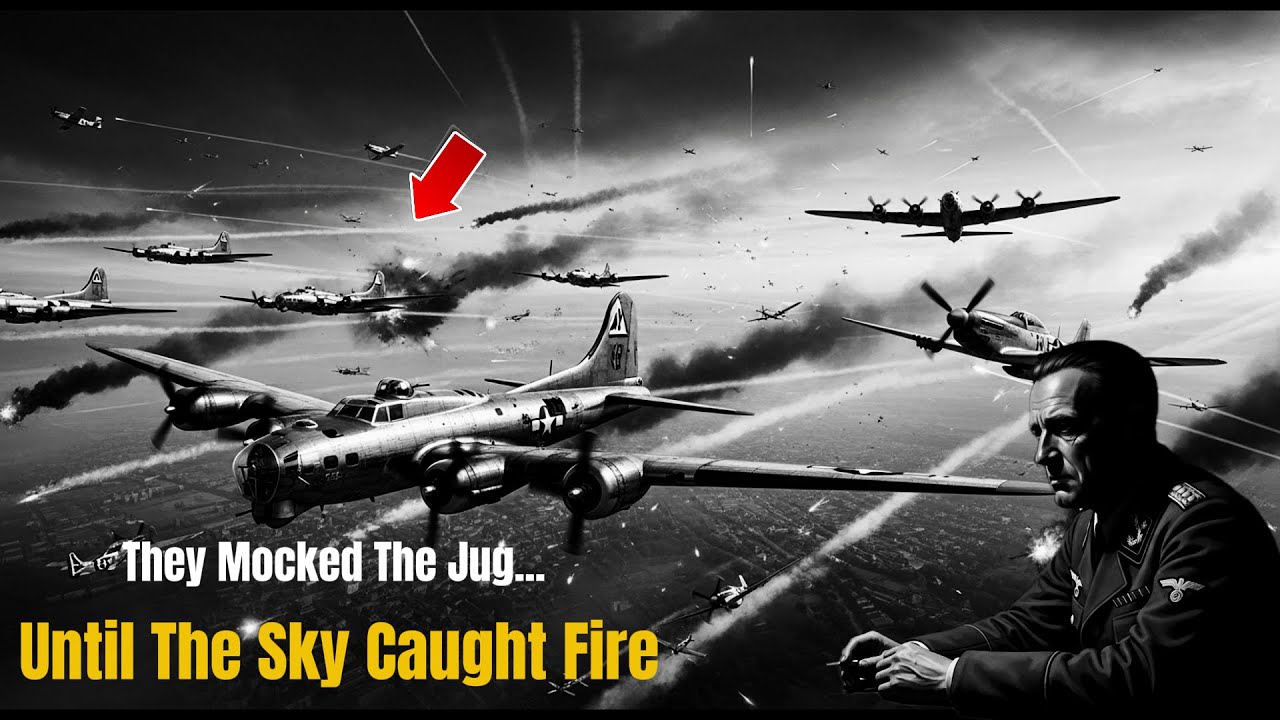
April 8, 1943, twenty-seven thousand feet over France, German pilots laughed at the new American fighters below—barrel-bodied P-47 Thunderbolts that looked slow, ungainly, and out of place in the thin blue air. They did not yet know they were seeing the first act of a transformation. Designed by Alexander Kartveli around the Pratt & Whitney R-2800 Double Wasp, turbo-supercharging, and eight .50 caliber Brownings, the Republic P-47 Thunderbolt was built for altitude, endurance, and punishment rather than elegance. Training was brutal and compressibility deadly, but the pilots who survived learned a new language of combat: do not turn, do not linger—dive, strike, and climb away. Under leaders such as Hubert Zemke and David Schilling, tactics shifted to boom-and-zoom, exploiting the Jug’s unrivaled dive and resilience. Robert S. Johnson’s bloodied return after absorbing staggering damage became legend and rewired squadron morale. With paddle-blade propellers, drop tanks, and longer legs, Thunderbolts escorted bombers deep into Germany, shredded twin-engine attackers over Schweinfurt–Regensburg, and then descended to break railroads, armor, and convoys before D-Day. German aces such as Josef “Pips” Priller, Hans Philipp, and Wilhelm-Ferdinand “Wutz” Galland discovered that at altitude the Thunderbolt hit like a hammer and refused to die. Even jets were not immune to concentrated .50 caliber fire. Across the Pacific the pattern repeated: survivability, firepower, and relentless pressure. By 1945, industrial scale and tactical clarity had turned ridicule into fear and finally into respect. The P-47’s legacy lives in statistics and in memory—the deep rolling rumble of an R-2800, the museum glass that frames gun-camera film and spent shells, and Adolf Galland’s late admission that the Americans built a different kind of fighter: one forged by production, firepower, and survival.
00:00 : Debut over France and first impressions of the P-47; the clash of philosophies—agility versus endurance.
05:17 Design origins in 1940–41, Kartveli’s choices, the R-2800, turbo-supercharging, and eight .50s.
15:42 Training losses, compressibility, and the learning curve that shaped new tactics.
24:09 Robert S. Johnson’s survival, Zemke’s doctrine, Schilling’s leadership, and boom-and-zoom in action.
32:36 Schweinfurt–Regensburg, D-Day, ground attack evolution, paddle-blade props, and range extension.
40:51 Late-war adaptations, clashes with jets, collapse of the Luftwaffe, Pacific echoes, and postwar legacy.
If this story challenges what you thought you knew about air combat, join the discussion below. Whose decisions mattered most—designers, pilots, or the crews who kept damaged aircraft flying? Share the moment in the script that stayed with you, and tell us where you stand on the Thunderbolt’s place among World War II fighters. For more carefully researched history told with clarity and respect, subscribe to the channel and turn on notifications. Your comments help surface overlooked sources and keep these histories alive for new viewers. Thank you for watching and for supporting thoughtful storytelling about the people, machines, and choices that shaped the modern world.
#WWII #AviationHistory #P47Thunderbolt #Luftwaffe #MilitaryHistory

Информация по комментариям в разработке