How Do Plants in the Deep Sea Perform Photosynthesis? | Ocean Science Explained for You
📌 Description
How can plants survive in the deep sea where sunlight is extremely weak or almost completely absent? 🌊🌱
Do they still perform photosynthesis — and if so, how?
In this video, we explore the amazing adaptations of deep-sea plants and algae. Learn how some species use faint blue light, how others rely on alternative energy sources, and why true photosynthetic plants can only live within the sunlit ocean zone.
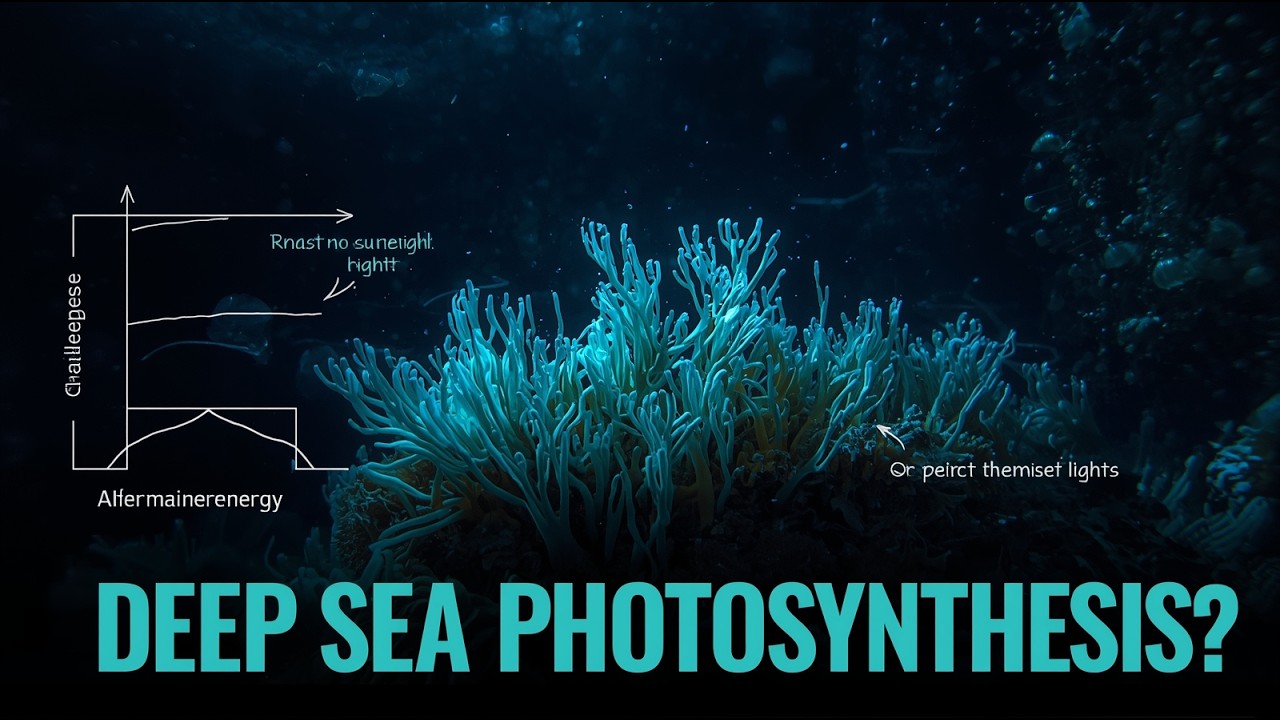
In the deep ocean, where sunlight weakens with every meter it travels downward, it seems almost impossible that any plant could perform photosynthesis, yet countless species of algae thrive there by using light in ways land plants cannot. All plants, including marine algae, rely on chlorophyll to capture light energy and convert carbon dioxide and water into sugars, but chlorophyll is picky—it mainly absorbs red and blue light. The problem is that red light disappears almost immediately beneath the surface, orange and yellow fade soon after, and only green, blue, and violet wavelengths can penetrate into deeper layers of seawater. To survive in this filtered world, marine plants have evolved special pigments called accessory pigments that allow them to absorb the colors of light chlorophyll cannot use. Green algae live in shallow water where enough red light remains for normal photosynthesis. Brown algae, like giant kelp, contain fucoxanthin, which absorbs greenish light that reaches deeper zones. Far below them live the red algae, which carry brilliant pigments like phycoerythrin that specialize in catching blue and violet light—the wavelengths that travel the farthest into the ocean’s darkness. These pigments don’t replace chlorophyll; instead, they funnel captured light energy directly to it, allowing photosynthesis to continue even when sunlight is incredibly scarce. Some green algae can even survive in surprisingly deep water by slowing their metabolism to minimal levels and using just the faintest traces of light. So even though the deep sea appears dark to human eyes, to marine plants it is a layered world of shifting colors, and evolution has equipped each species with exactly the pigments it needs to harvest every last ray that reaches its home.
If you enjoy learning about ocean science, biology, and the mysteries of the deep — don’t forget to like, share, and subscribe!
🔑 SEO Keywords
deep sea photosynthesis, how plants survive deep ocean, photosynthesis low light, ocean sunlight zones explained, algae deep sea light, ocean biology for you, photosynthesis science video, deep ocean energy sources, marine ecosystem learning, ocean sunlight absorption
🧩 Hashtags
#OceanScience #MarineBiology #ScienceForYou #DeepSeaFacts
#LearnScience #FunScienceFacts #BiologyExplained #STEMEducation #OceanEcosystem
🏷 Tags
photosynthesis deep sea, plants in deep ocean, algae low light survival, ocean sunlight zone, deep sea ecosystem explained, marine biology education, photosynthesis science video, ocean energy flow, biology learning, nature science documentary style

Информация по комментариям в разработке