A Kinetic Revolution: The 400-Meter Iron Giant That Never Was
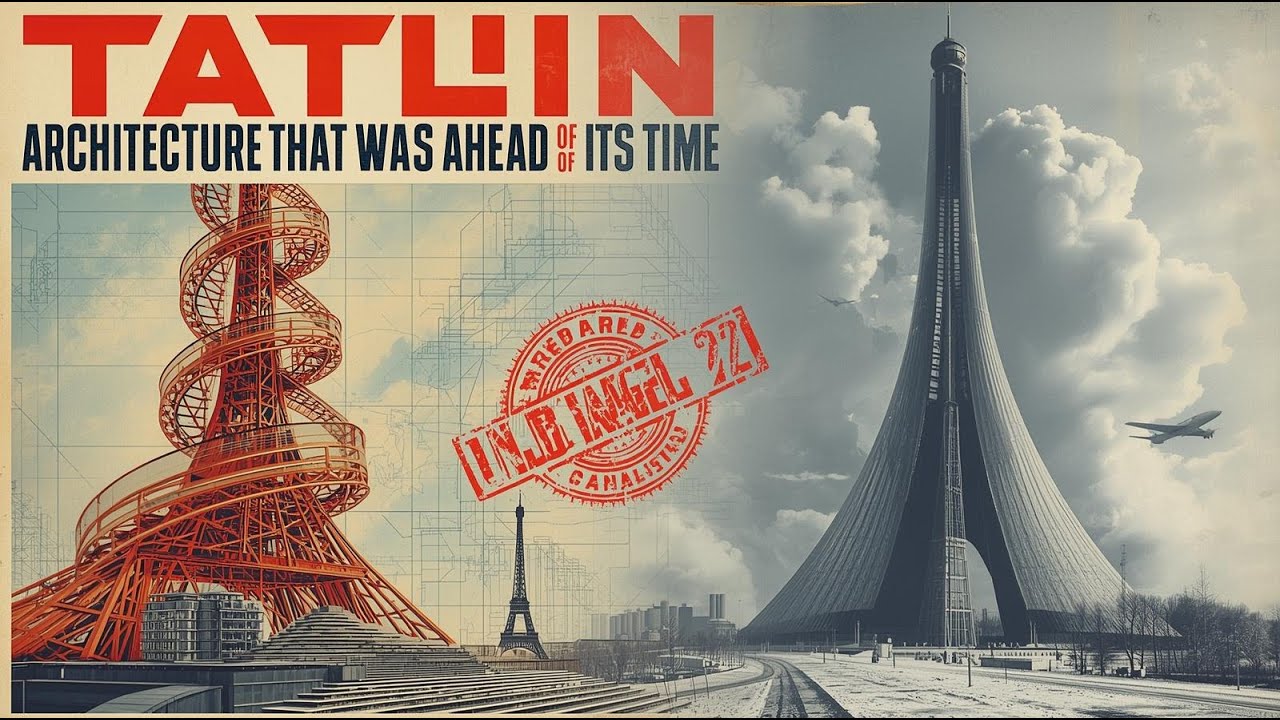
In the chaotic, revolutionary fervor of 1919, a vision was born that challenged every existing law of architecture and physics: the Monument to the Third International, better known as Tatlin’s Tower. Designed by the visionary Vladimir Tatlin, this colossal iron and glass spiral was intended to stand 400 meters tall—surpassing the Eiffel Tower—in the heart of St. Petersburg. It was not just a building, but a massive, kinetic sculpture of the revolution. Yet, this "grandeur" exists only in blueprints and models; it remains one of the most famous vanished architectural dreams, a structure forbidden by the very reality it sought to transform.
The Machine of the State: Geometry in Motion
What made Tatlin’s Tower truly revolutionary was its movement. The design featured four massive geometric glass volumes—a cube, a pyramid, a cylinder, and a hemisphere—each rotating at different speeds: once a year, once a month, once a day, and once an hour. This was kinetic architecture on a megalithic scale, intended to function as the nerve center for global communism, housing legislative meetings, executive branches, and a radio station that would project slogans directly onto the clouds.
The Material and Ideological Ban
Despite the immense political will of the early Soviet era, the tower was never built. The primary reason was a catastrophic shortage of steel in post-revolutionary Russia; building it would have required more iron than the entire country produced in a year. Furthermore, the 23.5-degree tilt (mirroring the Earth's axis) created structural stresses that 1920s engineering simply couldn't solve. As the political climate shifted toward Stalinist "heavy" monumentality, the light, abstract Constructivism of Tatlin was branded as "Formalism" and effectively banned. The Tower became the ultimate icon of "Paper Architecture"—a masterpiece preserved only on drafting tables.
The Ghost Legacy of the Spiral
Though it never rose from the ground, Tatlin’s Tower changed the world. Its "de-materialized" lattice-work DNA can be found in modern masterpieces like the Pompidou Center in Paris and the Gherkin in London. It stands as a "retro-future" icon in pop culture and a mandatory case study for architects who dream of the impossible. Its vanished grandeur is preserved in its purest, most idealistic form, forever young and forever revolutionary.
Join us on VANISHED GRANDEUR as we explore the phantom of the iron spiral and the brief moment when art and revolution spoke the same language.
Next Episode: The Lost Cities of the Amazon: The Forbidden Truth of Pre-Columbian Urbanism.
Subscribe and let us know in the comments: Should we try to build Tatlin’s Tower today with modern materials, or should it remain a dream?
Tatlin's Tower, Vladimir Tatlin, Monument to the Third International, Constructivist Architecture, Soviet Avant-Garde, Paper Architecture, Kinetic Architecture, Russian Revolution History, Unbuilt Projects, St. Petersburg History, Industrial Design, Iron and Glass Structure, 1920s Architecture, Formalism Soviet Union, Megalithic Sculptures, High-Tech Architecture, Norman Foster Inspiration, Engineering Dreams, Vanished Grandeur, Revolutionary Art, Constructivism, Petrograd, Architectural Models, Steel Shortage Russia, History of Design, Utopian Architecture, Radio Propaganda Tower, Third International, Geometric Architecture, Future That Never Was.
#TatlinsTower, #Architecture, #Constructivism, #SovietHistory, #VanishedGrandeur, #ArtHistory, #Unbuilt, #RevolutionaryArt, #Engineering, #HistoryDocumentary, #StPetersburg, #DesignHistory, #KineticArchitecture, #AvantGarde, #RussianHistory, #ModernArchitecture, #Utopia, #PaperArchitecture, #IronAndGlass, #1920s, #VladimirTatlin, #Blueprint, #ArchitecturalMystery, #TechnologicalHistory, #IndustrialDesign, #RetroFuture, #HistoricalLoss, #LostMasterpieces, #CreativeGenius, #Documentary

Информация по комментариям в разработке