TNEA 2024 Round 1 Course Seat Allocation Analysis
CSE (Computer Science and Engineering)
Seats: 5202
Percentage: 29.40%
Description: CSE dominates the seat allocation in TNEA 2024 Round 1, with nearly one-third of the total seats, reflecting its continued popularity among engineering aspirants.
ECE (Electronics and Communication Engineering)
Seats: 2939
Percentage: 16.62%
Description: ECE holds the second-largest share of seats, showing strong demand as a core engineering discipline
AI&DS (Artificial Intelligence and Data Science)
Seats: 2046
Percentage: 11.60%
Description: AI&DS is a prominent emerging field, capturing a significant portion of seats, indicating its growing importance in the tech industry.
IT (Information Technology)
Seats: 1988
Percentage: 11.20%
Description: IT remains a key area of study, closely following AI&DS, and is a popular choice among students interested in the software industry.
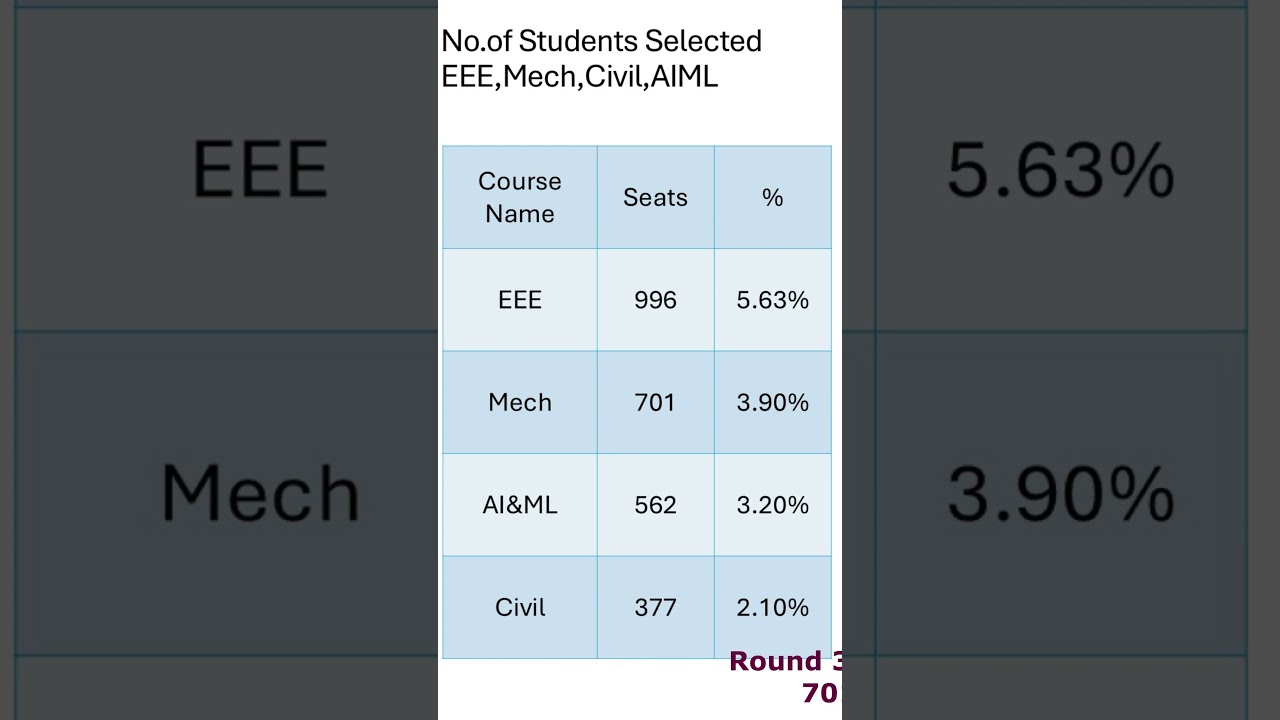
EEE (Electrical and Electronics Engineering)
Seats: 996
Percentage: 5.63%
Description: EEE continues to be a solid choice, with a moderate share of seats, catering to those interested in electrical systems and electronics.
Mechanical Engineering
Seats: 701
Percentage: 3.90%
Description: Mechanical Engineering, a traditional core branch, holds a lower share of seats compared to its historical standing, reflecting changing industry demands.
AI&ML (Artificial Intelligence and Machine Learning)
Seats: 562
Percentage: 3.20%
Description: AI&ML, a highly specialized and emerging field, has a modest share of seats, underlining its relevance in modern engineering education.
Civil Engineering
Seats: 377
Percentage: 2.10%
Description: Civil Engineering has a smaller allocation, indicating a shift in student preferences toward more technology-focused disciplines.
CSBS (Computer Science and Business Systems)
Seats: 306
Percentage: 1.70%
Description: CSBS, a hybrid course combining computer science and business, has a niche but growing presence.
Cyber Security
Seats: 301
Percentage: 1.70%
Description: Cyber Security, an increasingly vital field, has a similar allocation to CSBS, emphasizing the importance of digital safety.
Biomedical Engineering (BME)
Seats: 199
Percentage: 1.12%
Description: BME has a small allocation, reflecting its specialized nature, appealing to students interested in the intersection of healthcare and engineering.
Mechatronics Engineering
Seats: 113
Percentage: 0.60%
Description: Mechatronics, an interdisciplinary field, has a limited seat share, highlighting its role in advanced manufacturing and robotics.
CS Design
Seats: 73
Percentage: 0.40%
Description: CS Design has a minor allocation, catering to students interested in the design aspects of computer systems.
M.Tech CSE
Seats: 69
Percentage: 0.30%
Description: M.Tech in CSE has a very small seat allocation, focusing on postgraduate specialization in Computer Science.
Computer and Communication Engineering (CC)
Seats: 61
Percentage: 0.30%
Description: CC, a niche area combining computing and communication technologies, has a minimal presence.
CSE with IoT (Internet of Things)
Seats: 21
Percentage: 0.10%
Description: CSE with IoT, a highly specialized course focusing on the Internet of Things, has the smallest allocation, reflecting its emerging status.
This analysis highlights the distribution of seats across various engineering disciplines, with a clear emphasis on computer science and related fields, demonstrating their prominence in the current academic landscape.
Music Attribution:
Royalty Free Music: Bensound.com/royalty-free-music
License code: QPJO6QB5DFWF4XQA

Информация по комментариям в разработке