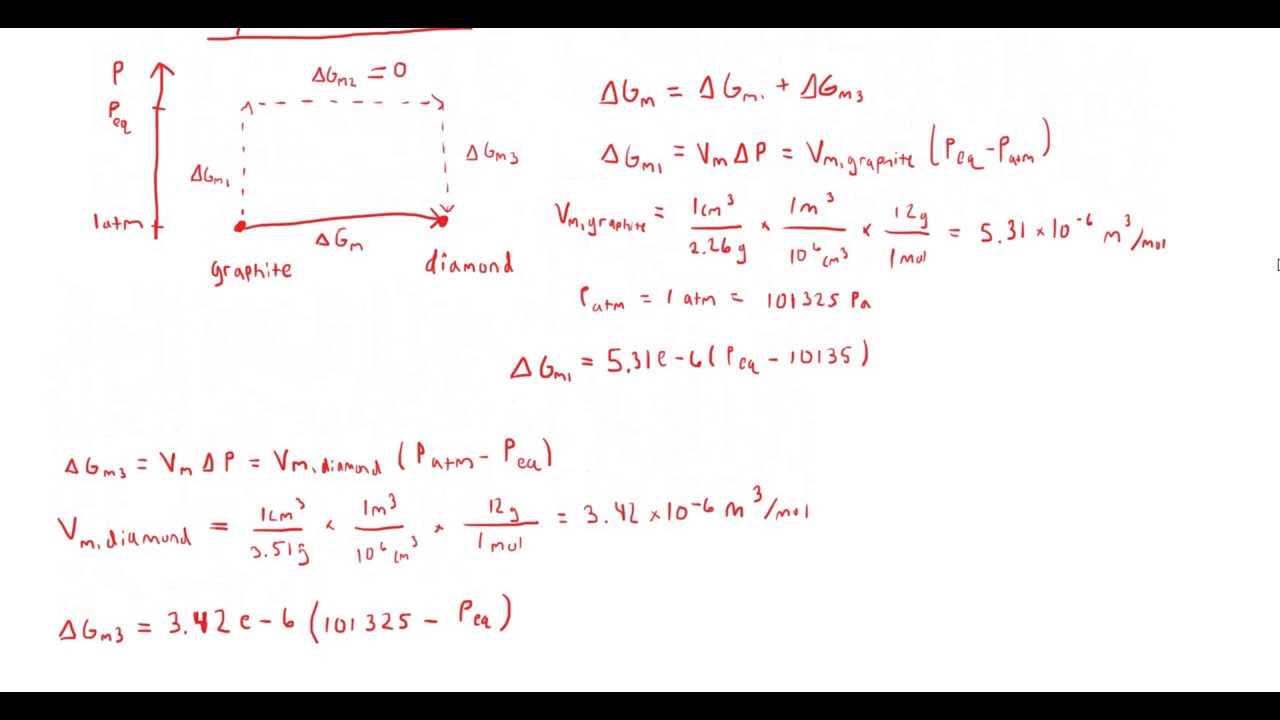
A walk through of an example problem using a hypothetical process to determine equilibrium pressure:
Tired of studying thermo, you come up with the idea of becoming rich by manufacturing diamond from graphite. To do this process at 25°C requires increasing the pressure until graphite and diamond are in equilibrium. The following data are available at 25°C:
Dg125°C, 1 atm2 5 gdiamond 2 ggraphite 5 2866 3J/mol4
rdiamond 5 3.51 3g/cm34
rgraphite 5 2.26 3g/cm34
Estimate the pressure at which these two forms of carbon are in equilibrium at 25°C.
Purdue University Omega Chi Epsilon
Text: Engineering and Chemical Thermodynamics by Koretsky 2nd edition
Topics: Hypothetical Process, equilibrium pressure, gibbs free energy, Thermodynamics, Thermodynamic Property Relations, Maxwell Relations, Thermodynamic relations, example problem, fixed temperature, fundamental property relations, chemical thermodynamics, chemical engineering, thermodynamic properties, how to, engineering, Purdue University, chemical engineering, Purdue university chemical engineering, CHE 211, Introduction to thermodynamics, Hypothetical Process, equilibrium pressure, gibbs free energy, Thermodynamics, Thermodynamic Property Relations, Maxwell Relations, Thermodynamic relations, example problem, fixed temperature, fundamental property relations, chemical thermodynamics, chemical engineering, thermodynamic properties, how to, engineering, Purdue University, chemical engineering, Purdue university chemical engineering, CHE 211, Introduction to thermodynamics, Hypothetical Process, equilibrium pressure, gibbs free energy, Thermodynamics, Thermodynamic Property Relations, Maxwell Relations, Thermodynamic relations, example problem, fixed temperature, fundamental property relations, chemical thermodynamics, chemical engineering, thermodynamic properties, how to, engineering, Purdue University, chemical engineering, Purdue university chemical engineering, CHE 211, Introduction to thermodynamics,
Tired of studying thermo, you come up with the idea of becoming rich by manufacturing diamond from graphite. To do this process at 25°C requires increasing the pressure until graphite and diamond are in equilibrium. The following data are available at 25°C:
Dg125°C, 1 atm2 5 gdiamond 2 ggraphite 5 2866 3J/mol4
rdiamond 5 3.51 3g/cm34
rgraphite 5 2.26 3g/cm34
Estimate the pressure at which these two forms of carbon are in equilibrium at 25°C.
Tired of studying thermo, you come up with the idea of becoming rich by manufacturing diamond from graphite. To do this process at 25°C requires increasing the pressure until graphite and diamond are in equilibrium. The following data are available at 25°C:
Dg125°C, 1 atm2 5 gdiamond 2 ggraphite 5 2866 3J/mol4
rdiamond 5 3.51 3g/cm34
rgraphite 5 2.26 3g/cm34
Estimate the pressure at which these two forms of carbon are in equilibrium at 25°C.















Информация по комментариям в разработке