Dolley (Payne) Todd Madison (1768–1849) lived through three wars, knew eleven presidents, and was a gracious and influential personality in the political landscape of Washington for fifty years.
Born on May 20, 1768, while her Virginia parents were temporarily in North Carolina, Dolley Payne was raised at Scotchtown near Ashland, Virginia. Her parents were Quakers, and in 1783 the family moved to Philadelphia where Dolley later married John Todd, Jr. Her husband and infant son both died during a yellow fever epidemic in 1793. Dolley and her other son, John Payne, barely survived.
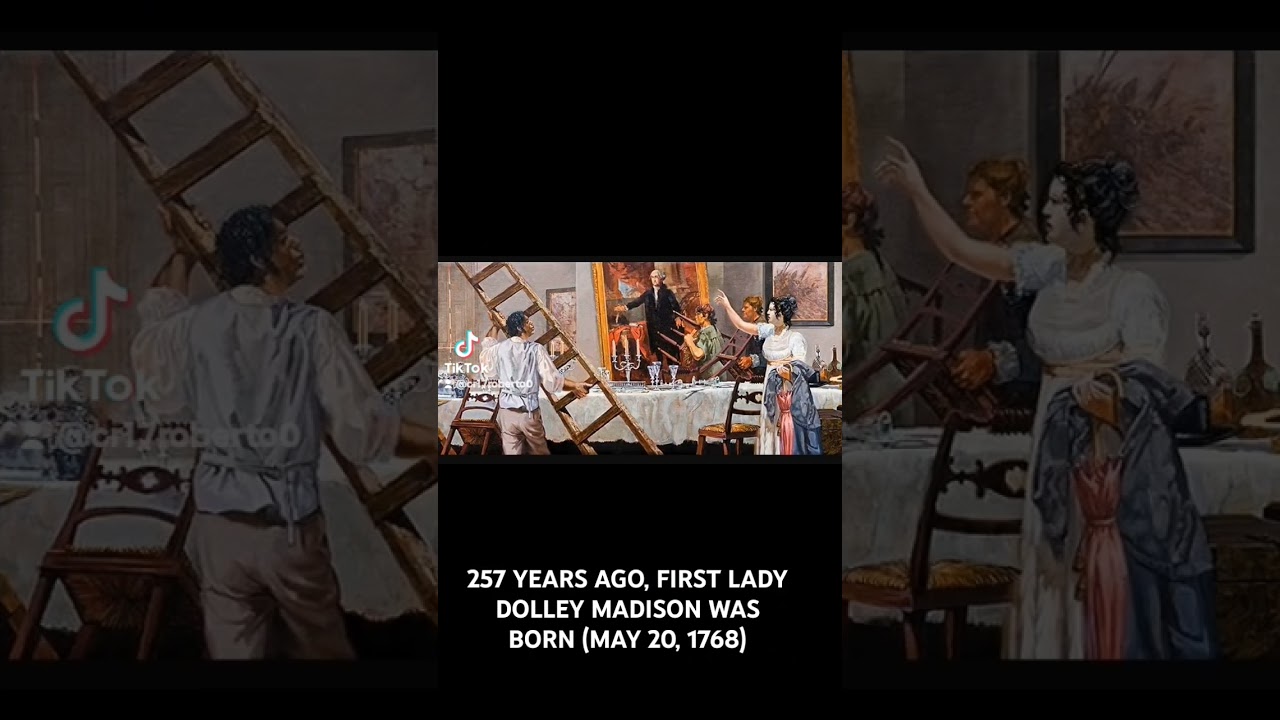
Despite her Quaker upbringing, Dolley played cards, dipped snuff, and enjoyed the latest fashions. And she ensured her place in history textbooks by rescuing important state papers and a portrait of George Washington when the British set fire to the White House during the War of 1812.
Madison was born as Dolley Payne on May 20, 1768, at Paines Tavern in Person County, North Carolina to Mary Coles and John Payne Jr. and lived with her family in a log cabin in New Garden, Guilford County (present-day Greensboro), North Carolina. Her parents had married in 1761, uniting two prominent Virginian families. Little is known about the family's life before 1793, when Madison was 25, because few documents have survived; Madison's earliest known letter dates to 1783. Mary Coles was from a Quaker family and two years after their marriage the couple applied for membership in the Cedar Creek meeting. The application was considered for a very lengthy time before they were admitted in 1765. He would become a fervent member of the faith. The family had moved to New Garden, a Quaker community, in 1765. Madison was the family's third child and first daughter. The family had an enslaved nursemaid.
In early 1769, the Paynes returned to Virginia for reasons that are unclear. Historians Catherine Allgor and Richard N. Côté have speculated in their biographical works on her that the family may have wanted to return to their extended family, become uncomfortable with the religion, faced local opposition, or failed at farming or business. Madison would later downplay her North Carolina birth, claiming herself to be a Virginian born when visiting an uncle in North Carolina. The family returned to Cedar Creek, where within four years they had moved at least twice. They eventually settled on a 176-acre (71 ha) farm several miles outside of Scotchtown. Madison grew up on the farm, working the land with the rest of her family. She was given a strict Quaker upbringing and education, which Côté describes her as "chafing" under.
Madison grew close to her extended family in the area. She had three younger sisters (Lucy, Anna, and Mary) and four brothers (Walter, William Temple, Isaac, and John), two of whom were younger. Her father did not participate in the American Revolutionary War, as his faith practiced pacifism, and Allgor writes that Madison was seemingly little affected by it. By 1783 John Payne had emancipated his enslaved people, as did numerous slaveholders in the Upper South. Payne, as a Quaker, had long encouraged manumission, but the act was not legal in Virginia until 1782.
When Madison was 15, Payne moved his family to Philadelphia, at the time the second largest American city. They lived at 57 North Third Street, and transferred to the local Northern District Meeting. While living there, Madison often visited Haddonfield, New Jersey, where many Quakers lived. She also met Eliza Collins and Dorothea Abrahams in Philadelphia, with whom she became lifelong friends. During her early years, Payne likely received formal education, though it is not known what this was. Allgor concludes that it was likely better than most Americans at the time, while Côté notes that it was probably "no more than a basic" one. Madison grew into a young woman who Côté writes was described "as one of the fairest of the fair".
Upon the family's move to Philadelphia, John had attempted to build a career as a starch manufacturer, but the business failed in 1789. This was seen as a "weakness" at his Quaker meetings, for which he was expelled. He was devastated by this failure and died on October 24, 1792. Mary Payne initially made ends meet by opening her home as a boardinghouse beginning in 1791. Before his death, John had arranged Madison's marriage to John Todd, a Philadelphia lawyer. According to Allgor, Madison had rejected marriage with Todd previously and John's marriage arrangement was "manipulation". Conversely, Côté considers their marriage to have been "for love, not just duty". They were married on January 7, 1790, at a Quaker meeting house. Madison's friend Eliza Collins was her bridesmaid. The couple moved several blocks away into a high-quality neighborhood.

Информация по комментариям в разработке