Aloe striata Haw.
Common Name: Coral Aloe
Family: Asphodelaceae
Taxonomy & Etymology
Aloe striata was first formally described by botanist Adrian Hardy Haworth in 1804. The specific epithet striata means “striated” or “striped,” referring to the faint longitudinal lines visible on its leaves . It belongs to the Paniculatae series of aloes, closely related to Aloe reynoldsii, though A. striata is distinguished by its smooth (untoothed) leaf margins and distinctive coral-red flowers .
Native Range & Habitat
This species is endemic to the Cape Floristic Region of South Africa—specifically the Eastern and Western Cape provinces . It thrives on rocky slopes and coastal or karoo outcrops, where it’s exposed to sun, wind, and well-draining soils .
Morphology & Description
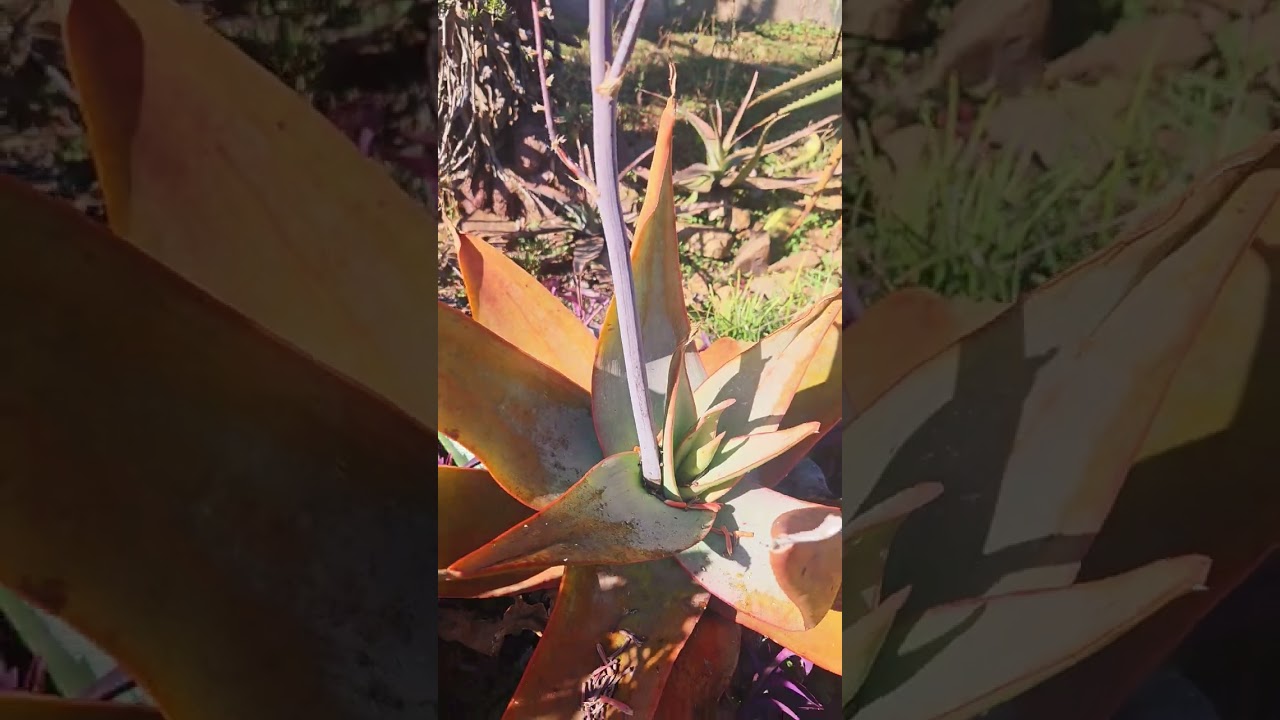
A. striata forms a stemless, rosette-forming succulent, growing to approximately 30–60 cm tall and wide . Leaves are broad, fleshy, and paddle-like—typically pale bluish-green, often fading toward pinkish tints in full sun, or gaining soft blue-gray hues in shade . Leaves are smooth-edged, lacking teeth, and bear subtle longitudinal striations .
Flowers & Blooming
In late winter to early spring, mature plants send up branched, candelabra-like inflorescences, often reaching 60–90 cm tall . These bear clusters of tubular coral-red to orange flowers, which typically attract pollinators such as bees and birds . When heated, these floral displays can last for several weeks, brightening winter gardens .
Ecological Adaptations
A. striata has evolved several traits to withstand its arid, sun-drenched habitats:
CAM photosynthesis for water-use efficiency.
Frost tolerance to around –4 °C, making it more cold-hardy than many succulents .
Sun-adapted leaf coloration, including pinkish margins and deeper tones in bright light to reduce water loss and sun damage.
Cultivation & Care
This species is prized in succulent landscapes and containers for its striking form and durable growth:
Light Requirements: Full sun is ideal for color, form, and flowering; partial shade acceptable in hot climates .
Soil: Needs excellent drainage. A sandy, loamy mix with grit or perlite mimics its native habitat .
Watering: Moderate during spring and summer; reduce in winter. Let soil dry between waterings to avoid root rot .
Hardiness: USDA zones 9–11; tolerates light frost in dry conditions when dormant .
Maintenance: Low; remove spent flower stalks, and an occasional feeding with a balanced cactus fertilizer encourages bloom .
Propagation
Offsets (Pups): Short-lived or rare; A. striata is primarily solitary.
Seeds: More common method—plants produce seeds after flowering, though maturity and bloom may take time.
Leaf or head cuttings: Possible but slow; ensuring adequate drying before planting is essential to success.
Toxicity
Not known to be toxic; generally considered safe for homes and gardens. As with most succulents, sharp leaf edges may cause mild irritation with rough handling.
Horticultural Significance
Aloe striata stands out for its architectural rosette, frost resilience, and radiant flower display. With its window-filtering coloration and winter blooms, it’s ideal for rock gardens, coastal landscapes, desert borders, or containers . It’s also an excellent focal point in indoor succulent collections.
Summary
Aloe striata (Coral Aloe) is a stemless South African succulent that combines elegance with resilience. Its paddle-shaped, smooth-edged leaves—often flushed pink in the sun—form a compact rosette. In late winter to early spring, tall clusters of vibrant coral flowers emerge, creating a dramatic focal display. With adaptations to sun, drought, and mild frost, it is versatile, low-maintenance, and a standout in succulent gardens and botanical collections.

Информация по комментариям в разработке