Logo video2dn
  • Сохранить видео с ютуба
  • Категории
    • Музыка
    • Кино и Анимация
    • Автомобили
    • Животные
    • Спорт
    • Путешествия
    • Игры
    • Люди и Блоги
    • Юмор
    • Развлечения
    • Новости и Политика
    • Howto и Стиль
    • Diy своими руками
    • Образование
    • Наука и Технологии
    • Некоммерческие Организации
  • О сайте

Скачать или смотреть ECG basics (1.2). Physics of ECG recordings

  • Kunole
  • 2025-05-18
  • 59
ECG basics (1.2). Physics of ECG recordings
ECGRecordingrecordphysicsdepolariztionrepolarizationwavedirection
  • ok logo

Скачать ECG basics (1.2). Physics of ECG recordings бесплатно в качестве 4к (2к / 1080p)

У нас вы можете скачать бесплатно ECG basics (1.2). Physics of ECG recordings или посмотреть видео с ютуба в максимальном доступном качестве.

Для скачивания выберите вариант из формы ниже:

  • Информация по загрузке:

Cкачать музыку ECG basics (1.2). Physics of ECG recordings бесплатно в формате MP3:

Если иконки загрузки не отобразились, ПОЖАЛУЙСТА, НАЖМИТЕ ЗДЕСЬ или обновите страницу
Если у вас возникли трудности с загрузкой, пожалуйста, свяжитесь с нами по контактам, указанным в нижней части страницы.
Спасибо за использование сервиса video2dn.com

Описание к видео ECG basics (1.2). Physics of ECG recordings

12-lead ECG is conventional. Using ten electrodes, twelve leads are recorded. At least two electrodes are needed to record one lead.
So, what is a lead? The electrical activity of the heart can be recorded from different directions. Each direction is described as a lead. The lead represents the electrical potential difference between two electrodes attached to the body surface. Such a pair of electrodes forms a dipole consisting of positive and negative poles.
Six leads are recorded using only four electrodes attached to each limb. These are limb leads. They represent the electrical activity of the heart in a vertical plane. These leads are called I, II, III, aVR, aVL, aVF. Sometimes leads aVR, aVL, aVF are also called augmented. Often in the designation of the last three leads, letter ‘a’ is omitted.
Precordial (also called chest) leads require both chest electrodes and limb electrodes. They represent electrical activity of the heart in a horizontal plane. Inaccurate electrode placement may significantly influence on ECG patterns and lead to inappropriate patient’s management. Precordial leads are called in accordance to the nomenclature of chest electrodes: V1, V2, V3, V4, V5, V6.
Neutral electrode placed is also called electrical earth or point zero, to which the electrical current is measured.
Leads I, II and III are recorded as electrical potential difference between two limb electrodes as a positive and negative pole.
Leads aVR, aVL, aVF are recorded as electrical potential difference between Goldberg’s central terminal as a negative pole and input of another limb electrode as a positive pole. Goldberg’s central terminal is a combination of inputs from two limb electrodes.
Precordial leads (from V1 to V6) are recorded using Wilson's central terminal which is average electrical potential measured from three limb electrodes placed on the right arm, left arm and left foot.
If the depolarization wave moves toward the positive pole of a certain lead, an ECG trace shows a positive deflection. For example, electrodes of lead I are placed on the horizontal level. The direction of the depolarization wave corresponds to the direction of lead I. This causes a positive deflection in the ECG trace.
If the depolarization wave moves away from the positive pole of a certain lead, an ECG trace shows a negative deflection. The direction of the depolarization wave is opposite to the direction of lead I. This causes a negative deflection in the ECG trace.
If the direction of the depolarization wave is perpendicular to the direction of the certain lead, there is no positive and negative deflections. The absence of any deflections in the ECG trace is seen if the direction of the depolarization wave is perpendicular to the direction of a certain lead.
In real conditions, the direction of the depolarization wave is not constant. Therefore, different amplitudes of the positive and negative deflections may be seen.
A conventional ECG records an electrical activity of the heart from the different directions. They are defined in terms of the angle relative to the horizontal line.
Precordial (chest) leads represent an electrical activity of the heart in the horizontal plane. The approximate angles of the leads in relation to the right-to-left line are shown below. There is no need to memorize them. They are just for better understanding.
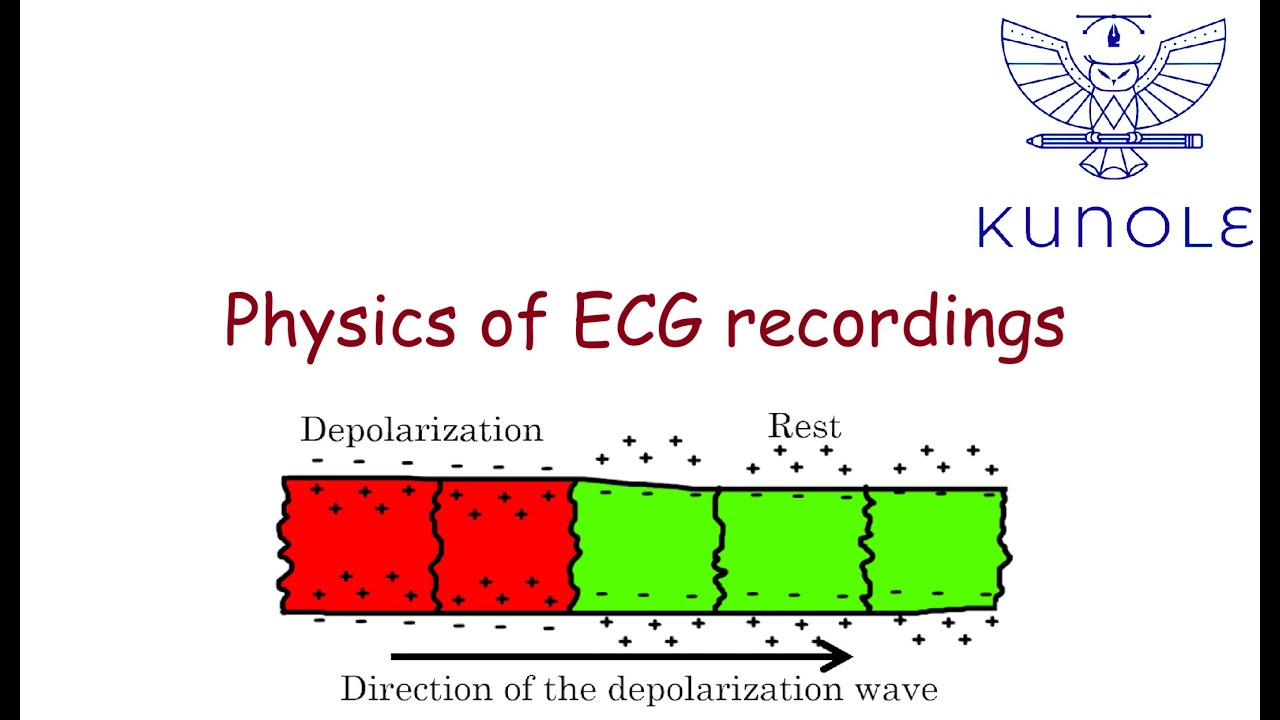
The cardiac cycle consists of contraction and relaxation. An electrical impulse is needed for heart contraction. The electrical impulse causes depolarization of the cardiomyocytes. ‘Depolarization’ means the change of the cardiomyocyte charge from negative to positive. The charge outside the cardiomyocytes is opposite to the charge inside the cells (negative during depolarization and positive at rest and during repolarization). ‘Repolarization’ means a return of the positive charge of cardiomyocyte to the negative one that is observed at rest.
During myocardial depolarization, there are cardiomyocytes that have already been depolarized and cardiomyocytes that haven’t yet been depolarized. Depolarization spreads on the adjacent cardiomyocytes resulting in the depolarization wave. ECG records the mean direction of the depolarization wave as deflections in the ECG trace. Repolarization is recorded in a similar way.

Комментарии

Информация по комментариям в разработке

Похожие видео

  • О нас
  • Контакты
  • Отказ от ответственности - Disclaimer
  • Условия использования сайта - TOS
  • Политика конфиденциальности

video2dn Copyright © 2023 - 2025

Контакты для правообладателей [email protected]