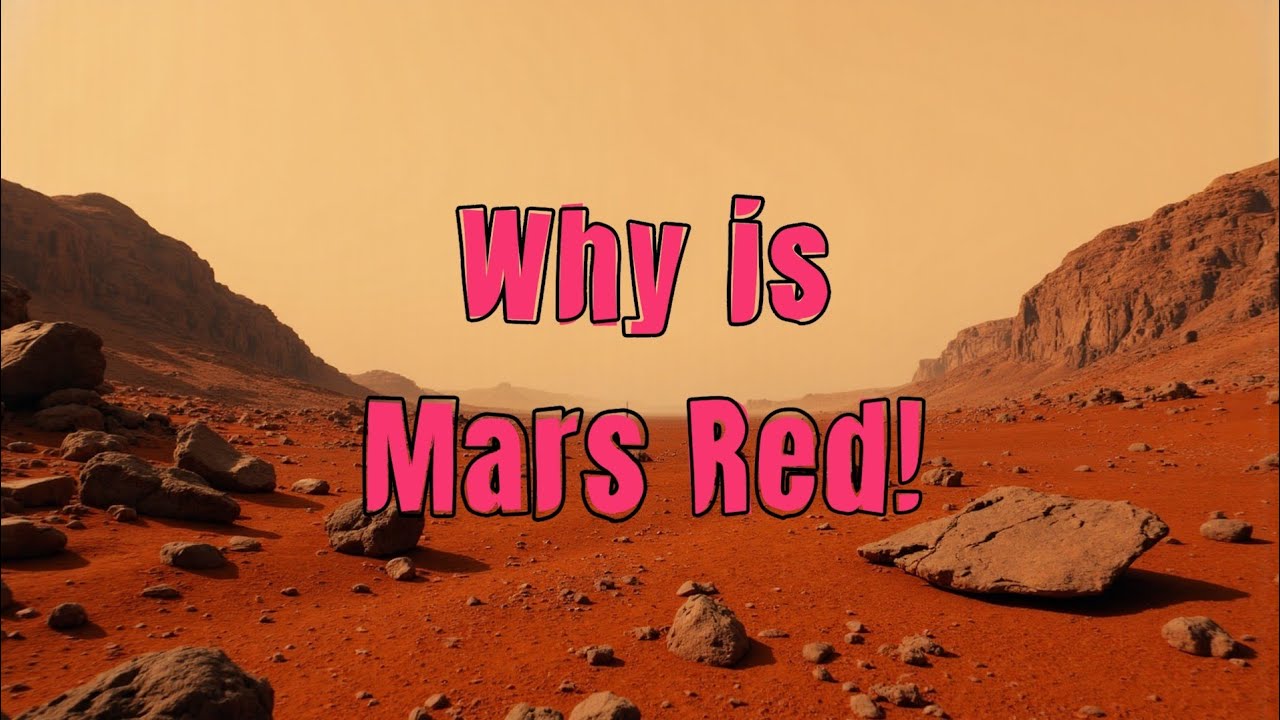
Mars, known as the Red Planet, owes its distinctive rusty hue to iron oxide formed over billions of years. Unlike Earth, Mars lacks oceans and vegetation, leaving its iron-rich surface exposed to the thin atmosphere, leading to rusting. Dust storms further enhance its red appearance from afar. This color hints at Mars' watery past, reminding us of the unique beauty of our solar system and the design of a creator.#Mars #RedPlanet #SpaceExploration #Astrobiology #PlanetaryScience
00:00-00:05
When you look at pictures of Mars, one thing immediately stands out. It's red.
00:05-00:14
Not blue like Earth, not pale yellow like Venus, but a dusty, rusty red. That's why we call it the Red Planet.
00:14-00:28
But why does Mars look this way? What makes it so different from the other planets? The answer begins with iron. Just like Earth, Mars has a lot of iron in its rocks and soil.
00:28-00:41
But unlike Earth, Mars doesn't have oceans or thick vegetation to cover its surface. Instead, much of its ground is bare and exposed. Over billions of years,
00:41-00:49
this iron mixed with oxygen in the thin Martian atmosphere. And what happens when iron meets oxygen?
00:49-01:08
It rusts, just like a nail left out in the rain. That rusty material, called iron oxide, coats the dust and rocks all over Mars. And that's why, when sunlight hits the surface, Mars reflects back a reddish color.
01:08-01:24
But here's something fascinating. Mars isn't always bright red up close. Astronauts and rovers that have landed there discovered the soil can actually look brown, golden, or even butterscotch-colored.
01:24-01:32
The red is most visible from far away because tiny dust particles float high into the atmosphere and scatter light.
01:32-01:39
It's this dusty haze that makes the whole planet look red when viewed from space or through a telescope.
01:39-01:50
And Mars is very dusty. The planet experiences massive dust storms, sometimes so big they cover the entire planet for weeks.
01:50-02:07
During these storms, red dust is lifted high into the sky, giving Mars its signature look. Imagine standing on the surface and watching a red-tinted storm blur out the horizon. It would feel like being in the middle of a never-ending desert.
02:07-02:14
Now, why is this important? Because the color of Mars tells us about its history.
02:14-02:21
Billions of years ago, scientists believe Mars may have had rivers, lakes, and even seas.
02:21-02:35
Water helped iron mix with oxygen, spreading that reddish rust everywhere. Today, those waters are gone, but the rusty fingerprints remain, painting Mars forever red.
02:35-02:47
But here's a deeper reflection. The fact that each planet in our solar system looks so unique, Earth's blue oceans, Saturn's golden rings,
02:47-02:56
Jupiter's swirling storms, and Mars's red deserts, reminds us of the incredible variety and balance in the universe.
02:56-03:07
This beauty and order is not an accident. It is part of the design of God, the creator of everything. So the next time you see a picture of
03:07-03:24
Mars glowing red in the night sky, remember, it's not just a distant planet. It's a story written in rust, a reminder of the history of worlds, and a sign of the wisdom of the one who made them all.

Информация по комментариям в разработке