Ca. 2.1 Ga impact spherules from the Rae Province, northern Canada: age, origin and possible significance
John Percival
Geological Survey of Canada
Recent work on the lower Montresor belt, part of the Rae cover sequence of
mainland Nunavut, revealed a 7-cm-thick spherule bed in a weakly deformed and metamorphosed mudstone. Its age is bracketed by detrital zircons in associated sandstone to less than 2189±5 Ma and more than 2045±13 Ma, the U-Pb age of zircon in a boudinaged gabbro dyke. Carbonaceous units in the correlative lower Amer Group 150 km to the south have a Re-Os age of 2126±24 Ma (Jefferson et al., 2023, CJES 60, 1005–1039). Unlike the Zaonega Fmn (Karelia) and Graenso (Greenland) spherule beds, inferred to be ejecta from the ca. 2020 Ma Vredefort impact event, the Montresor bed could relate to the ca. 2.1-2.05 Ga termination of the Lomagundi carbon isotopic excursion. In light of the potential significance of an impact event to atmospheric evolution models, we conducted extensive mineralogical, geochemical and geochronological studies of the spherule bed.
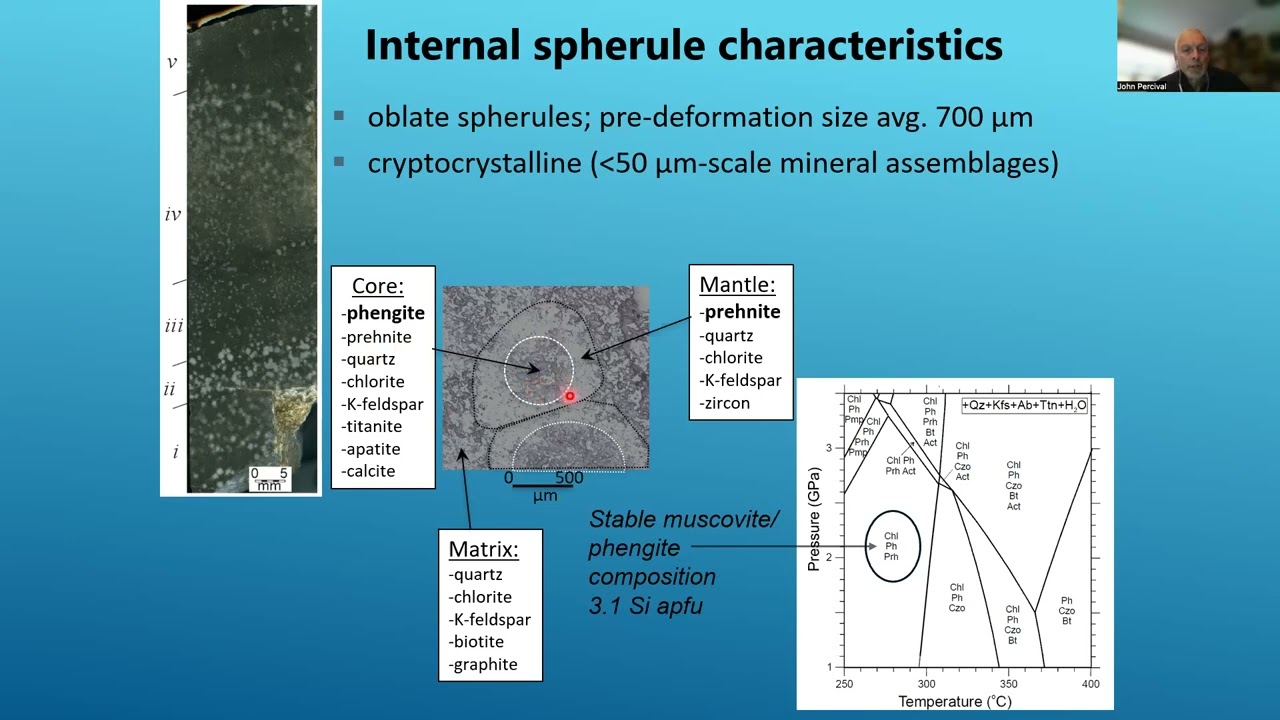
Macroscopically, the spherules are oblate (flattened ca. 3:1), with an average strain-corrected size of 700 μm. Some primary features are preserved through less than 310°C, less than 0.34 GPa metamorphism at ca. 1.85 Ga. Spherules are zoned, with potassic (phengite-rich) cores and calcic (prehnite-quartz-chlorite-K-feldspar) mantles. The cores are an amalgam of μm-scale phengite particles transected by nanometric amorphous lamellae. Their compositions (up to 3.72 afu Si) suggest crystallization at pressures up to ca. 8 GPa. Small (less than 50 μm), complex zircons provided U-Pb ages of 2.83-2.09 Ga, with large uncertainty. Spherules are inferred to have accreted from fine dust in the atmosphere prior to deposition in a basin distal from the impact site.
Possible seawater-diagenetic-metamorphic alteration effects were explored through elemental maps (LA-ICP-MS). The clearest evidence of spherule-matrix interaction is decline of Fe, Mg, Co, Ni, Mn and Zn contents across the outer ~250 μm of the spherules, suggesting inward diffusion. However, other chemical patterns such as similar distribution of fluid-mobile (e.g. Li, Sr) and immobile (e.g., W, Sc, Nb, Ta) trace elements point to preservation of primary composition. Bulk spherule compositions may thus provide clues to the nature of the source terrane. Relative to average upper continental crust (AUCC), compositions are enriched in potassium and calcium, with less sodium and iron. Light rare earths are slightly lower and HREE slightly higher than AUCC. Spherules are strongly enriched in high field-strength elements (HFSE), considered generally immobile during secondary processes (Nb=3.1 x AUCC; Zr=2.3 x AUCC), implicating a rare HFSE-rich source material. Some ratios (avg Nb/Ta=29; Zr/Hf=53; Nb/La=3.2) are well above chondritic values, unlike those that characterize almost all terrestrial materials. Together, the presence of relict phengite, HFSE-rich character and super-chondritic HFSE ratios provide challenges in defining plausible terrestrial source terrane characteristics and introduce the possibility that the impactor was exotic to the solar system.

Информация по комментариям в разработке