Building Homes from Rice Waste: Turning Husks into Sustainable Bricks
by AZLAN ADNAN, M.A.
Saturday, 9 August 2025
• Building Homes from Rice Waste: Turning Hu...
In recent years, innovators across the world have been finding ingenious ways to turn agricultural by-products into valuable building materials. Among the most promising of these is the humble rice husk—a by-product of rice milling that is often discarded or burned, contributing to pollution. From Central Asia to Europe, rice husks are being transformed into strong, insulating bricks and blocks, offering an eco-friendly alternative to traditional construction materials.
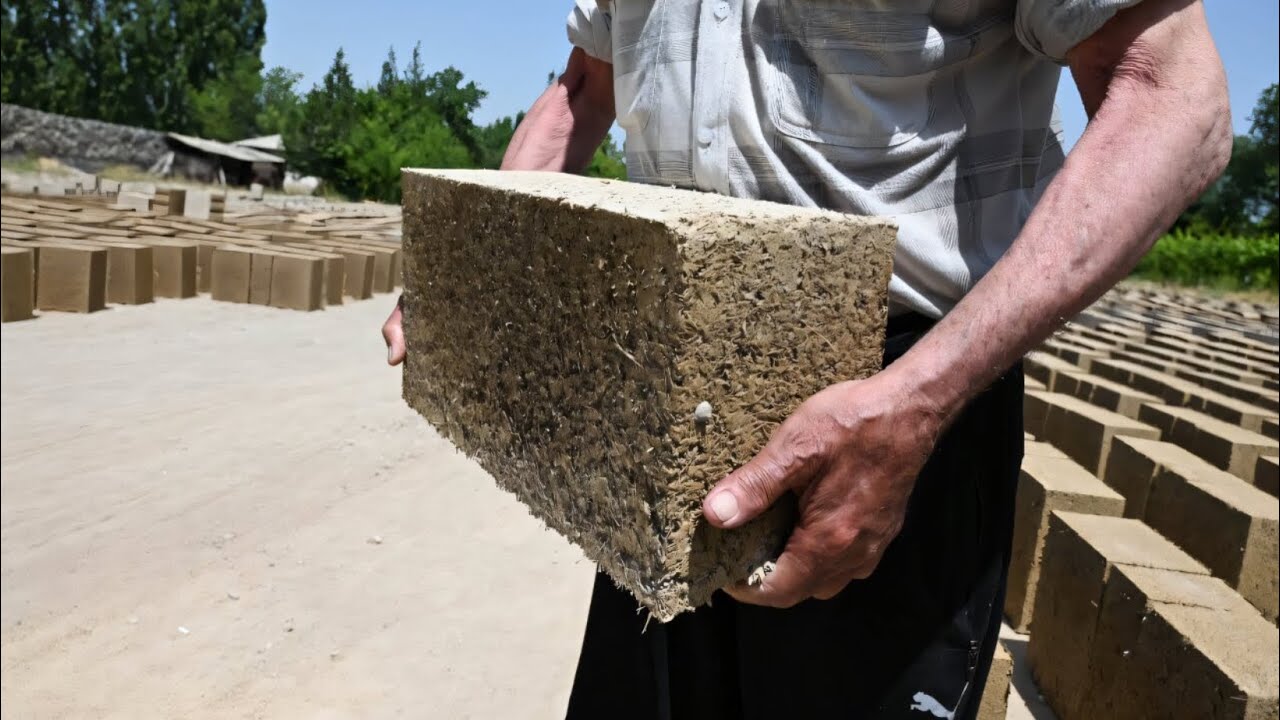
In the Batken region of southern Kyrgyzstan, entrepreneur Nursultan Taabaldyev has pioneered the production of eco-bricks made from around 60% rice husks mixed with clay, cement, and a chemical-free adhesive. After being air-dried, these bricks exhibit thermal performance and strength comparable to conventional cement blocks. Over the past five years, more than 300 houses have been built using them. Residents report that these homes remain warm in winter and cool in summer, significantly cutting heating costs while reducing carbon emissions and agricultural waste.
Academic research reinforces the benefits of rice husks in brickmaking. Studies have shown that adding between 5% and 10% rice husk to fired clay bricks yields compressive strengths between 7 and 10 megapascals—more than adequate for indoor structural applications—while also improving insulation due to the increased porosity. In Bangladesh, bricks made by replacing 5% of clay with rice husk ash have demonstrated high compressive strength, low water absorption, and excellent density, making them suitable for internal walls and temporary structures. In adobe bricks, small additions of rice husk—between 1% and 3% by weight—have been found to increase strength, reduce shrinkage, and improve thermal and acoustic properties. Even in ceramic brick production, rice husk ash content of up to 15% improves insulation and reduces weight, though such bricks are best reserved for non-structural uses where high mechanical strength is not required.
In some parts of the world, low-tech building methods also make use of rice hulls. The “rice-hull bagwall” technique involves filling sturdy bags or long tubes with untreated rice hulls, stacking them with barbed wire reinforcement, and then encasing the structure in mesh and stucco. When treated with boric acid or borax, these walls offer improved fire resistance alongside their natural insulation properties. Meanwhile in Italy, cutting-edge 3D printing technology has been used in the Tecla project to construct entire homes from a blend of local soil, rice husk fibres, rice straw, and a natural binder—producing thermally efficient walls with minimal material waste.
The environmental advantages of these approaches are substantial. By repurposing rice husks—an abundant by-product in rice-growing regions—builders reduce the need for landfill disposal and avoid the air pollution caused by open burning. Incorporating rice waste into bricks and blocks also lowers dependence on cement, the production of which accounts for roughly 8% of global carbon dioxide emissions. The resulting homes are not only more sustainable to build, but also more comfortable to live in, staying cooler in summer and warmer in winter, with the added benefit of lower energy costs.
From rural Kyrgyzstan to experimental Italian eco-villages, the use of rice waste in construction demonstrates how traditional knowledge, local resources, and modern innovation can combine to address environmental challenges. For countries like Malaysia, where rice cultivation is widespread, adopting similar techniques could transform agricultural waste into affordable, durable housing—offering a practical step toward greener, more self-reliant communities.
⸻
Word count: 748
Character count (with spaces): 5,040
#SustainableConstruction
#RiceHuskBricks
#EcoFriendlyHousing
#GreenBuildingMaterials
#AgriculturalWasteRecycling
#ClimateSmartArchitecture

Информация по комментариям в разработке