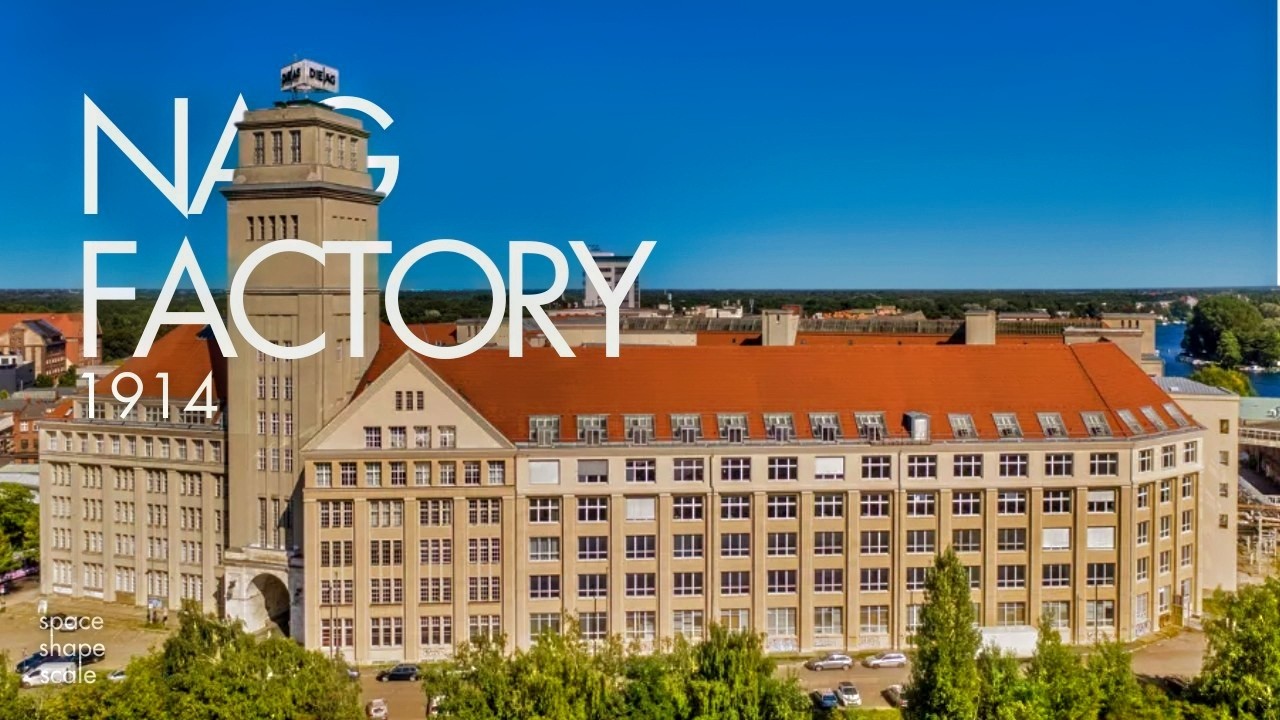
Travel back to early 20th-century Berlin and discover one of the most visionary industrial buildings of its time the National Automobile Society (NAG) Factory, designed by Peter Behrens in 1914.
At a moment when Europe was on the brink of unprecedented change, Behrens reimagined what a factory could be: not just a warehouse for machines, but a monument to modernity, labor, and the emerging identity of the corporate age.
In an era when industrial buildings still wore the heavy cloaks of historicist decoration, the NAG Factory stood in stark contrast. Here, Behrens stripped away ornamental facades to reveal a new, unapologetic honesty of form and structure.
Symmetry, proportion, and geometric clarity replaced eclectic styling.
Materials like exposed brick and steel were elevated from mere utility to architectural statement.
Every bay, window, and vertical rhythm served not to mimic the past, but to celebrate the logic of modern production.
Behrens and the birth of modern corporate identity
Peter Behrens was more than an architect he was one of the first true corporate design directors. As artistic consultant to AEG (Allgemeine Elektricitäts-Gesellschaft) before NAG, he had already crafted everything from buildings to logos and typefaces, laying the groundwork for what we now call corporate branding.
At the NAG Factory, he brought this unified vision to the automobile industry.
The building itself became a brand ambassador, communicating strength, precision, and modern ideals to employees, investors, and the public.
Its monumental yet restrained presence signaled that the company was part of a new industrial aristocracy, commanding respect through innovation rather than borrowed historic grandeur.
In doing so, Behrens anticipated how the look of a company’s headquarters would become inseparable from its identity a lineage that stretches from Ford’s River Rouge to Apple’s sleek campuses today.
A philosophical shift: from ornament to order
The NAG Factory reveals how architecture in the early 1900s was undergoing a seismic shift. The excesses of 19th-century eclecticism, with its overloaded facades and decorative illusions, no longer matched the spirit of an industrializing, scientifically minded world.
Behrens argued that the truth of a building lay in expressing what it was:
Columns, beams, and repetitive bays were shown proudly, not disguised.
Large windows were celebrated for the light and air they brought to workers, reflecting a new respect for human comfort and productivity.
The facade was no longer a canvas for applied motifs but a direct expression of structural rhythm and industrial logic.
This was more than aesthetic it was ideological. It proclaimed that beauty could be found in order, function, and the honest interplay of material and light. It was a declaration of a new architectural morality.
A laboratory for future modernists
Perhaps even more remarkable is how the NAG Factory served as a silent classroom for the future titans of modern architecture. In Behrens’s Berlin office, a young Walter Gropius absorbed these lessons in industrial rhythm and social purpose. Ludwig Mies van der Rohe studied how large spaces could feel dignified and even noble without historical crutches. Charles-Édouard Jeanneret, soon to be known as Le Corbusier, witnessed how rigorous geometry and modern materials could create powerful new spatial experiences.
It’s no exaggeration to say that without Behrens’s work and buildings like the NAG Factory there might never have been the Bauhaus, the International Style, or the glass-and-steel towers that define our cities today.
Subscribe & keep exploring
At Space Shape and Scale, we unravel how visionaries from Gaudí’s organic fantasies to Wright’s democratic prairies, Loos’s minimalist manifestos, Perret’s concrete temples, and here Behrens’s industrial sanctuaries changed how we build, work, and live.
Join us each week to see how space, shape, and scale reveal the deepest hopes of their time and continue to shape ours.
#PeterBehrens #IndustrialArchitecture #ModernArchitecture #NAGFactory #BauhausOrigins #CorporateIdentity #ArchitecturalHistory #FactoryDesign #DeutscherWerkbund #SpaceShapeScale
TIMELINE OF INFLUENTIAL ARCHITECTS
Joseph Paxton (1803) – Victorian Engineering / Proto-Modernism
Otto Wagner (1841) – Vienna Secession
Lluís Domènech i Montaner (1850) – Catalan Modernisme
Antoni Gaudí (1852) – Catalan Modernisme
Louis Sullivan (1856) – Prairie School / Functionalism
Frank Lloyd Wright (1867) – Prairie School / Organic Architecture
Charles Rennie Mackintosh (1868) – Art Nouveau / Arts and Crafts
Peter Behrens (1868) – Industrial Modernism
Giacomo Mattè-Trucco (1869) – Industrial Architecture
Adolf Loos (1870) – Rationalism / Early Modernism
Auguste Perret (1874) – Concrete Modernism
Walter Gropius (1883) – Bauhaus / Modernism
Le Corbusier (1887) – International Style / Modernism

Информация по комментариям в разработке