This is my humble attempt to serve Ma.
If you have further queries- write to me at [email protected]
Shri Matre Namah.
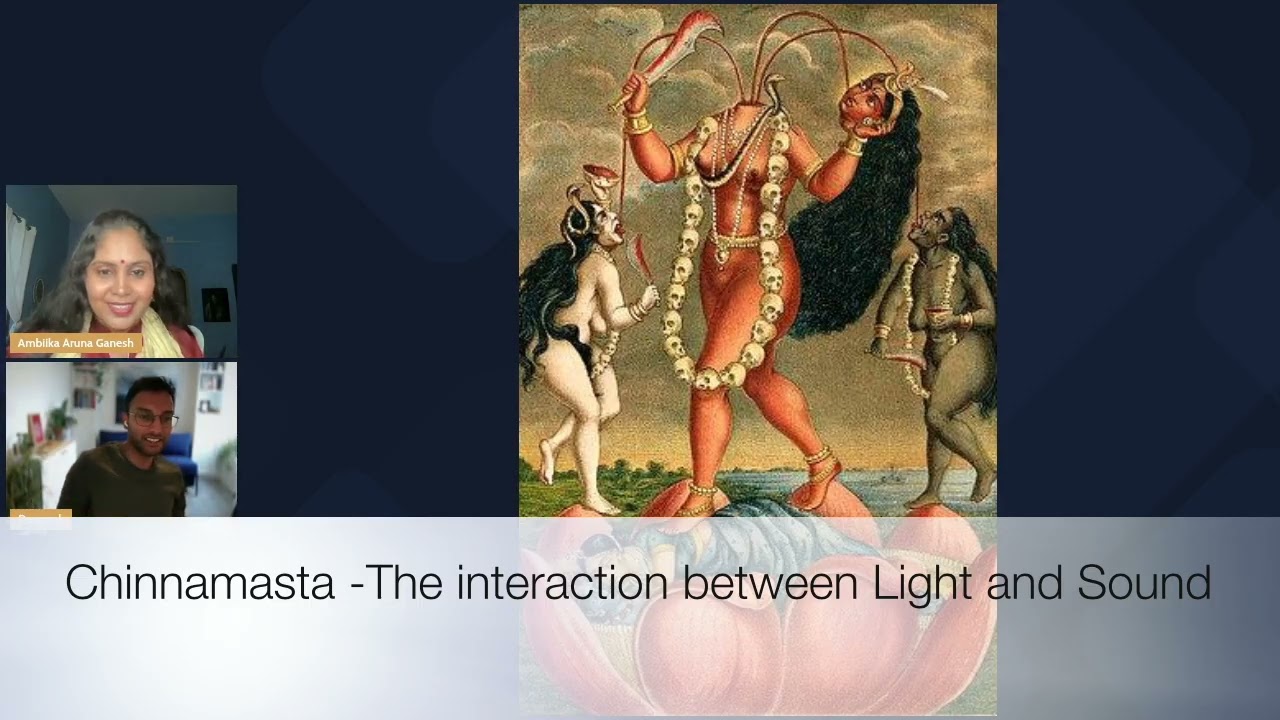
Chinnamasta is standing on - “Rati and Manmatha, the loving couple. are lying in close embrace. She has no head at all. A headless trunk with two arms held aloft is her peculiar form. In one hand, she holds her own severed head and in the other a pair of scissors. From the headless neck three streams of blood gush forth. The middle stream is drunk by her own mouth in the severed head held in her hand while the other two streams are drunk by two attendants standing on either side of the Goddess.
Thus the Tantra describes the form of Chinnamasta, the sixth of the Dasa Maha Vidyas. How can a headless trunk have life? Hon can it hold its own head chopped off in its hand? And the ghastly sight of blood spouting forth and being drunk by the very head that has been cut off and by the two attendants! How can such a form be fit for worship ? How can it be invoked to elevate and ennoble man? All these questions naturally arise in the minds of aspirants.
Many wise men have classed Chinnamasta as an inferior deity, a grama devatà, a Goddess fit to be worshipped by the uncultured village folk. Some, intrigued by the fact that the Goddess has been included in the panel of Dasa Maha Vidyas, admit her as a vamacara deity, as according to them, love, blood, mutilated bodies all point. to Vamachara. Some others go to the extent of calling the God. dess a durdevata, wicked deity.
The Tantra Shastra talks about her form, about her Mantra, about the method of worship; it does not throw any light on the esoteric significance of the deity.
It was left to the late Kavyakantha Vasishtha Ganapati Muni the Seer-poet of the Umasahasram, to delve deep into the mysteries of the Sadhana of Chinnamasta, to realise concretely in himself by arduous tapasya, the Goddess in her manifold play and to proclaim to the world through his works the greatness of this particular manifestation of the Goddess as Chinnamasta,
The occult path and the philosophical and esoteric basis of the whole Sadhana. A modern representative of the ancient sages and seers of the land, the Muni was famous for his rational approach to matters spiritual and for his scientific bent of mind. A versatile genius, he could straight go to the heart of a subject and have an instantaneous grasp of the whole matter. Testimony from suit a person cannot be slighted.
Vasishtha Muni realised in himself Chinnamasta to such an extent that his cranium split asunder even as he was alive and then heceforth people could see a streak of glowing light about the Muni's head, coming through an opening at the top of the head, as it were!
We have said that Light prakasa and Sound nada are the precursors of creation. Prakasa when it becomes delimited as Akasa, Space, is Bhuvaneshwari. When the delimitation taks the form of duration, Time, it is Kali. When Prakasa get volved in creation, when it becomes the immanent principle in everything, at the same time transcending it, it is Sundari. The unexpressed, unmanifest Sound turned towards Creation in a concentrated consciousness is Bhairavi while the Sound perceiving itself, the Seeing Word is Tara.
The interaction of Prakasa and Nada, Light and Sound to precipitate the creation is known to the Tantrics as the great Goddess Chinamasta.
The whole purpose of creation is for the One to delight itself in separate existences as the Many. The Many have to be cut off from the One to become separate existences. The umbilical cord connecting the mother and the child has to be incised to ensure the separate life of the child. The interaction of Light and Sound is so terrific and violent that it almost cuts off the creation from the creator. That is why Chinnamasta is represented as cutting off the head.
In the world of phenomena, the interaction of Light and Sound results in thunder and lightning. Chinnamasta is the thunder-clap and the lightning-flash.
The most powerful activity of the senses is the physical sensual activity translated in the language of sex. The great Goddess is depicted as trampling with her feet Rati and Manmatha joined in amorous union. This is the picturesque and dramatic way of the Tantric to drive home the fact that the worship of Indra's force Chinnamasta grants complete mastery over the sex-impulse and other impulses of the senses indriyas.!
Chinnamasta represents the indomitable force, the striking power of the Supreme.
What is the difference between her action and the action of Kali? Kali's action is fierce and terrible and she is known as Chandi. But Chinnamasta is more terrible than the terrible Kali and therefore she is known as Prachanda Chandi.
Kali represents the power of transformation, the force of evolution in creation. Her action is no doubt strong and swift; but she works with the aid of Time.

Информация по комментариям в разработке