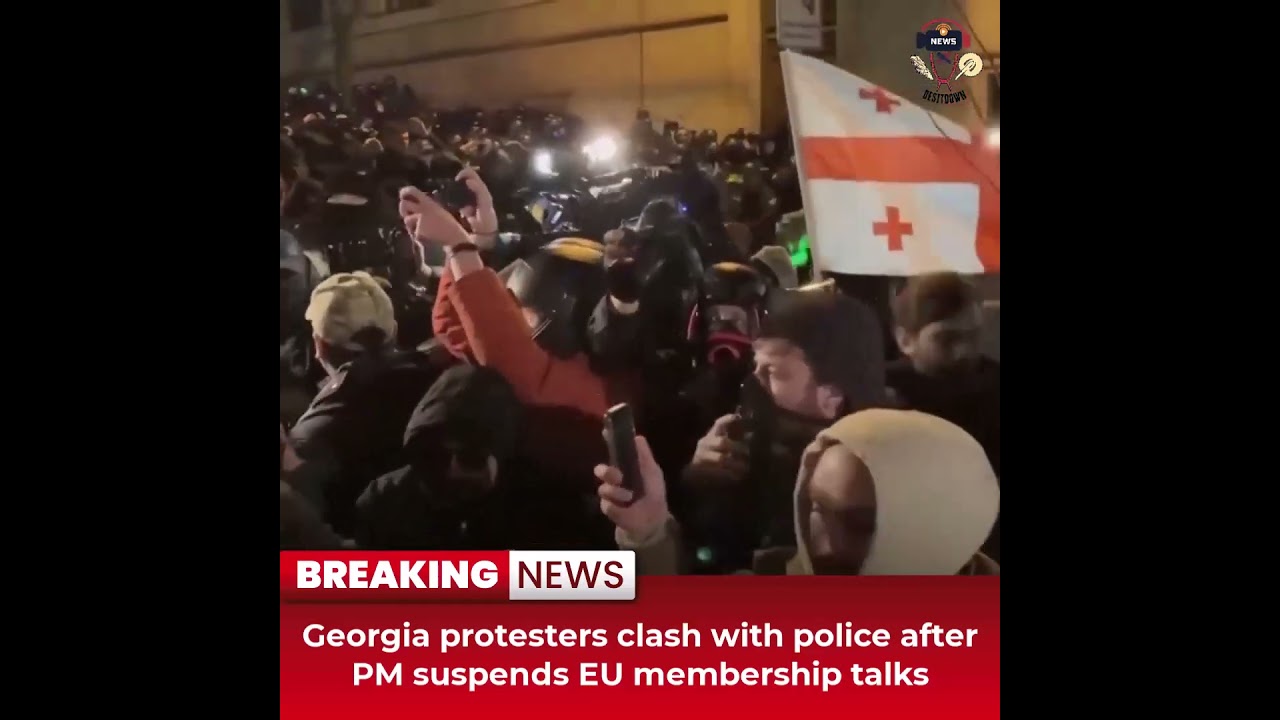
Police clashed with protesters in Tbilisi, the capital of Georgia, after the country's ruling party announced it would suspend talks on European Union (EU) accession until 2028. The Interior Ministry reported that 43 protesters were arrested, and three police officers were injured—two of whom required hospitalization. In an effort to disperse the crowds, police used water cannons, pepper spray, and tear gas as demonstrators, some wearing masks, attempted to break into the parliament. The protesters, many of whom were pro-EU, shouted slogans such as "Russians" and "slaves," and some threw fireworks at the police. The protests began when thousands of Georgians blocked streets in Tbilisi to voice their opposition to the government's decision. The country's outgoing pro-EU president, Salome Zourabichvili, condemned the government’s actions, accusing it of waging "war" against its own people. Zourabichvili, who has long been critical of the ruling Georgian Dream (GD) party, confronted riot police during the demonstrations and questioned whether they were serving Georgia or Russia. "This marks the conclusion of the constitutional coup that has been unfolding for weeks," she told reporters at a news conference, standing alongside opposition leaders. "This illegitimate government has declared war on its own people," she said, referring to herself as Georgia's "sole legitimate representative." The government’s announcement came just hours after the European Parliament adopted a non-binding resolution that rejected the results of Georgia's parliamentary elections on October 26, citing significant irregularities. The resolution called for new elections to be held under international supervision and for sanctions to be imposed on top officials from the GD party, including Prime Minister Irakli Kobakhidze.
Shota Sabashvili, a 20-year-old protester, expressed outrage, stating, "Georgian Dream didn’t win the elections; they staged a coup. There is no legitimate parliament or government in Georgia. We will not let this self-proclaimed prime minister destroy our European future."
Relations between Georgia and the EU have deteriorated in recent months. Brussels has criticized the government for adopting authoritarian measures and pro-Russian stances. Despite the GD party’s claims of being committed to democracy and Western integration, critics point to recent laws that curtail freedoms, such as restrictions on LGBTQ+ rights, which mirror similar laws in Russia. In response to EU pressure, the Georgian government announced it would suspend any talks about EU membership until 2028 and refused to accept any EU budgetary grants for the same period. The GD party has accused the EU of using accession talks as "blackmail" to interfere with Georgia's internal politics and destabilize the country. The EU’s ambassador to Georgia, Paweł Herczyński, called the decision to halt the EU accession process "heartbreaking" and condemned the violence against protesters during Thursday’s demonstration. Georgia, a country of 3.7 million people, has long been one of the most pro-Western nations among former Soviet republics, with EU membership embedded in its constitution. Despite this, public support for EU membership remains strong, with around 80% of Georgians in favor, and EU flags are displayed prominently across government buildings. The GD’s announcement sparked widespread protests across the country, including in provincial cities. Prominent opposition leader Giorgi Vashadze criticized the government's decision, writing on Facebook, "The self-proclaimed, illegitimate government has already legally signed the betrayal of Georgia and the Georgian people." Zourabichvili, whose term ends in December, denounced the government's actions as a declaration of war against the people of Georgia. In response, the GD has proposed Mikheil Kavelashvili, a former footballer with anti-Western views, as her successor. Opposition leaders have rejected the results of the October elections, in which the GD bloc secured nearly 54% of the vote, calling the outcome fraudulent. Western nations have called for an investigation into election irregularities, with one research firm describing the official results as "statistically impossible." Although protests against the election results flared briefly in late October, they quickly subsided. However, with the government’s recent suspension of EU accession talks, the opposition hopes that this will reignite widespread and sustained protests across the country.
The growing discontent has even extended to Georgia’s diplomatic corps. Over 100 serving diplomats have signed an open letter criticizing the government's EU decision, and more than 45 officials from the Ministry of Defense have expressed support for closer EU cooperation.
In addition, three major universities in Tbilisi have suspended studies in response to the ongoing unrest. #desitdown #news #globalnews #Georgia
#protesters #clash #police #PM #suspends

Информация по комментариям в разработке